

In Australia, an employer can refuse a work-from-home request, and can direct you back to the workplace, if the decision is lawful and reasonable. But the law limits that power. Some employees have a legal right to request flexible work, and an employer can refuse that request only on reasonable business grounds, after a proper process and in writing. If your award, agreement or contract gives you more, those terms apply too.
This guide explains where the lines sit, what a valid refusal looks like, what happens if you refuse a direction to attend, and where redundancy and redeployment fit in.
TL;DR
- Employers can give lawful and reasonable directions about where you work. Refusing one can lead to discipline, and in some circumstances termination.
- Eligible employees can make a formal flexible work request. The employer must reply in writing within 21 days and can refuse only on reasonable business grounds.
- A refusal must explain the grounds, say what changes (if any) the employer will make, and point to help from the Fair Work Commission.
- A genuine health and safety concern, a protected attribute or an award or agreement term can change the answer.
- If a dispute ends in dismissal, strict time limits apply. Gather your evidence early.
Table of Contents
- Can your employer make you return to the workplace?
- Check your documents first
- The right to request flexible work
- When an employer can refuse a flexible work request
- Can you refuse to return for health and safety reasons?
- Discrimination and adverse action
- Can you be dismissed for working from home without permission?
- Redeployment and redundancy when roles change
- If a remote work dispute ends in dismissal
- Get your documents in order with Terminationhelp
- FAQ
- Sources
Can your employer make you return to the workplace?
Generally, yes. The Fair Work Ombudsman explains that an employee can't refuse a direction to perform work if it is reasonable and consistent with the employer's legal obligations. Where you perform that work is part of what an employer can direct, unless your contract, award or enterprise agreement says otherwise.
Working from home became common during the pandemic, but that did not turn it into a standing entitlement. As a legal commentary on the issue puts it, working entirely from home is not a right without caveats: employers may give lawful and reasonable directions about work location, while protected attributes can still give rise to discrimination or adverse action claims.
So the starting question is not "do I have a right to work from home?" It is a set of narrower ones:
- Does my contract, award or enterprise agreement say anything about where I work or about flexibility?
- Am I eligible to make a formal flexible work request?
- Is the direction to return lawful and reasonable in my circumstances?
- Is there a health and safety concern, or a protected attribute involved?
Check your documents first
An employee may have rights to work from home, or to make a request, if their award, enterprise agreement or employment contract contains workplace flexibility provisions. Many people never read these. Start with:
- Your employment contract. Look for a place-of-work clause, and for any wording about working from home or "as agreed from time to time".
- Your enterprise agreement, if you have one. Some include their own flexible work or remote work terms. Recent Fair Work Commission decisions have reinforced that refusing a request only because it is inconsistent with an enterprise agreement is not automatically a reasonable business ground, citing May v Paper Australia.
- Your award. The Clerks Award now has specific working-from-home rules. They apply from an employee's first full pay period starting on or after 26 October 2026, and let employees request a working-from-home arrangement or record an existing one. If you are covered by that award, read the Fair Work Ombudsman page for the exact process.
- Written policies and past practice. An email confirming a regular work-from-home day is evidence, even if it is not a formal contract change.
Keep copies of all of these. They are the first things anyone reviewing your situation will ask for.
The right to request flexible work
The National Employment Standards give some employees a right to ask for a change in working arrangements, including where they work. Under the Fair Work Ombudsman's guidance, full-time and part-time employees with 12 months' service, and qualifying casual employees, may request flexible work if they meet a listed circumstance.
The listed circumstances are that you:
- are the parent of, or have caring responsibility for, a child of school age or younger
- are a carer
- have a disability
- are 55 or older
- are pregnant
- are experiencing family and domestic violence, or are supporting an immediate family or household member who is
If none of these apply to you, you can still ask your employer informally. They just do not have the same statutory duties in responding. Casual employees who want to understand their wider rights can read our guide to what casual employees need for an unfair dismissal claim.
How to make the request well
Put it in writing. State that you are making a request under the Fair Work Act, say which circumstance applies, describe the change you want (for example, three days at home each week), and explain how it would work in practice. The Fair Work Ombudsman's best practice guide encourages employers to talk with the employee to explore their needs and suitable options, weighing both the employee's interests and the business's needs. A request that anticipates the employer's concerns, such as meetings, supervision and coverage, is harder to dismiss.

When an employer can refuse a flexible work request
An employer must reply in writing within 21 days of receiving the request. According to the Fair Work Ombudsman, an employer may refuse only on reasonable business grounds, and only after:
- discussing the request with you
- genuinely trying to reach an agreement on changes that would work for both sides
- considering the consequences of refusing for you
A written refusal must explain the grounds and how they apply to your situation, set out any changes the employer is willing to make (or say there are none), and include information about getting help from the Fair Work Commission.
What counts as a weak refusal
The Commission has made clear that vague reasons are not enough. In Ridings v Fedex Express Australia, the Commission clarified that employers cannot rely on generic productivity claims as the sole basis for refusing a request. The Deputy President said claims that remote work would harm productivity and efficiency need to be backed by evidence.
Warning signs in a refusal letter include:
- no reply at all inside 21 days
- a one-line response such as "the business needs people in the office"
- no mention of alternatives, such as fewer remote days
- no information about the Commission
- no evidence behind statements about productivity, culture or supervision
If you see these, keep the letter, note dates, and seek advice from the Fair Work Ombudsman, a union, a community legal centre or an employment lawyer about whether to take the dispute further.
Can you refuse to return for health and safety reasons?
Sometimes. Employers must meet their work health and safety obligations, and the Fair Work Ombudsman says that in some circumstances an employee may be able to refuse to return because of a reasonable health and safety concern or another legitimate reason.
The words "reasonable" and "legitimate" carry the weight. A personal preference is unlikely to qualify. A documented medical condition, a hazardous workplace or a family violence situation is a different matter. Before you refuse a direction outright:
- Tell your employer the specific concern, in writing.
- Offer an alternative, such as a temporary adjustment or a medical review.
- Provide medical evidence if the concern is health-related.
- Keep a record of every reply.
Refusing without raising the concern first leaves you exposed. Get advice from a union, a community legal centre or a lawyer before you stay away from work on this ground.
Discrimination and adverse action
Where a refusal is linked to a protected attribute, other protections may be in play. The same legal commentary notes that an employee's protected attribute may give rise to discrimination or adverse-action claims. Typical examples are a disability that makes commuting difficult, caring responsibilities, pregnancy, age, or family and domestic violence.
These claims turn on facts: why the employer acted, whether other staff were treated differently, and what reasonable adjustments were available. For a general sense of how unlawful workplace bias is framed in other jurisdictions, see this material on unlawful workplace discrimination. Australian rules differ, so rely on Australian sources for your own claim.
Can you be dismissed for working from home without permission?
If your employer has given a lawful and reasonable direction to attend the workplace and you ignore it, discipline is possible. The Fair Work Ombudsman says that non-compliance may lead to disciplinary action, including termination in some circumstances.
That does not make every such dismissal fair. A dismissal still has to meet the usual tests of a valid reason, notification of the reason, and a chance to respond. Whether it is harsh, unjust or unreasonable depends on the full picture: what the direction was, whether it was clear, how you responded, your record and the process followed.
If you have been told to attend and disagree, the safer path is to put your objection in writing, keep working as directed where you reasonably can, and use the formal request process or a dispute procedure. Staying at home and hoping for the best hands your employer a simple argument.
Redeployment and redundancy when roles change
Remote work and location can also surface when a role is cut. A dismissal is not a genuine redundancy if it would have been reasonable in all the circumstances to redeploy the employee within the employer's enterprise or that of an associated entity.
When it assesses whether redeployment was reasonable, the Commission looks at the nature of the available position, your skills, qualifications and experience, the location of the role relative to your home, and the pay offered. That matters if your employer closes a remote or hybrid position and offers a job that requires a long commute, or if a remote-capable job elsewhere in the business was available and was never offered.
If you think redeployment was possible, note any vacancies you knew of, any roles you could have done remotely, and what you were told. Our guides on genuine redundancy evidence and redundancy versus dismissal go through what to collect.

If a remote work dispute ends in dismissal
The most common mistake is waiting. An unfair dismissal application to the Fair Work Commission has a short deadline of 21 days from the day the dismissal takes effect, and eligibility depends on factors such as your length of service and whether you are covered by the unfair dismissal rules. Our guides explain how to check eligibility and the 21-day limit, the minimum employment period and what employers must do when dismissing.
Evidence to collect straight away:
- your flexible work request and the employer's written reply
- the direction to return, and any later warnings
- contract, award, agreement and policy extracts about work location
- medical certificates or other documents supporting a health or safety concern
- emails or messages showing past work-from-home arrangements
- a timeline of dates, conversations and who was present
Our view on remote work disputes
We see the same pattern again and again: people have a reasonable case but lose ground because the paperwork is scattered and the dates are blurry. A flexible work dispute is rarely one event. It is a request, a reply, a direction, a warning and sometimes a dismissal, and each step has its own rules and its own timing.
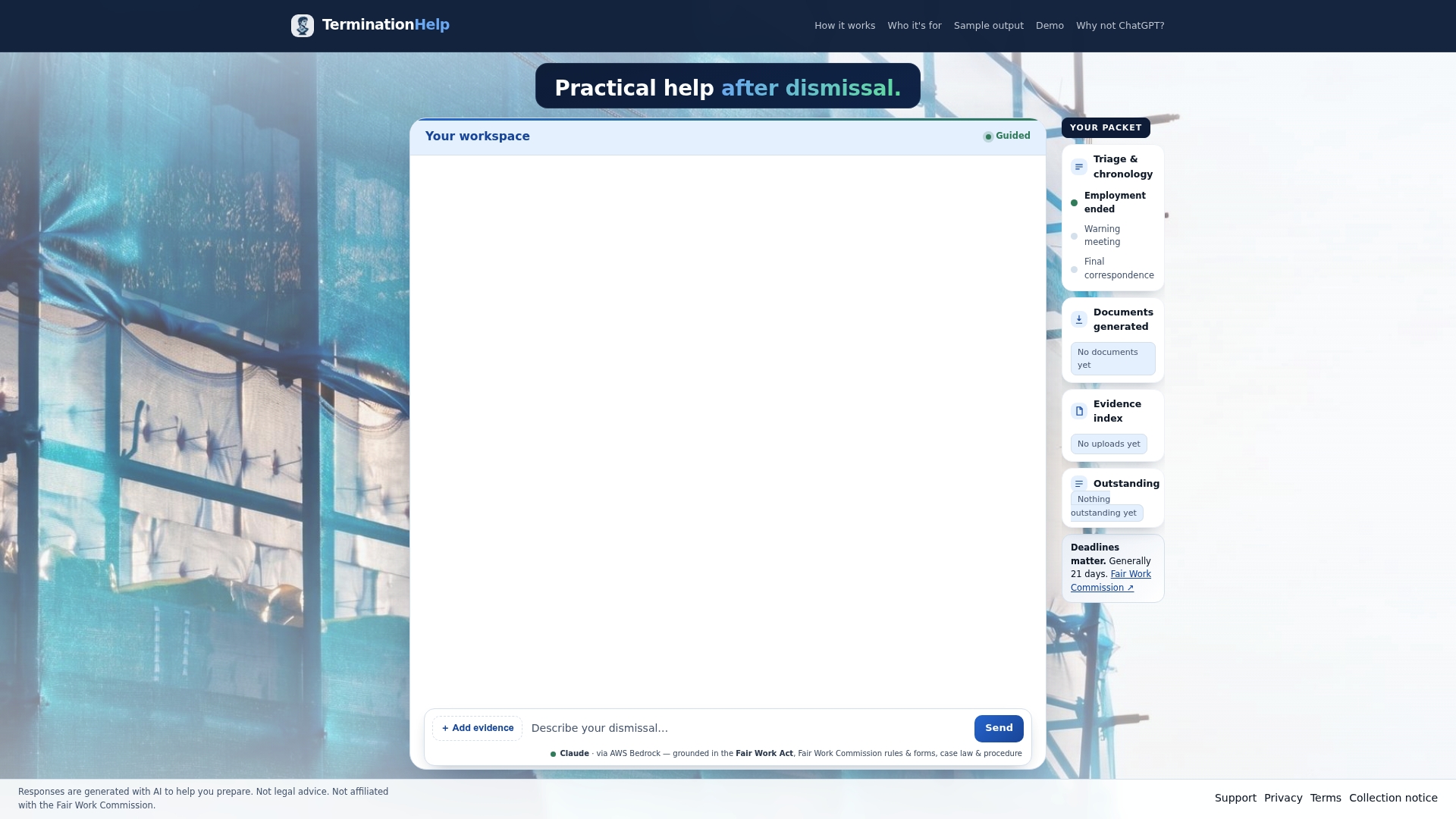
That is why we built our tool around Australian legislation, Fair Work Commission procedures and case law, and nothing else. It is designed to check eligibility, organise your evidence, build a timeline and generate the Fair Work forms you need at each stage, so you can file independently or bring a tidy packet to a lawyer, union or community legal centre.
Our approach is preparation, not prediction. We help you put your own facts in order so that whoever reads them can see the issues quickly.
Nicolas
Get your documents in order with Terminationhelp
If a work location dispute has led to dismissal, or you are heading that way, the hardest part is often turning a messy pile of emails into something usable. Our preparation support walks you through eligibility checks, evidence organisation and document upload, and generates the Fair Work forms for your stage of the matter.
It is a one-time, matter-specific service. You can use the finished packet to file yourself or take it to a lawyer, union or community legal centre. It does not replace legal advice, and it does not predict outcomes. Our content is built on Australian legislation, Fair Work Commission rules and case law.
FAQ
Can my employer refuse my request to work from home?
Yes, but only within limits. If you are eligible to make a flexible work request, your employer must reply in writing within 21 days and can refuse only on reasonable business grounds after discussing it with you and trying to find alternatives. If you are not in an eligible group, your employer has more freedom, subject to your contract, award or agreement.
What must a written refusal include?
It must explain the grounds for refusing and how they apply to your situation. It must also set out any changes the employer is willing to make, or say there are none, and give information about getting help from the Fair Work Commission.
Do I have to return to the office if my employer directs me to?
Usually, yes, if the direction is lawful and reasonable. A reasonable health and safety concern or another legitimate reason may justify refusing in some circumstances. Raise the concern in writing and get advice before staying away, because refusing a reasonable direction can lead to discipline.
Can a redundancy be unfair if I could have worked remotely in another role?
Possibly. A dismissal is not a genuine redundancy if it would have been reasonable to redeploy you within the employer's enterprise or an associated entity. The Commission considers the role, your skills, its location relative to your home and the pay offered.
Sources
- Directing employees to the workplace and COVID-19, Fair Work Ombudsman
- Flexible working arrangements, Fair Work Ombudsman
- Flexible working arrangements best practice guide, Fair Work Ombudsman
- New working from home rules in the Clerks Award, Fair Work Ombudsman
- Redeployment, Fair Work Commission
- FWC Bulletin Volume 4/25, Fair Work Commission
- Can Australian employers stop you working from home?, ABC News
- Working (entirely) from home: not a right without caveat, GC Legal
- Fair Work Commission guidance on return to office requirements, Landers
- Discrimination: unlawful workplace bias
Recommended
- Check Unfair Dismissal Eligibility in Australia: 21 days to lodge
- Employer obligations when dismissing an employee in Australia
- Fixed Term Contract Dismissal in Australia: Your Rights
- Fixed-Term Contracts and Unfair Dismissal in Australia
Article produced using AI. This is not legal advice.