

A dismissal is a genuine redundancy under the Fair Work Act only when the employer no longer requires the job to be performed by anyone, and any consultation obligations in a relevant award or agreement have been met. Redeployment also matters: if it would have been reasonable to place the employee elsewhere in the business, the redundancy is not genuine, and an unfair dismissal remedy may follow.
TL;DR:
- A redundancy fails section 389 if the role’s duties remain, required consultation was skipped, or reasonable redeployment existed within the business or an associated entity.
- Redeployment depends on suitable vacancies available when dismissal took effect, assessed against skills, location, pay, and retraining; save internal vacancy lists and related correspondence.
- Statutory redundancy pay generally requires at least one year of continuous service and an employer with 15 or more employees; smaller businesses are usually exempt.
- If the Commission finds redundancy was not genuine, unfair dismissal claims generally must be filed within 21 days, with compensation more common than reinstatement.
- Employers proposing 15 or more redundancy dismissals must notify Services Australia in writing before dismissals take effect, stating reasons, affected numbers and categories, and timing.
Table of Contents
- Statutory definition: what section 389 actually says
- How the Commission weighs consultation and redeployment
- Redundancy pay and notice: what the NES guarantees
- Mass redundancies: notifying Services Australia for 15 or more dismissals
- When a redundancy is not genuine: your options as an employee
- Preparing a challenge: a practical checklist
- Employer perspective: running a defensible redundancy process
- How preparation support helps you challenge a non-genuine redundancy
- FAQ
- Sources
Statutory definition: what section 389 actually says
The genuine redundancy test comes from section 389 of the Fair Work Act 2009, and it has two limbs that both need to be satisfied.
- The employer no longer requires anyone to perform the dismissed employee's job, usually because of changes in operational requirements, restructuring or a downturn in work.
- The employer has complied with any consultation obligation in an applicable modern award or enterprise agreement.
- Even where both limbs are met, the dismissal is not a genuine redundancy if it would have been reasonable to redeploy the employee within the employer's business or an associated entity.
The exact wording of these requirements sits in the consolidated Act text on AustLII, which is the primary legal source the Fair Work Commission applies when a dismissal is challenged. "No longer required to be performed by anyone" does not mean the tasks vanish; it means no one, under any title, is retained to do that bundle of duties going forward. The consultation limb only bites when an award or agreement requires it, but where it does apply, skipping it is usually fatal to the employer's case.
How the Commission weighs consultation and redeployment
Consultation and redeployment are where most genuine redundancy disputes are actually fought, because the "job no longer required" limb is often uncontroversial.
- Check whether a modern award or enterprise agreement contains a consultation clause: if one does, the employer must give affected employees information about the change and a real chance to respond before a final decision is made.
- Assess whether consultation happened early enough to matter: a meeting held after the decision is locked in rarely satisfies the consultation obligations the Commission expects.
- Look at redeployment factors the Commission actually weighs, including whether a suitable vacancy existed at the time of dismissal, the employee's skills and experience, location, pay, and whether reasonable retraining could bridge any gap.
- Consider whether the employer ran a competitive recruitment process for a role the redundant employee could reasonably have filled without competing, since Commission decisions have found this can tip a redundancy into "not genuine" territory.
Pro Tip: Ask for, and keep, copies of any internal vacancy list circulated around the time of your dismissal; it is often the single most useful document in a redeployment dispute.
Redeployment enquiries focus on what was actually available when the dismissal took effect, not on speculative future roles. An employer does not have to sack someone else to make room, but it does need evidence the vacancy existed and was suitable.
Redundancy pay and notice: what the NES guarantees
Most employees with at least one year of continuous service are entitled to redundancy pay under the National Employment Standards when their employer has 15 or more employees, with the minimum payable rising in bands tied to years of service.
- Employees with service under one year generally do not qualify for statutory redundancy pay.
- Small businesses with fewer than 15 employees are typically exempt from paying redundancy pay under the NES, though some awards or agreements may still apply.
- Notice periods under the NES apply separately from redundancy pay, and employers can usually choose to provide payment in lieu of working out the notice period.
Most employees need at least a year of service with an employer of 15 or more staff to qualify for statutory redundancy pay, with the exact amount set by NES bands. That threshold is why service length is often the first thing to check before assuming an entitlement exists. For the exact tax treatment of a redundancy payout, including how much is tax free, the ATO's guidance on genuine redundancy payments sets out the current indexed limits.
Mass redundancies: notifying Services Australia for 15 or more dismissals
When an employer proposes to dismiss 15 or more employees for reasons related to redundancy, additional notification steps apply before any dismissal takes effect.
- Notify Services Australia in writing as early as possible, and before the dismissals occur, setting out the reasons for the redundancies, the number and categories of employees affected, and the proposed timing.
- Consult with any relevant union where employees are covered by an award or agreement that requires it, giving the union genuine opportunity to respond.
- Build a practical checklist covering notification timing, consultation records, and categories of affected roles so the process can withstand later scrutiny.
Employers who treat this as a late formality, rather than a genuine step in the process, often create the paper trail that undermines an otherwise defensible redundancy.
When a redundancy is not genuine: your options as an employee
If the Commission finds the s.389 test was not met, the dismissal is treated as an ordinary termination and assessed under the general unfair dismissal framework, which means jurisdictional objections based on "it was a genuine redundancy" fall away.
- Applications must generally be lodged within 21 days of the dismissal taking effect, so timing matters as much as the merits.
- Remedies typically centre on compensation, with reinstatement being used far less often in practice.
- A compensation cap applies to unfair dismissal remedies, discussed in more detail in our overview of unfair dismissal remedies.
Build your case around records, not recollection.
- Consultation records showing what you were told and when.
- Any vacancy adverts or internal job postings circulating around your dismissal date.
- Emails or messages discussing alternative roles, retraining or redeployment.
- Pay records and correspondence confirming your length of service and role.
- Witness statements from colleagues who observed the process.
Pro Tip: Save every email and message about your redundancy the day you receive it. Screenshots and forwarded copies sent to a personal account are far more reliable than relying on employer-controlled systems later.
Preparing a challenge: a practical checklist
A genuine redundancy challenge stands or falls on documentation gathered early, before memories fade and employer systems get tidied up.
- Confirm your coverage: check your award, enterprise agreement or contract for any consultation clause that applied to your role.
- Build a timeline of events from first mention of restructuring through to your dismissal date.
- Copy every consultation meeting invite, agenda and follow-up email.
- Capture screenshots of any vacancy adverts posted internally or externally during the relevant period.
- Note down redeployment discussions, including who raised them and what was said.
- Preserve pay slips and leave records confirming your service history and entitlements.
A redundancy dispute is usually won or lost on paperwork gathered in the first two weeks, not on arguments made months later.
The preparation workflow organises this evidence against the s.389 test, generates the Fair Work forms your application needs, and tracks the 21-day deadline so nothing slips through, much like the detailed guidance provided for CCMA unfair dismissal cases in South Africa. For a deeper look at disputing redundancy pay specifically, our guide to challenging redundancy pay walks through the evidence that matters most, and our eligibility explainer covers the lodgement rule in more detail.
Employer perspective: running a defensible redundancy process
The employers who avoid disputes are the ones who treat consultation as a genuine conversation, not a formality to tick off before a decision already made. Document the operational reasons for the role becoming redundant, consult early enough that feedback could actually change the outcome, and record every redeployment option considered, even the ones ruled out.

Transparency tends to reduce claims simply because employees who understand the reasoning are less likely to suspect it was really about performance or personality. Where the situation involves complex award interpretation or a request to vary standard redundancy pay, seeking independent advice before the decision is finalised is far cheaper than defending it afterwards.
How preparation support helps you challenge a non-genuine redundancy
Where you believe your redundancy failed the s.389 test, whether because consultation never happened or a suitable role went to someone else without you being considered, our preparation support organises your evidence against that exact legal test and generates the Fair Work forms your application needs.
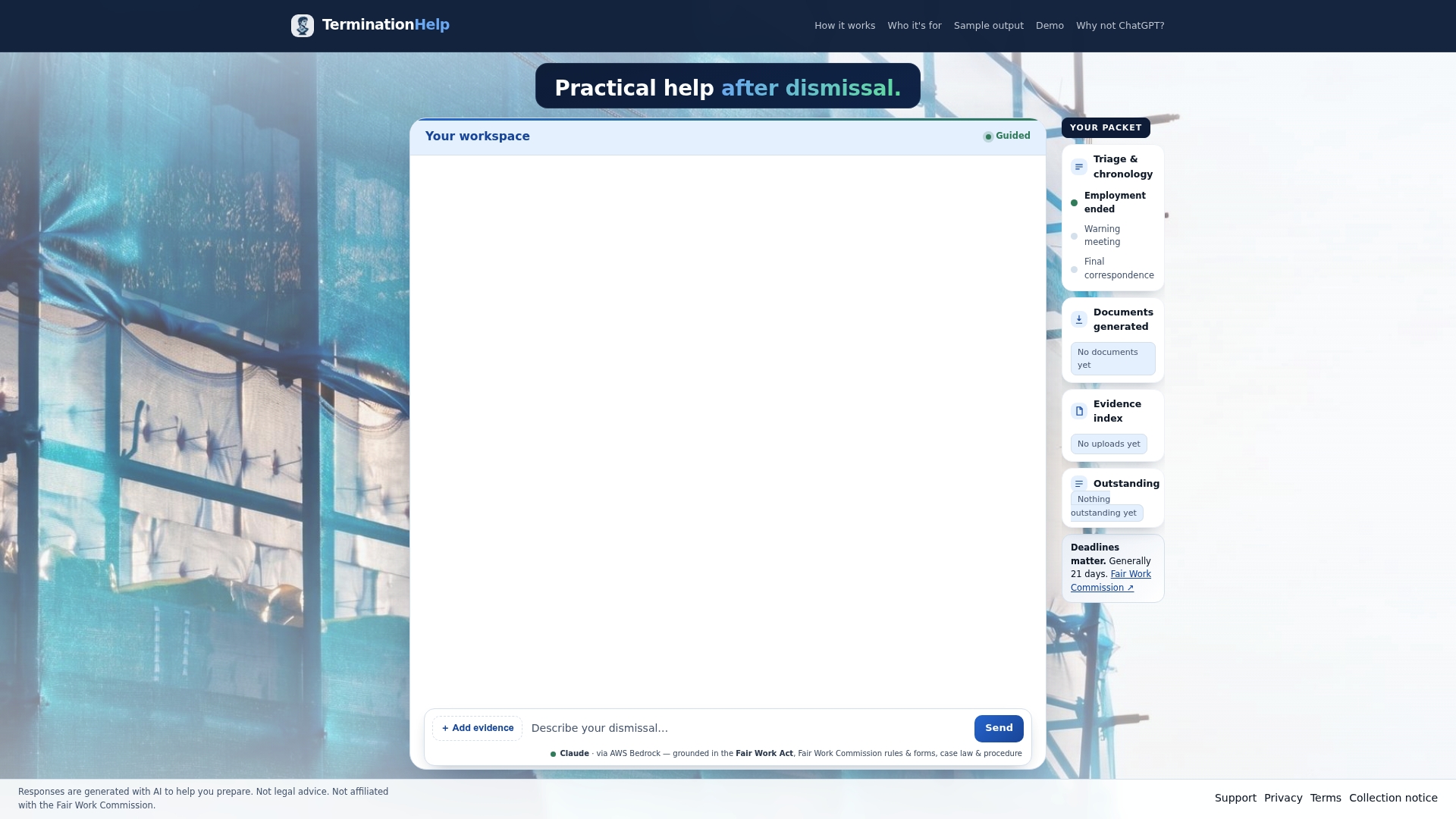
We built this specifically for Australian Fair Work matters, drawing on the legislation, Commission guidance and case law that actually decide these cases, rather than generic legal templates. It suits anyone facing a tight 21-day deadline, a redundancy involving multiple awards or agreements, or redeployment facts that need careful documentation before they're forgotten. Check your eligibility and start a preparation packet through Terminationhelp today.
This article is general information, not a substitute for advice from a qualified lawyer. Consult a qualified legal professional about your own circumstances before acting on anything here.

FAQ
What is the minimum redundancy notice period in Australia?
Notice periods under the NES depend on length of service and age, and apply separately from any redundancy pay owed. Employers can choose to provide payment in lieu of notice rather than requiring the employee to work out the period, as explained in Fair Work's redundancy guidance.
How much notice does an employer have to give for redundancy?
The notice period required depends on the employee's continuous service, with longer-serving employees entitled to more notice under the NES. The Fair Work Ombudsman's redundancy pay page sets out how notice interacts with redundancy pay entitlements.
Do I get redundancy pay after working for 4 years?
Employees with at least one year of continuous service are generally entitled to redundancy pay under the NES, provided their employer has 15 or more employees, so four years of service would typically qualify. The exact amount depends on the NES redundancy pay bands set out by the Fair Work Ombudsman.
What are the 5 stages of redundancy?
There is no single legally defined "5 stages" model, but a genuine redundancy process typically moves through identifying the business need, consulting affected employees, considering redeployment, confirming the decision, and providing notice and redundancy pay. Each of these stages connects directly to the statutory test set out in section 389 of the Fair Work Act.
What happens if my redundancy is found not to be genuine?
If the Fair Work Commission finds the s.389 test was not met, your dismissal is assessed as an ordinary unfair dismissal rather than a redundancy, and jurisdictional objections based on redundancy no longer apply. Remedies usually focus on compensation, and applications must generally be lodged within 21 days of your dismissal taking effect.
— Nicolas
Sources
- What is a genuine redundancy? | Fair Work Commission
- Redundancy | Payment & entitlements
- FAIR WORK ACT 2009 - SECT 389 Meaning of genuine redundancy (AustLII)
- 2010 FWAFB 7578 — Redeployment jurisprudence
Recommended
- Australia: 21 Day Evidence Casual Employees Need for Unfair Dismissal
- Australia: $95,050 payout cap and unfair dismissal remedies
- Check Unfair Dismissal Eligibility in Australia: 21 days to lodge
- 3 checks to claim unfair dismissal on probation in Australia
Article produced using AI. This is not legal advice.