

If your fixed-term contract simply runs out on the agreed date, you generally cannot make an unfair dismissal claim, because the employment ended by the passing of time and not by your employer's decision. That changes if your contract was cut short, if it is really a "maximum-term" contract, or if the fixed end date does not hold up under the 2023 fixed-term rules. This guide explains each situation, the 21-day deadline that applies to all of them, and what to prepare.
TL;DR
- A genuine fixed-term contract that ends on its agreed date is generally not an unfair dismissal, according to the Fair Work Ombudsman.
- If your employer ends the contract early, or the contract lets either side terminate on notice before the end date, you may have been dismissed and may be able to apply.
- Since 6 December 2023, most fixed-term contracts are limited to 2 years including renewals. If the limits are breached, the end date no longer applies.
- You still need to meet the minimum employment period and lodge within 21 days of the dismissal taking effect.
Table of Contents
- What counts as a fixed-term contract
- Fixed-term versus maximum-term contracts
- When a fixed-term end date may not protect the employer
- Do you still meet the eligibility rules?
- The 21-day deadline
- Building your case: what to gather
- If you are the small business
- Our perspective
- Prepare your claim with Terminationhelp
- FAQ
- Sources
What counts as a fixed-term contract
A fixed-term contract has a start date and an end date (or an event that ends it, such as the completion of a project). When the end arrives, the job finishes automatically. Nobody has to give notice and nobody has to make a decision.
That is the key legal point. The Fair Work Commission (FWC) can only hear an unfair dismissal claim if the person has been dismissed, which means employment ended at the employer's initiative. The Commission's decisions treat employment that ends through the passing of time under a genuine fixed-term contract as not a dismissal. The FWC's own guidance says a genuine contract for a specified period may end by effluxion of time rather than by termination.
So the usual answer for someone whose contract expires on the date written in it is no, there is nothing to claim. But "usually" carries real weight, and the rest of this article covers the exceptions.
Fixed-term versus maximum-term contracts
Many contracts that look fixed-term are not. The difference is the termination clause.
| Fixed-term contract | Maximum-term contract | |
|---|---|---|
| Ends on the end date | Yes, automatically | Yes, if not ended earlier |
| Can either side end it early on notice? | No, only for cause or by agreement | Yes, a broad or unconditional right to terminate |
| Typical wording | "Employment ends on 30 June" | "Employment is for up to 12 months but either party may terminate on 4 weeks' notice" |
| Unfair dismissal risk for employer | Low if the contract is genuine | Higher, especially on early termination or non-renewal |
Legal publishers describe a maximum-term contract as one that has a broad or unconditional right to terminate during the term as well as an outer limit. The FWC makes the same distinction: a genuine fixed-term contract ends through the passing of time, whereas a maximum-term contract contains an unqualified right for either party to terminate on notice before the outer limit.
If your contract says anything like "either party may terminate this agreement by giving notice" alongside an end date, read it carefully. It may be a maximum-term contract.
Why maximum-term contracts matter
For years, employers assumed that letting a maximum-term contract expire was safe. A Full Bench decision in the Navitas matter changed that view. As summarised by a law firm, the Full Bench held that whether the end of a maximum-term contract is a dismissal depends on the employment relationship and not only on the contract's termination. In practical terms, if the employer decides not to continue the arrangement, the Commission can treat that as a dismissal at the employer's initiative, even though the contract ran to its outer limit.
This area of law is still being tested, so the outcome depends on the facts of each case. If you are in this position, keep the contract, any variations and every message about renewal.
When a fixed-term end date may not protect the employer
The Commission looks at the reality of the job, not just the paperwork. These are the situations where a claim is worth examining.
1. The employer ends the contract early
If you were sacked, made redundant or told to leave before the end date, the contract did not end by the passing of time. That is a termination at the employer's initiative. You can apply, provided you meet the other requirements (below). A genuine redundancy or a valid reason may still defeat the claim, but you are not blocked at the starting gate.
2. A series of contracts where renewal is a formality
The FWC says it looks beyond the contract terms, particularly where a series of fixed-term contracts is used and renewal is effectively a formality. If you were rolled from contract to contract for years, with no real expectation of the job ending, the final "expiry" may be treated as a dismissal.
3. The contract was not genuinely for a fixed period
The law firm summary of the Navitas decision lists situations in which an employee can still reach the unfair dismissal system, including where the contract was designed to avoid rights under the Fair Work Act, was varied so the time limit no longer applies, or where the employer made representations (for example, that continued work depended on performance) that undercut the end date.
A common real-world example: you are told in week 40 of a 12-month contract that you will be kept on if your performance stays strong, then you are let go on the end date. Those assurances matter.
4. The contract breaches the 2023 fixed-term limits
This is the newest piece, and it favours employees. From 6 December 2023, fixed-term contracts are generally limited to 2 years including renewals, with no more than one extension or renewal, plus conditions on consecutive contracts. Where the limits are not met, the end date no longer applies. There are exceptions, so the Fair Work Ombudsman's page is the place to check whether yours is covered.
The rules also include protections against employers taking steps specifically to avoid them. Employers must give new fixed-term employees the Fixed Term Contract Information Statement for contracts entered into on or after 6 December 2023, and civil penalties can apply if the limits are breached.
In plain terms: if you were employed on a contract that exceeded the limit and your employer relied on the end date to let you go, the end date may not protect them. Whether that amounts to a dismissal in your case is a question to take to a lawyer, union or community legal centre.

Do you still meet the eligibility rules?
Even when you were dismissed, you must be eligible. The FWC says protection applies only after a minimum period of employment: 6 months, or 12 months for a small business with fewer than 15 employees. The same page notes that irregular casual employees, independent contractors and employee-like platform workers are not covered. For more on the service counts, see our guide to the minimum employment period and our eligibility checklist.

Fixed-term employees on a contract of 6 months or less can therefore fall short of the minimum period in some workplaces, so length of service is worth checking early. If you were casual before moving onto a fixed-term contract, earlier regular and systematic work may count, as explained in our article on casual employees.
There is also a separate trap: if you resigned because you felt forced out, the question becomes whether that was a dismissal at all. Our page on constructive dismissal covers it.
The 21-day deadline
The deadline is strict. An application must reach the Commission within 21 days after the dismissal takes effect, on Form F2. The dismissal takes effect on the date the employment contract ends, which may be your last day at work, your last day of paid leave, or a later date in a notice of termination.
Extensions are possible only in exceptional circumstances, such as serious illness, and most requests are declined. For fixed-term workers, there is a particular risk: people wait until the end date passes, then spend weeks wondering whether they have a claim. If you suspect your contract is not genuinely fixed, start the paperwork within days, not weeks. See our explanation of the 21-day time limit and the steps to file.
Building your case: what to gather
A fixed-term dispute usually turns on documents. Collect these before you lodge:
- Every version of your contract, including renewals, variations and the Fixed Term Contract Information Statement if you received one.
- Start and end dates of each period of employment, with payslips to prove continuity.
- Messages about renewal or ongoing work, such as emails saying "we'll keep you on" or performance-based promises.
- The termination notice or conversation record, with the date you were told and the date employment ended.
- Evidence that the role continued after you left, for example the position being advertised again or filled by someone else.
- Your employer's size, since it sets the 6 or 12 month minimum period.
Our article on employer obligations when dismissing shows what a fair process normally involves, which helps you compare it with what happened to you.
If you are the small business
Employers are often caught out here too. If you have received a claim from a worker on a fixed-term or maximum-term contract, you can ask the Commission to dismiss it on the basis that there was no dismissal, because the employment ended at the contracted time. Your strongest position is a contract that is genuinely fixed, within the 2-year and single-renewal limits, with no assurances of continuing work and a record that the end date was applied consistently. Weak points are rolling contracts, informal promises and a termination-on-notice clause that turns the contract into a maximum-term one.
Our perspective
We see the same pattern again and again: people assume "fixed-term" means "no rights", and employers assume the same. Neither assumption is safe. The label on the contract is where the analysis starts, not where it ends. The Commission asks who really ended the relationship, whether the end date was genuine, and whether the 2023 limits were respected.
Our own tool is built exclusively around Australian legislation, Fair Work Commission procedure and case law, which is why we focus on the questions that decide these matters: eligibility, timing and evidence. We do not predict outcomes, and a fixed-term claim can be genuinely uncertain. What we can do is make sure that, if you decide to proceed, your forms are right and your timeline is under control. If the contract is complicated, take the packet to a lawyer, union or community legal centre. Our unfair dismissal case law guide explains how to read decisions like these.
— Nicolas
Prepare your claim with Terminationhelp
If you think your fixed-term or maximum-term contract ended in a dismissal, the hardest part is usually getting the eligibility check, the timeline and the documents in order before the 21 days run out. Our preparation support walks you through eligibility, organises your evidence, and generates the Fair Work forms required at each stage, so you can file on your own or hand a structured packet to a lawyer, union or community legal centre.
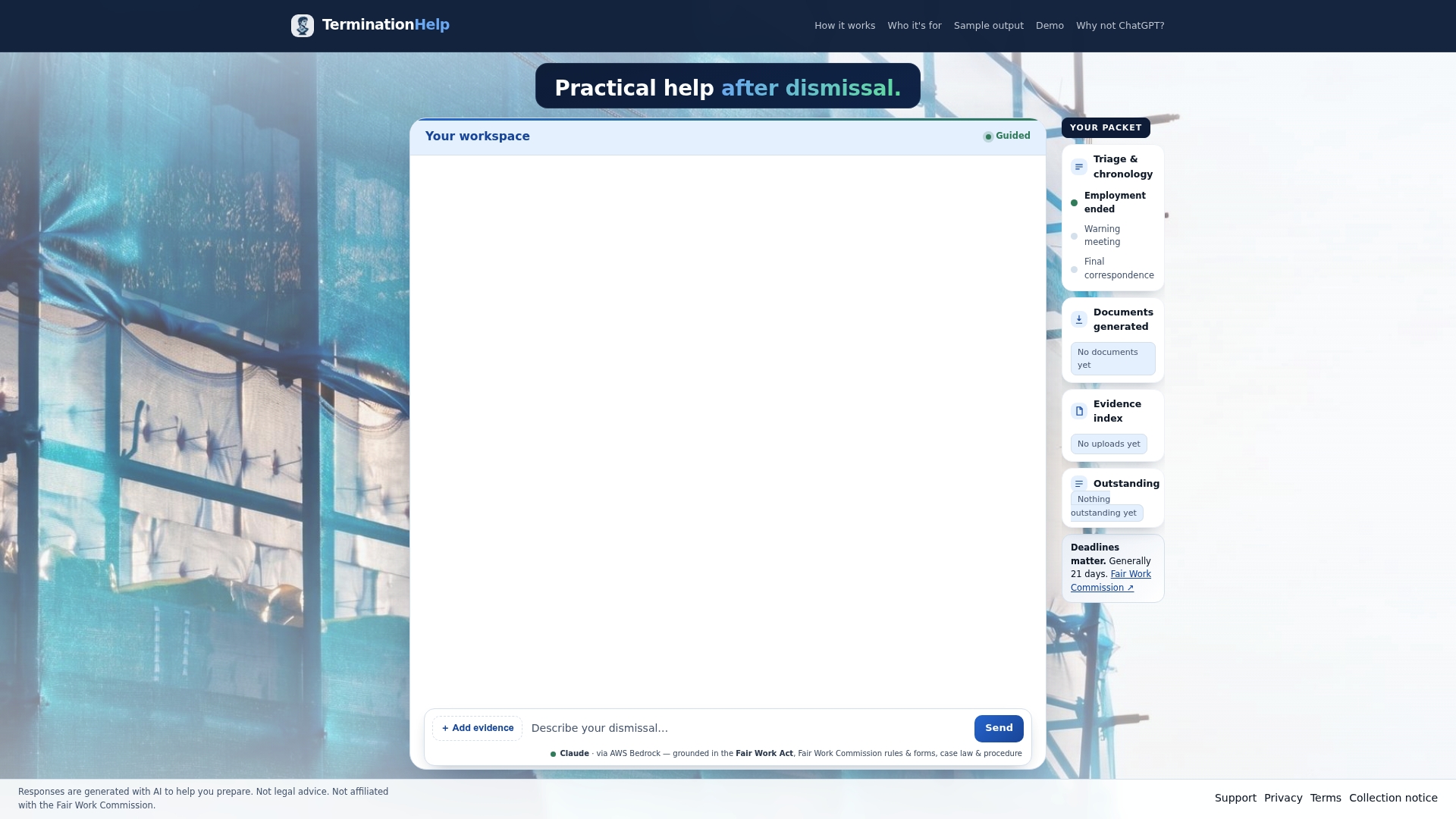
You can see how it works on the preparation support page. Our service is for preparation, not legal advice or outcome prediction. If compensation is on your mind, our page on remedies and the payout cap explains the limits.
FAQ
Can I claim unfair dismissal if my fixed-term contract was not renewed?
Generally no, if the contract was genuine and simply expired. However, the Commission looks at the reality of the relationship, so a pattern of repeated renewals where continuation was expected, or a contract that breaches the 2023 limits, may change the answer. Get advice quickly because of the 21-day limit.
Is a maximum-term contract the same as a fixed-term contract?
No. A maximum-term contract also lets one or both parties end it early on notice, so it can end before the outer date. Because of that, ending or not continuing it can be treated as a dismissal, depending on the facts.
How long can an employer keep me on fixed-term contracts?
From 6 December 2023, the general limit is 2 years including renewals, with no more than one extension or renewal, subject to exceptions. Check the Fair Work Ombudsman's fixed-term page for the exceptions that might apply to you.
What if I was dismissed before the end date?
Then the contract did not end by the passing of time, and you may be able to apply if you meet the minimum employment period and are not excluded. The 21 days run from the date your dismissal takes effect, so do not wait for the original end date.
Sources
- Fixed term contract employees, Fair Work Ombudsman
- Fixed Term Contract Information Statement, Fair Work Ombudsman
- Contract for a specified period of time, Fair Work Commission
- Unfair dismissal: can you apply?, Fair Work Commission
- Fair Work Commission decision [2018] FWC 20
- Fixed term employment contract, Practical Law
- Workers on maximum term contracts and unfair dismissal, Stevens & Associates Lawyers
Recommended
- Check Unfair Dismissal Eligibility in Australia: 21 days to lodge
- Employer obligations when dismissing an employee in Australia
- Australia: $95,050 payout cap and unfair dismissal remedies
- File an unfair dismissal claim in Australia within 21 days
Article produced using AI. This is not legal advice.