

You can usually file for unfair dismissal if you have served the minimum employment period and meet the Fair Work Commission's eligibility tests. The 21-day deadline starts the day after your dismissal took effect, so begin your Form F2 through MyFWC now. If the deadline is close, lodge first and add evidence afterwards.
TL;DR:
- Most applicants need six months’ service, or 12 months at a small business with fewer than 15 employees; probation does not remove eligibility.
- Casual employees qualify only when work was regular and systematic, with a reasonable expectation of ongoing employment; associated entities count in small business headcounts.
- Count 21 days from the day after employment actually ends, including weekends and holidays; late extensions require exceptional circumstances, not ignorance or postal delays.
- File Form F2 through MyFWC before the deadline, even if evidence is incomplete; supporting documents can be added after lodgment.
- The Commission weighs the employer’s reason and process; missing warnings can weaken performance cases, while a job that still exists may undermine redundancy claims.
Table of Contents
- Are you eligible to file unfair dismissal?
- How does the 21-day deadline work, and can you apply late?
- Which dismissals does the Commission treat as unfair?
- What changes for small business, probation and casual workers?
- How do you prepare and lodge your application?
- What happens after you file?
- What remedies can you expect?
- How should you respond to your employer's submissions?
- Lodge first, then organise your case
- Get lodgment-ready with Terminationhelp preparation support
- FAQ
- Sources
Are you eligible to file unfair dismissal?
Eligibility turns on a handful of gates, and you can check most of them in a few minutes.
- Minimum service: you generally need 6 months with your employer, or 12 months if it is a small business with fewer than 15 employees.
- Headcount: small business status comes from a simple headcount of all employees at a particular time, and employees of associated entities are included.
- Coverage: check the Fair Work Commission's eligibility guidance to see whether you meet the coverage requirements.
- Casuals: you qualify only if you were employed on a regular and systematic basis with a reasonable expectation of continuing employment.
- Probation: being on probation does not block a claim, provided you have met the minimum service period.
If you are unsure where you sit, the Commission publishes an eligibility checker that walks you through each gate.
How does the 21-day deadline work, and can you apply late?
The clock starts the day after your dismissal took effect, not the day you were told. Notice periods, paid-out leave and dates written in your termination letter can shift which day counts as the effective date, so check what your employer's paperwork actually says. Weekends and public holidays count toward the 21 days, although the Commission commonly accepts a lodgment on the next business day if the last day falls on one.
- Write down the date your employment actually ended.
- Count 21 days forward, including weekends.
- Lodge through MyFWC well before that date.
- Add supporting documents after lodgment if you are still gathering them.
Late applications are treated as out of time and extended only in exceptional circumstances, such as serious illness or the death of a family member. Postal delays or not knowing the deadline are usually not enough.
Pro Tip: Lodge on time with an incomplete file. A prompt application with thin evidence beats a perfect one that arrives out of time.
Which dismissals does the Commission treat as unfair?
A dismissal is unfair when it is harsh, unjust or unreasonable, and it is not a genuine redundancy. For small businesses, it must also be inconsistent with the Small Business Fair Dismissal Code. The Commission looks at several mandatory factors, and your reason for dismissal determines which ones carry the most weight.
- Valid reason: the employer needs a reason related to your conduct or capacity.
- Process: you should have been told the reason and given a chance to respond.
- Performance: a missing warning is a key consideration when poor performance is the stated reason.
- Redundancy: it is not genuine if your job still exists, was simply handed to someone else, or you could have been redeployed.
- Serious misconduct: theft, assault or a major safety breach can justify summary dismissal, but the employer must still be able to show it happened.
- Forced resignation: if you resigned because of your employer's conduct, this may be treated as a dismissal. Our guide to constructive dismissal covers the steps.
What changes for small business, probation and casual workers?
Some workplace categories have their own wrinkles, and they are a common reason people wrongly rule themselves out.
- Small business: you need 12 months of service, and an employer that followed the Small Business Fair Dismissal Code can establish the dismissal was fair. Count associated entities when working out whether the business is small.
- Probation: a probationary label does not remove your rights. A dismissal can still be unfair if you were never warned or never heard.
- Casuals: irregular casuals are excluded, but regular and systematic work with a reasonable expectation of continuing can qualify. Our piece on evidence casual employees need shows what to gather.
Our minimum employment period explainer covers the 6 and 12 month rules in more detail.
How do you prepare and lodge your application?
The prescribed form is Form F2, lodged through the MyFWC portal, which replaced the older online lodgment system in 2025. Other forms exist for other claims: Form F8 for general protections involving dismissal and Form F9 for unlawful termination, as listed on the Commission's online lodgment page.
- Gather your employment contract, payslips, warnings, emails and any medical or leave records tied to the dismissal.
- Write a short timeline of key dates and events, with witness names and contact details.
- Note your employer's legal name and ABN, and decide what outcome you want.
- Complete the form in MyFWC, saving drafts as you go, and attach your documents.
- Pay the lodgment fee or request a waiver. The fee is refunded if you discontinue before a conciliation date is set, or at least two days before an arranged date.
Pro Tip: Keep one dated folder per issue, such as warnings, performance and redundancy evidence, so you can find any document in seconds during conciliation.
What happens after you file?
After lodgment the Commission usually acts within 5 business days, sends a copy to your employer and organises a conciliation meeting. Conciliation is voluntary and non-binding, and it resolves around 75% of unfair dismissal cases.
- Conciliation: a facilitated discussion where both sides can negotiate a settlement. Our conciliation guide explains what to expect.
- If it fails: the matter moves toward a hearing, where each side files evidence and a Commission member decides.
- Representation: rules differ between conciliation and hearings, so check before you bring anyone.
- While you wait: keep your timeline updated, store new correspondence, and consider advice from a lawyer, union or community legal centre.
The Unfair dismissals benchbook sets out the procedure for conciliation, hearings and remedies if you want the detail.
What remedies can you expect?
The outcome you win shapes what you do next, so it helps to know what is realistic.
- Reinstatement: the primary remedy, but ordered rarely. It depends on whether your position exists, whether the relationship can be repaired and whether you can return to work.
- Compensation: the usual alternative when reinstatement is inappropriate. Our article on compensation caps and remedies breaks down the limits.
- Compliance: if an order is made, it carries deadlines, so read it carefully and act promptly.
How should you respond to your employer's submissions?
Your employer will usually explain its reasons in writing, and you need to answer calmly and with documents, not heat. Read the response against your timeline and mark each statement as agreed, disputed or incomplete. For every disputed point, find a document or witness that contradicts it: a contract clause, a payslip, an email showing you were never warned, or a message showing the role was advertised again.

Keep your reply short and factual. State what is wrong, point to the evidence, and say what you want the Commission to find. Avoid attacking the people involved. The Commission cares whether there was a valid reason, whether you were told and heard, and whether a warning was given where performance was the issue, so organise your answers around those factors.
If your employer raises serious misconduct, address the specific allegation and whether any process was followed. If it claims you resigned, explain why you had no real choice. Meet every date the Commission sets, and ask for more time in writing before a deadline passes, not afterwards. Respond to what was filed, not to what you assume the employer thinks.
Lodge first, then organise your case
Lodge first, then tidy. Missing the deadline can prevent a claim from proceeding, so a timely application is more useful than a polished one filed late. Once you are in, build a concise timeline, group your documents by issue, and decide what outcome would actually satisfy you before conciliation starts. Knowing your number and your fallback makes the meeting far less stressful. If you want help assembling the documents quickly, structured preparation support can take much of the admin off your plate.
— Nicolas
Get lodgment-ready with Terminationhelp preparation support
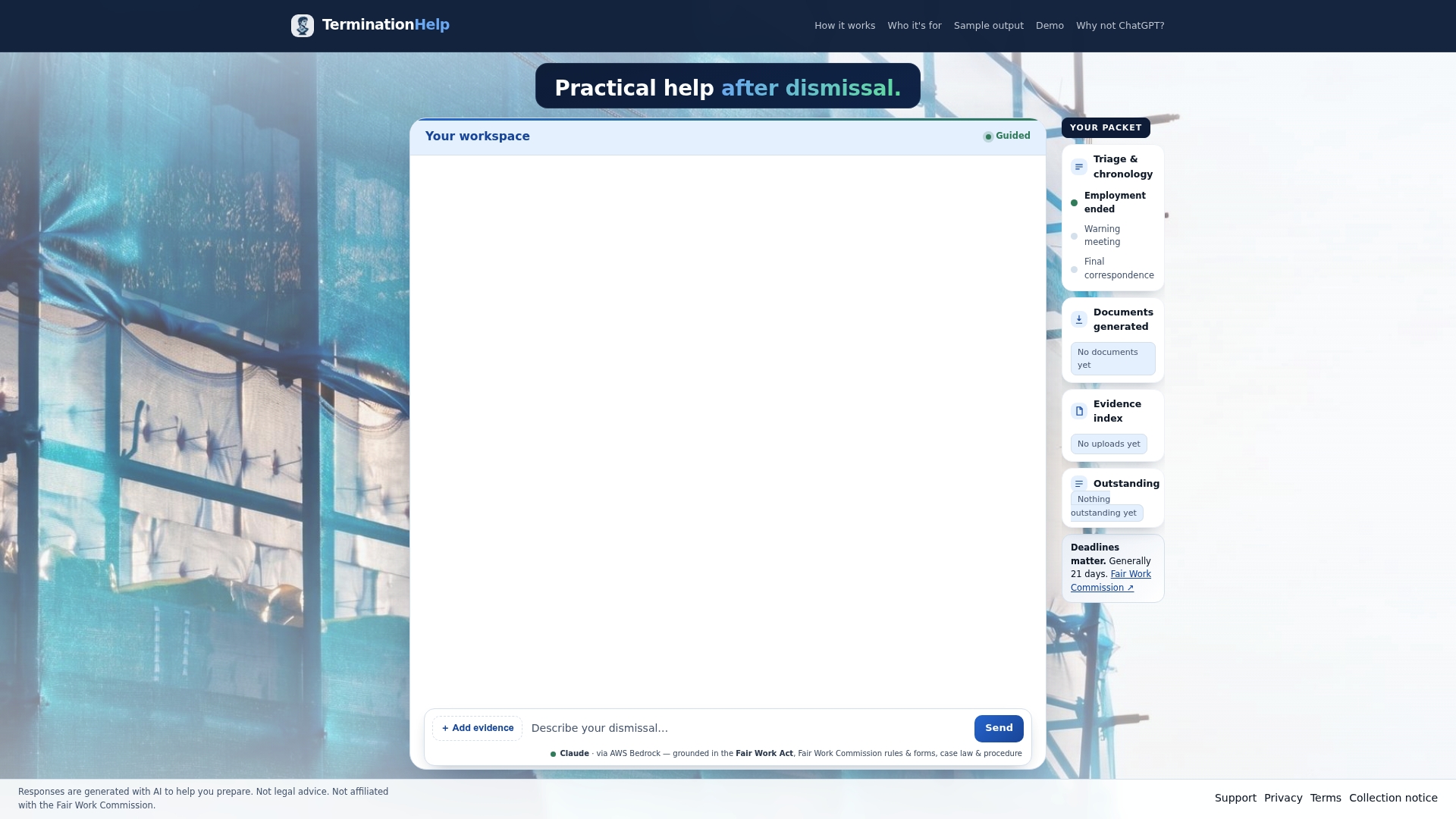
If the deadline is tight or the paperwork feels heavy, we built our tool for exactly this. Our preparation support is built only for Australian Fair Work claims, so every step follows Australian law and Commission procedure. We offer:
- Eligibility checks that tell you quickly whether you can apply.
- Evidence organisation that turns a pile of emails and payslips into a clean file.
- Lodgment-ready material including Form F2 content you can file yourself or hand to a lawyer, union or community legal centre.
Current pricing details are on our website. Start at Terminationhelp and begin your preparation today.
This article is general information, not a substitute for advice from a qualified lawyer. Consult a qualified legal professional about your own circumstances before acting on anything here.
FAQ
What is a wrongful dismissal claim?
Wrongful dismissal is a common term for a dismissal that breached the law or your contract. In Australia, the Commission deals with unfair dismissal, general protections and unlawful termination claims, each with its own form and tests, as the Fair Work Commission explains.
What is the difference between unlawful termination and unfair dismissal?
Unfair dismissal asks whether the dismissal was harsh, unjust or unreasonable. Unlawful termination covers dismissals for prohibited reasons, and uses Form F9. Both share the same 21-day deadline.
What are the three grounds for dismissal?
Under the Fair Work Act, a dismissal is unfair if it was harsh, unjust or unreasonable. Employers also need a valid reason connected to your conduct or capacity, as the Fair Work Ombudsman's best practice guide outlines.
Can I file unfair dismissal while on probation?
Yes, if you have completed the minimum employment period and meet the other eligibility tests. Probation alone does not remove your right to apply.
Sources
- Unfair dismissal - Fair Work Ombudsman
- Deadlines | Fair Work Commission
- Reinstatement after unfair dismissal | Fair Work Commission
Recommended
- Check Unfair Dismissal Eligibility in Australia: 21 days to lodge
- Australia: 21 Day Evidence Casual Employees Need for Unfair Dismissal
- Constructive dismissal in Australia: lodge within 21 days
- 3 checks to claim unfair dismissal on probation in Australia
Article produced using AI. This is not legal advice.