

Under the Fair Work Act you must usually have six months' service, or 12 months if your employer is a small business with fewer than 15 employees, before you can apply for unfair dismissal. You cannot lodge before that date, and once you are dismissed you have only 21 days to apply. General protections claims have no minimum employment period at all.
TL;DR:
- Minimum employment period for unfair dismissal is six months for most employers and 12 months for small businesses with fewer than 15 staff, counted by calendar months.
- Casual work counts towards minimum service only if it was regular and systematic, with a genuine expectation of ongoing employment, based on rostering patterns and employer statements.
- Employees must apply within 21 days of dismissal, with the deadline starting on the dismissal date, regardless of current work status or notice period.
- Redundancy pay requires at least 12 months of continuous service, excluding dismissals for misconduct or fixed-term contracts ending without redundancy.
- Probation does not automatically disqualify unfair dismissal claims once the minimum employment period is reached, and small business dismissals must follow specific fair dismissal guidelines.
Table of Contents
- How the Fair Work Act defines the minimum employment period
- When your service counts: casuals, gaps, and change of employer
- Notice of termination: minimum notice periods and pay in lieu
- Redundancy pay: eligibility, the statutory scale and exclusions
- Probation, small business rules, and your other options if you're not eligible yet
- What to do next if you think your dismissal was unlawful
- Borderline cases: how tribunals actually weigh them
- How Terminationhelp can help you prepare your application
- FAQ
- Sources
- Primary legislation and official Fair Work resources
How the Fair Work Act defines the minimum employment period
The Fair Work Act 2009 sets two qualifying periods for unfair dismissal. You need six months of continuous service with most employers, or 12 months if you work for a small business employer. The Act counts a month as a calendar month, so your qualifying date falls on the same date in the sixth or twelfth month after you started, not after a rounded number of weeks.

Small business status is tested by headcount at the time of your dismissal, not at the time you started. That headcount includes regular casuals and anyone else dismissed as part of the same event.
A few examples show how the calculation works in practice:
- Starting on 3 March means your six month qualifying date falls on 3 September.
- Starting on 15 January for a small business employer means your 12 month date falls on 15 January the following year.
- A business that grows from 12 to 20 staff during your employment is assessed on its headcount on your dismissal date, not when you were hired.
Small miscalculations of the start date or the headcount decide a surprising number of eligibility disputes before they reach a hearing.
When your service counts: casuals, gaps, and change of employer
Casual work, broken service and business sales all raise the same question: does your earlier time count towards the minimum employment period? The answer depends on the pattern of work and the reason for any gap.
- Casual periods count only when the work was regular and systematic and you had a reasonable expectation that the employment would continue, a test the Fair Work Commission applies by looking at rostering patterns and employer statements rather than any fixed number of shifts.
- Gaps caused by unpaid leave, seasonal shutdowns or irregular rostering are examined case by case, and the Commission looks at whether the employment relationship genuinely continued through the gap rather than ending and restarting.
- When a business changes owners, your prior service usually transfers and counts towards your minimum employment period if the new employer is a related entity or the transfer falls within the Act's transfer of business rules, though a genuinely new and unrelated purchaser can reset the clock.
Documenting your roster history and any employer assurances about ongoing work strengthens your position if continuity becomes contested.
Notice of termination: minimum notice periods and pay in lieu
Notice of termination is a separate entitlement from the minimum employment period, and the two are often confused. Notice is about how much warning, or payment instead of warning, you get when your employment ends.
- An employee must be given a minimum notice period that increases with length of continuous service, starting at one week and increasing for longer service; employees over 45 with at least two years of service receive additional notice.
Your employer can pay you out instead of having you work the notice period, and your employment contract can set a longer notice period than the statutory minimum, which then becomes your legal entitlement. None of this notice period affects your minimum employment period for an unfair dismissal claim: you can meet the six or 12 month threshold on day one of your notice period and still need to apply within 21 days of your dismissal taking effect.
Redundancy pay: eligibility, the statutory scale and exclusions
Redundancy pay is triggered by job loss, not poor performance or misconduct, and it has its own service threshold separate from unfair dismissal eligibility. You generally need at least 12 months of continuous service before redundancy pay applies, and the statutory scale then increases with each year of service up to a capped maximum.
- Employees with under 12 months of service do not qualify for statutory redundancy pay.
- Certain fixed term contract employees whose contract simply ends are excluded.
- Employees dismissed for serious misconduct are not entitled to redundancy pay.
Even where redundancy pay is correctly calculated, you can still challenge the dismissal itself if the role was not genuinely redundant or your employer skipped a proper consultation process.
Probation, small business rules, and your other options if you're not eligible yet
Being on probation does not automatically stop you from claiming unfair dismissal. Probation is a contractual arrangement, not a statutory bar, so if you have already reached your six or 12 month minimum employment period, probation status alone will not disqualify your claim.
Small business employers get an extra layer of protection: the Small Business Fair Dismissal Code sets out what a fair dismissal looks like for employers with fewer than 15 staff, and following it properly can be a complete defence to an unfair dismissal claim.
- You must apply to the Commission within 21 days of your dismissal taking effect.
- Late applications are only accepted where you show an exceptional reason, and the Commission has discretion to refuse them.
- If you do not meet the minimum employment period, a general protections claim may still be available with no qualifying period at all, provided the dismissal relates to a protected workplace right, discrimination or similar prohibited reason.
Pro Tip: Mark the 21-day deadline in your calendar the day you're told your employment is ending, not the day you stop working, since the clock often starts earlier than people expect.
What to do next if you think your dismissal was unlawful
Work through these steps as soon as possible after your dismissal, since evidence and deadlines both move fast.
- Check your employer's headcount on your dismissal date and calculate your continuous service start date using calendar months.
- Gather your rosters, payslips, employment contract and any emails or texts about your dismissal or your work patterns.
- Calculate the 21 day deadline from the date your dismissal took effect and note it clearly.
- Consider whether a general protections claim fits better if the real reason looks discriminatory, retaliatory or related to a workplace complaint.
- Decide where to get help: the Fair Work Commission's own guidance, a community legal centre, your union, or a paid preparation service if your situation is complex or time is short.
Free help through a community legal centre or union suits straightforward cases with time to spare. Paid preparation support earns its keep when your casual service history is messy, your headcount is disputed, or the 21 day window is closing fast.
Borderline cases: how tribunals actually weigh them
Tribunals test regular and systematic casual work by looking at actual rostering patterns and what an employer told you about ongoing shifts, not by counting a fixed number of weeks. Headcount disputes often turn on who was employed on the dismissal date, including other casuals. Claims frequently fail for a lack of documentation rather than a lack of merit, which is why gathering payslips and rosters early, and moving quickly towards conciliation, tends to produce better outcomes than waiting.
— Nicolas
How Terminationhelp can help you prepare your application
We offer preparation support designed to help with eligibility questions such as checking your continuous service date, working out a contested headcount, and generating the Fair Work forms your application needs.
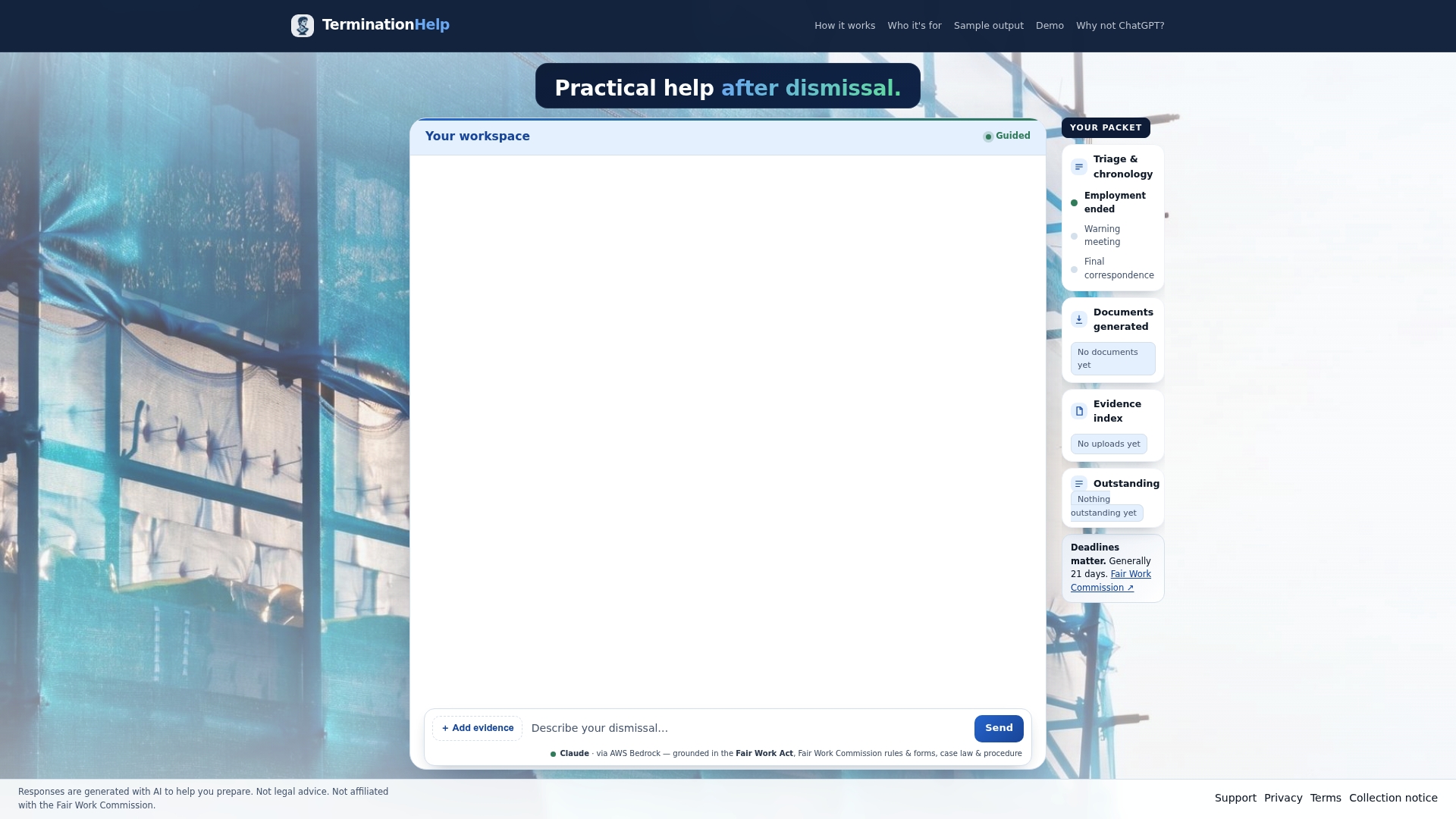
- Our service includes an eligibility check based on your dates of service and employer size before you begin filling out forms.
- We assist in generating the required Fair Work documents and organising your evidence into a structured packet.
- Our service provides step-by-step guidance through each stage of the process, aligned with how the Fair Work Commission handles applications.
A paid preparation order through our preparation support page makes the most sense when your casual work history is complicated, your headcount is contested, or your 21 day deadline is close. Start with our Terminationhelp landing page to check your eligibility now.
This article is general information, not a substitute for advice from a qualified lawyer. Consult a qualified legal professional about your own circumstances before acting on anything here.
FAQ
Is a 3 month probation period legal in Australia?
Yes, a three month probation period is legal and common in Australian employment contracts. Probation does not change your statutory minimum employment period of six or 12 months, so you can still be dismissed during probation without that alone affecting your unfair dismissal rights once you reach the threshold.
Can I get 5 weeks of annual leave in Australia?
Five weeks of annual leave is not a standard entitlement under the National Employment Standards, which set four weeks as the base for most employees. Some awards, enterprise agreements or individual contracts provide extra leave, including five weeks for certain shift workers, so check your specific award or agreement.
Is it legal to work 8 days in a row in Australia?
There is no blanket rule against working eight days in a row, as legality depends on your award, enterprise agreement and the maximum weekly hours and rest break rules that apply to your role. Many awards set minimum rest periods between shifts and maximum consecutive days, so check the relevant award through the Fair Work Commission for your industry.
Can I work and still accumulate service while on a casual contract?
Yes, casual service counts towards your minimum employment period when the work is regular and systematic and you had a reasonable expectation of continuing employment. The Fair Work Commission looks at your actual rostering pattern and any employer statements about ongoing work, rather than applying a fixed number of shifts or weeks.
Sources
- Unfair dismissal – can you apply? | Fair Work Commission
- What is the Small Business Fair Dismissal Code? | Fair Work Commission
- Redundancy pay | Fair Work
- Legislation
- Fair Work Commission decisions and resources
Primary legislation and official Fair Work resources
These official sources back the rules explained above and are worth reading directly if you want to verify your own situation.
- Unfair dismissal – can you apply? | Fair Work Commission
- What is the Small Business Fair Dismissal Code? | Fair Work Commission
- Redundancy pay | Fair Work
- Legislation
- Fair Work Commission decisions and resources
Article produced using AI. This is not legal advice.