

If your fixed term contract simply reaches its end date, you generally cannot make an unfair dismissal claim. If your employer ends it early, or the "fixed term" label doesn't match how you were really employed, you may have options, and the deadline to lodge a claim is only 21 days. This guide explains which situation you are in, what you may be owed, and what to do next.
TL;DR
- Employment that ends because a genuine fixed term contract expires is generally not eligible for unfair dismissal.
- A dismissal before the end date, or a contract that doesn't clearly say employment ends on expiry, can be a different matter and is worth checking.
- You still need to meet the usual tests: minimum employment period, employee status and the earnings threshold.
- The unfair dismissal deadline is 21 days from the day the dismissal took effect, so check eligibility early.
- Since 6 December 2023, new rules limit how long fixed term contracts can run and how often they can be renewed.
Table of Contents
- Fixed term contracts: what they are and why they matter
- When the contract simply ends
- When ending or not renewing can still be a dismissal
- If your employer ends the contract early
- The new fixed term contract rules since 6 December 2023
- Do you meet the general unfair dismissal tests?
- The 21-day deadline
- What to do if you think it was unfair
- Perspective
- Get your claim material ready
- FAQ
- Sources
Fixed term contracts: what they are and why they matter
A fixed term contract is an employment contract that ends at the end of a set period. That might be a set date, a set length of time or a season. Employers use them to cover parental leave, projects, grant-funded roles and seasonal peaks.

The key point is that the contract itself brings the employment to an end. In legal terms, that is different from an employer choosing to dismiss you. This is why the end of a genuine fixed term contract is usually treated differently from a termination at the employer's initiative, and why the details of your paperwork matter so much.
Three questions sort almost every case:
- Did the contract run to its end date, or was it cut short?
- Does the contract clearly say employment ends when the period ends?
- Do you meet the general eligibility tests for unfair dismissal?
When the contract simply ends
The Fair Work Ombudsman says an employee is generally not eligible for unfair dismissal if their employment finishes at the end of the contracted period. Not being offered a new contract, when the old one was genuinely for a set period, usually falls into this category.
The Fair Work Commission explains that a genuine contract for a specified period can terminate by the passing of time where its start and finish dates are unambiguous. So a clear contract, a clear end date and an employer who simply lets it run out is the weakest position from which to bring a claim.
That doesn't mean you have no rights. You are still entitled to be paid everything owed to you up to the end date, including accrued annual leave. The Fair Work Ombudsman is the body to contact about unpaid entitlements.
When ending or not renewing can still be a dismissal
The label "fixed term" does not decide the question on its own. The Commission's guidance points out that non-renewal may be relevant where the contract does not show agreement that employment ends on expiry. Successive standard-form contracts are the example it gives.
Look for these warning signs:
- Ambiguous dates. The contract has a start date but no clear finish date, or the finish depends on something vague.
- Rolling renewals. You have been re-signed several times on the same template, and the paperwork reads like ongoing employment with a renewal habit.
- Early termination. Your employer ended the contract before the end date. This is a termination at the employer's initiative, so the usual unfair dismissal tests can come into play.
- Contract limits ignored. The arrangement runs longer, or is renewed more often, than the rules allow (see below).
If any of these fit, read the contract line by line and keep every version you signed, plus emails about renewal. Our guide to checking unfair dismissal eligibility walks through the general tests.
If your employer ends the contract early
When employment is terminated before the contracted period ends, the employee isn't entitled to National Employment Standards (NES) notice or redundancy pay unless an enterprise agreement or employment contract provides otherwise. The NES notice rules also don't apply to employees employed for a specific period or doing seasonal work.
So your own contract and any applicable award or enterprise agreement are the first documents to open. Check for:
- a clause allowing either party to end the contract early on notice;
- any payment promised if the contract is terminated early;
- redundancy terms in an enterprise agreement;
- the process the employer said it would follow.
Early termination is also the situation where an unfair dismissal application is most realistic, because the dismissal was the employer's decision rather than the passing of time. Whether it was harsh, unjust or unreasonable, or a genuine redundancy, is then assessed in the usual way. See our overview of redundancy versus dismissal if the reason given was restructuring.
The new fixed term contract rules since 6 December 2023
For contracts entered into from 6 December 2023, the Fair Work Act limits how fixed term contracts are used. In summary, per the Fair Work Ombudsman:
| Rule | What it means |
|---|---|
| Maximum length | A fixed term contract can't be for longer than 2 years, including extensions and renewals |
| Consecutive contracts | Limits apply to successive contracts for the same or substantially similar work |
| Casuals | Casual employees are excluded from the limits |
| Exceptions | Some exceptions apply, for example for certain roles and funding situations |
| Information | Employers must give every employee on a new fixed term contract a Fixed Term Contract Information Statement (FTCIS) when they enter the contract or as soon as possible after |
The government's explanatory material says the policy aims to prevent abuse of successive short-term contracts while keeping flexibility for legitimate needs such as project-based work or temporary funding. The 2024 Regulations also extended exceptions for organised sport, high-performance sport, live performance and higher education for specified contract periods.
If your contract breaches these limits, the term that breaches them can be affected, and the Fair Work Ombudsman or the Commission is the place to raise it. A breach does not by itself make a dismissal unfair, but it is a strong reason to look harder at whether your arrangement is really ongoing employment.
Do you meet the general unfair dismissal tests?
Even when a dismissal happened, you must be eligible. The Commission lists these requirements on its eligibility page:
- Minimum employment period: 6 months, or 12 months if the employer is a small business with fewer than 15 employees. Our page on the minimum employment period explains how time is counted.
- Employee status: independent contractors, volunteers, interns and work experience participants can't apply, and neither can irregular casuals. Regular, systematic casuals may be covered, as covered in our guide for casual employees.
- Earnings: if you earn above the high income threshold ($167,500 a year from 1 July 2023, indexed each year), you must be covered by an award or enterprise agreement.
A short fixed term, say three months, will often fall under the minimum employment period anyway. Where contracts have been renewed back to back, the time may add up, so count carefully from your first day of continuous employment.
The 21-day deadline
An unfair dismissal application must be lodged with the Fair Work Commission within 21 days from the date the dismissal took effect. The application is made in the approved form, which can be filed through the Commission's website.
In a fixed term setting, the clock question can be tricky. If you were terminated early, the date is the day your employment ended. If the dispute is whether non-renewal was a dismissal at all, don't wait for that to be resolved: protect the deadline by working out the dates now. Our explainer on the 21-day time limit covers how to count the days and what late applications involve.
What to do if you think it was unfair
Work through these steps in order:
- Write down the dates. Contract start, end date, any renewals, the day you were told and the day employment actually ended.
- Gather the documents. All contract versions, renewal emails, letters, payslips and any warnings or performance notes.
- Check your status. Employee or contractor? Regular casual? Above or below the high income threshold?
- Check the contract's end clause. Is the end date clear? Was the contract cut short? Did it allow early termination?
- Count to 21 days. Mark your last day to lodge.
- Choose how to proceed. You can file yourself, or take your material to a lawyer, a union or a community legal centre.
- Consider other routes. Some situations are better suited to a different claim, such as general protections or an underpayment claim with the Fair Work Ombudsman.
If the matter proceeds, the Commission generally expects you to be able to explain your case and back it with evidence. Our guide on filing an unfair dismissal claim sets out the stages, and the page on employer obligations when dismissing shows what your employer was expected to do.
Perspective
Most fixed term disputes we see are decided by paperwork, not by the story people tell. Whether the end date is clear, whether the contract was cut short, how many renewals there were and what the dates add up to: these facts decide whether a claim has a path.
That is why we built our preparation support around structure. Our tool is designed to be grounded in Australian legislation, Fair Work Commission procedure and relevant case law. It helps you check eligibility, organise evidence, build a timeline and generate the forms for the stage you are at, so you aren't guessing at 2am on day 18.
We don't predict outcomes, and we don't replace a lawyer, union or community legal centre. What we do is get your material into a form you can file yourself or hand to one of them, quickly and in order. Given a 21-day limit, that head start matters.
Nicolas
Get your claim material ready
If you think your fixed term contract was ended unfairly, the most useful thing you can do this week is get your facts in order. Our preparation support walks you through eligibility checks, evidence organisation, timelines and the Fair Work forms for your matter, in a packet you can file independently or take to a lawyer, union or community legal centre.
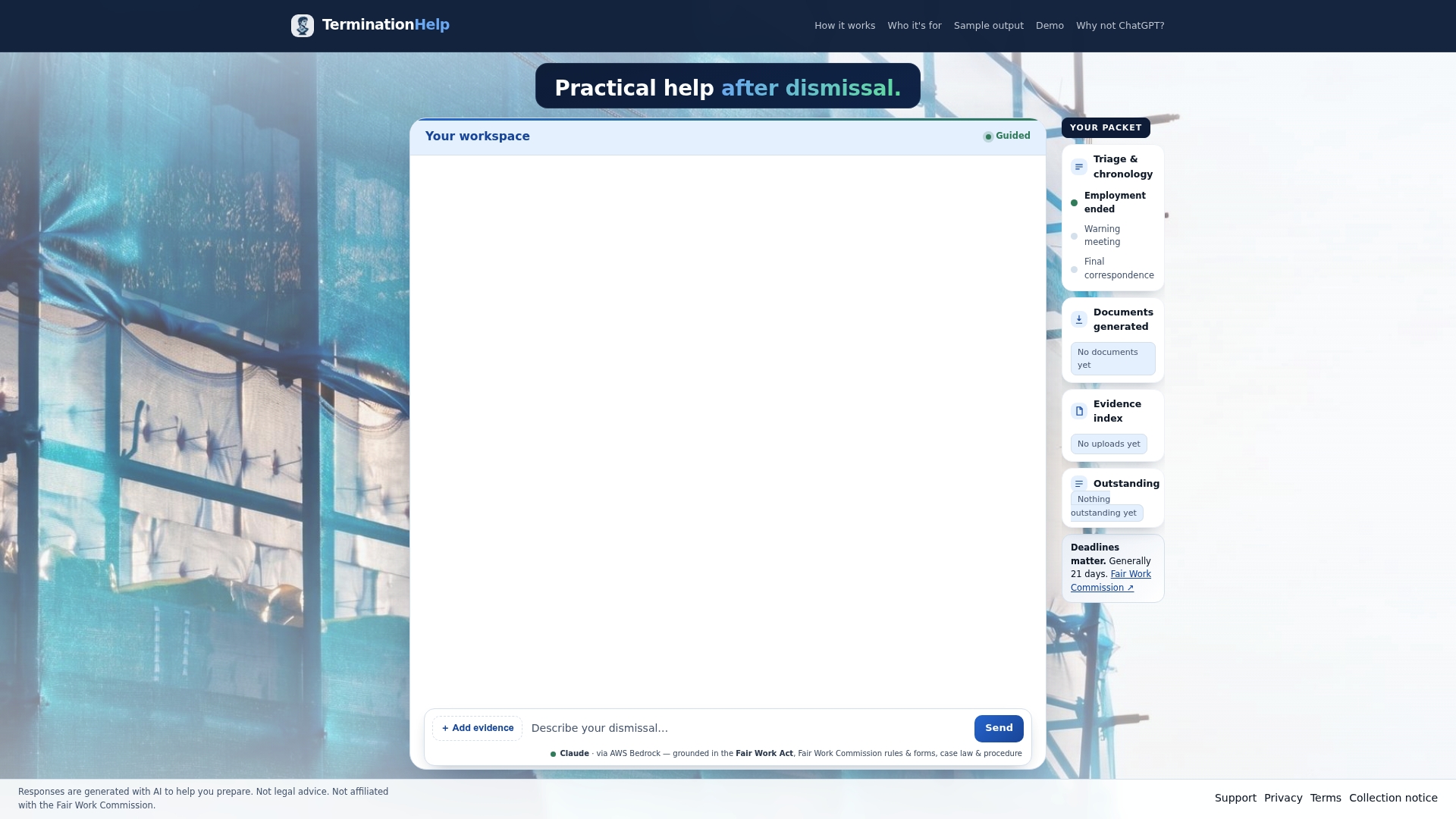
It is built only for Australian Fair Work claims, so every step follows Australian law and Commission procedure. If you want to read first, start with our guide to the unfair dismissal remedies available if a claim succeeds.
FAQ
Can I claim unfair dismissal if my fixed term contract wasn't renewed?
Generally not, if the contract was genuinely for a set period and employment ended when that period did. It may be different where the contract doesn't clearly show employment ends on expiry, such as successive standard-form contracts. Check your documents and the deadline early.
What if my employer terminated my fixed term contract before the end date?
That is a termination at the employer's initiative, so you may be able to apply for unfair dismissal if you meet the eligibility tests. You also need to check your contract and any award or agreement for notice or payout terms, because NES notice and redundancy pay don't automatically apply to fixed term employees.
Is there a limit on how long a fixed term contract can last?
Yes, for contracts entered into from 6 December 2023, a fixed term contract can't be for longer than 2 years including extensions and renewals, with limits on consecutive contracts and some exceptions. Casual employees are excluded from these limits.
Do I have to be employed for a minimum period to claim?
Yes. You generally need 6 months of employment, or 12 months if your employer is a small business with fewer than 15 employees. Renewed contracts may count together if employment was continuous.
Sources
- Fixed term contract employees - Fair Work Ombudsman
- Contract for a specified period of time - Fair Work Commission
- Who doesn't get notice - Fair Work Ombudsman
- Unfair dismissal: can you apply? - Fair Work Commission
- Unfair dismissal - Fair Work Commission
- Explanatory Statement, 2024 Regulations - legislation.gov.au
Recommended
- Check Unfair Dismissal Eligibility in Australia: 21 days to lodge
- Employer obligations when dismissing an employee in Australia
- Redundancy vs Dismissal: Australian Employees Have 21 Days to Act
- Constructive dismissal in Australia: lodge within 21 days
Article produced using AI. This is not legal advice.