

A show cause letter asks you to explain, in writing, why your employer should not take action against you, which can include dismissal. Your reply is usually your main chance to put your side before a decision is made, so answer every allegation, ask for what you need, and keep a copy of everything. If a dismissal follows, the same paper trail becomes the evidence for an unfair dismissal claim, and at Terminationhelp we built our preparation tool to organise it for you.
TL;DR
- A show cause letter sets out allegations about your conduct or performance and invites you to respond before your employer decides whether to dismiss you.
- The Fair Work Act expects you to be told the reason and given a genuine chance to respond before any decision is made. There is no fixed number of days, so you ask for a reasonable time if the deadline is too short.
- Answer each allegation separately, stick to facts, attach evidence, and say so if the allegations are too vague to answer.
- If you are dismissed, an unfair dismissal application must be lodged within 21 days after the dismissal takes effect, so start preparing your documents now.
Table of Contents
- What a show cause letter is, and how it differs from a warning
- Why your response matters legally
- Step 1: Read the letter and work out what is being alleged
- Step 2: Check the deadline and ask for more time if you need it
- Step 3: Gather your evidence
- Step 4: Write the response
- Step 5: Ask for a support person and a meeting
- Responding to a written warning you think is unfair
- What happens after you reply
- If you are a casual, probationary or small business employee
- Common mistakes to avoid
- Where our tool fits
- Prepare your matter with our support
- FAQ
- Sources
What a show cause letter is, and how it differs from a warning
A show cause letter is a formal request from your employer to explain an alleged problem. Australian Unions describes it as something an employer gives after a disciplinary meeting when they believe the allegations are serious enough for you to lose your job. You are asked to say why you should keep it.
A written warning is different. It records a concern and tells you what must change. The Fair Work Ombudsman says a written warning about underperformance should be in writing, clear about the reason, set out expectations about what needs to be done differently, and be fair and reasonable. A show cause letter goes a step further: it tells you a decision about your employment is being considered.
The practical difference is this. A warning says "fix this". A show cause letter says "explain why we should not act". Treat it as the point where the outcome is still open.
Why your response matters legally
Under section 387 of the Fair Work Act 2009, when the Fair Work Commission decides whether a dismissal was harsh, unjust or unreasonable, it must take into account whether you were notified of the reason and given an opportunity to respond to any reason related to your capacity or conduct. That is why employers send these letters, and why your reply carries weight later.
Two points from the Commission's own guidance are worth knowing:
- The reason must be given before the decision to terminate is made, in explicit and plain, clear terms.
- The opportunity to respond needs no formality and is applied in a common-sense way. It is satisfied where you know the precise nature of the concern and have a full opportunity to respond.
The Commission has also said that an opportunity to defend implies one that might lead the employer to decide not to terminate if the defence has substance. Going through the motions after the decision has already been made is not a genuine opportunity (see the same Opportunity to respond page). So write your response as if it could change the outcome, because legally it is meant to be able to.
For a wider look at what fair process means, see our guide to procedural fairness in dismissal.
Step 1: Read the letter and work out what is being alleged
Before you write anything, pull the letter apart:
- The allegations. List each one. Note dates, places, people and any policy or contract term the employer relies on.
- The deadline and how to reply. Check the date and time, and whether the reply goes to a named person by email or in a meeting.
- What action is proposed. Some letters say dismissal is being considered. Others say the employer is deciding the outcome, which may be a warning or a demotion.
- What was attached. Procedural fairness generally means you are given the information the process is based on. The NT Workers' Welfare Centre notes that the employer must provide all information the disciplinary process is based on.
If the letter does not tell you what you are accused of in enough detail, that is the first thing to raise in your response.
Step 2: Check the deadline and ask for more time if you need it
There is no single legal number of days. The NT Workers' Welfare Centre says a reasonable time may vary from a day to a month, depending on the complexity of the issue, whether an urgent decision is essential and other relevant factors.
Some public-sector processes set their own periods. A Queensland Teachers' Union article describes one example with 14 days to respond to substantiated allegations and 7 days to respond to a second letter proposing a penalty. Your workplace may be different, so check your contract, enterprise agreement and the employer's disciplinary policy.
If 24 or 48 hours is not enough to gather evidence or get advice, do not ignore the deadline. Reply in writing before it expires and:
- say you intend to respond fully;
- explain why you need more time (a complex allegation, documents you must collect, a support person you want to bring);
- propose a specific new date;
- ask for any documents the allegations rely on.
Keep that email. If the employer refuses a reasonable extension and dismisses you, the refusal is part of the story of how fair the process was.
Step 3: Gather your evidence
Your reply is stronger when each point is backed by something concrete. Collect:
- emails, messages and rosters that show what actually happened;
- performance reviews, feedback and any earlier warnings;
- policies, your contract and position description;
- names of colleagues who saw the events, and their contact details if appropriate;
- any medical or personal circumstances that are relevant and that you are comfortable disclosing.
Put everything in date order and keep copies outside any work system. If you are still employed, do not forward confidential company information to a personal account unless your employer's policy allows it. Stick to material that concerns you, such as your own emails, reviews and warnings.
Step 4: Write the response
The Working Women's Centre SA template advises responding to each allegation in clear, concise paragraphs. A structure that works:
- Opening. Acknowledge the letter, give its date, and confirm you are responding within the deadline.
- Allegation by allegation. Repeat each allegation as a heading, then give your account: what happened, what you admit if anything, what you dispute and why. Refer to attached evidence by number.
- Context and mitigation. Explain your record, any training or support you were or were not given, and any circumstances that bear on the issue.
- Process concerns. Say if an allegation is too vague to answer. The same template notes that if allegations are vague, general, subjective or unsubstantiated, you can say you lack enough information to respond adequately. It also says that where events occurred more than two weeks before the letter, you can ask why they were not raised sooner, particularly for serious misconduct.
- Outcome you want. State plainly that you ask the employer not to proceed with dismissal, and propose what could address the concern, such as training, a performance plan or a conversation with a support person.
- Close. Offer to meet, say who may attend with you, and ask for the decision in writing.
Tone
Be calm and factual. Do not attack the manager's character or write while angry. If you are in the wrong on a point, acknowledging it and explaining what you will do differently is often more persuasive than denial. Do not admit to anything that is not true just to end the process.
A short worked example
Suppose a letter alleges you were late on five named dates in one month and asks why your employment should continue.
- Heading: "Allegation 1: Late arrival on 3, 7, 12, 19 and 24 of the month".
- Your reply: "I accept I arrived after 9:00am on 7 and 19, by 12 and 20 minutes, because of train cancellations (see Attachment A). I dispute 3, 12 and 24: my swipe-card records and the roster show I started at 9:00 or earlier (Attachments B and C). I was not given a written warning about punctuality before this letter."
That is specific, short, referenced and easy for a decision-maker to check.
Step 5: Ask for a support person and a meeting
If the process includes a meeting, ask to bring a support person, such as a colleague, a union representative or a family member. You can ask for the allegations and any documents in writing beforehand. Ask for notes of any meeting to be shared, and write your own notes straight afterwards.
Responding to a written warning you think is unfair
A warning is not a show cause letter, but your reply to it still matters. The Commission's unfair dismissals benchbook says there is no legislative requirement for a set number of warnings before a performance dismissal. There is no "three warnings" rule. It also says a warning must identify the specific performance concern and make clear employment is at risk, not merely exhort improvement.
If a warning is inaccurate or unclear:
- reply in writing within a few days;
- say which statements you dispute and attach evidence;
- ask what specific improvement is expected and by when, and what support will be provided;
- ask that your response be placed on your file.
The Fair Work Ombudsman says the Commission usually considers whether you were given a chance to fix performance issues when it looks at an unfair dismissal claim. A written reply shows you took the concern seriously and engaged with it.
What happens after you reply
The employer considers your response and decides. In a conduct matter the employer will typically weigh the evidence and decide whether the allegations are made out. The outcomes range from no action, to a warning, to dismissal. If you are dismissed, the notice should be in writing and explain the reason.

If dismissal follows, three things matter straight away.
1. The 21-day limit. An application must be lodged with the Commission within 21 days after the dismissal takes effect. The Commission may allow a further period only in exceptional circumstances. Do not wait for the outcome of other conversations before preparing. Our explainer on the unfair dismissal time limit sets out how the clock works, and our guide to filing an unfair dismissal claim covers the next steps.
2. Whether you are eligible. According to the benchbook, a national system employee is protected if they have completed the minimum employment period (six months, or one year for an employer with fewer than 15 employees) and either earn below the high income threshold or are covered by a modern award or enterprise agreement. The benchbook, dated 1 July 2026, states the current threshold as $190,100; it is indexed each 1 July, so check the Commission's site for the figure that applies to your dismissal. Genuine redundancy and dismissals that comply with the Small Business Fair Dismissal Code are excluded. Our pages on unfair dismissal eligibility and the minimum employment period go through each test.
3. What your response proves. If the employer ignored a substantive reply and dismissed you anyway, your documented response is evidence that you were not given a genuine opportunity to respond. If you were never given a chance at all, the missing show cause step is itself relevant. Either way, the Commission looks at the whole picture, including whether there was a valid reason, so the strength of your answers on the substance still matters.
If you are a casual, probationary or small business employee
- Casuals: the benchbook says periods of service count toward the minimum employment period only if you were a regular casual with a reasonable expectation of continuing employment on a regular and systematic basis (s 384(2) of the Fair Work Act). See our guide for casual employees.
- Probation: being on probation does not by itself remove protection once the minimum period is met. Our probation checklist explains the checks.
- Serious misconduct: if the letter alleges serious misconduct, the stakes are higher because an employer may seek to dismiss without notice. Our page on serious misconduct explains the 21-day position.
- Gig workers and contractors: unfair dismissal applies to employees. If you are unsure whether you are an employee or a contractor, the status question comes first, and that is worth settling before the 21 days run.
Common mistakes to avoid
- Missing the deadline without a word to the employer.
- Replying with a general apology that does not answer the allegations.
- Sending a long emotional message with no evidence.
- Resigning in the middle of the process without understanding the consequences. If you resign, the question of whether you were forced to resign becomes complicated, and the unfair dismissal route may become harder.
- Deleting messages or files that the employer may later rely on.
- Failing to keep a copy of the letter, your reply and any follow-up.
Where our tool fits
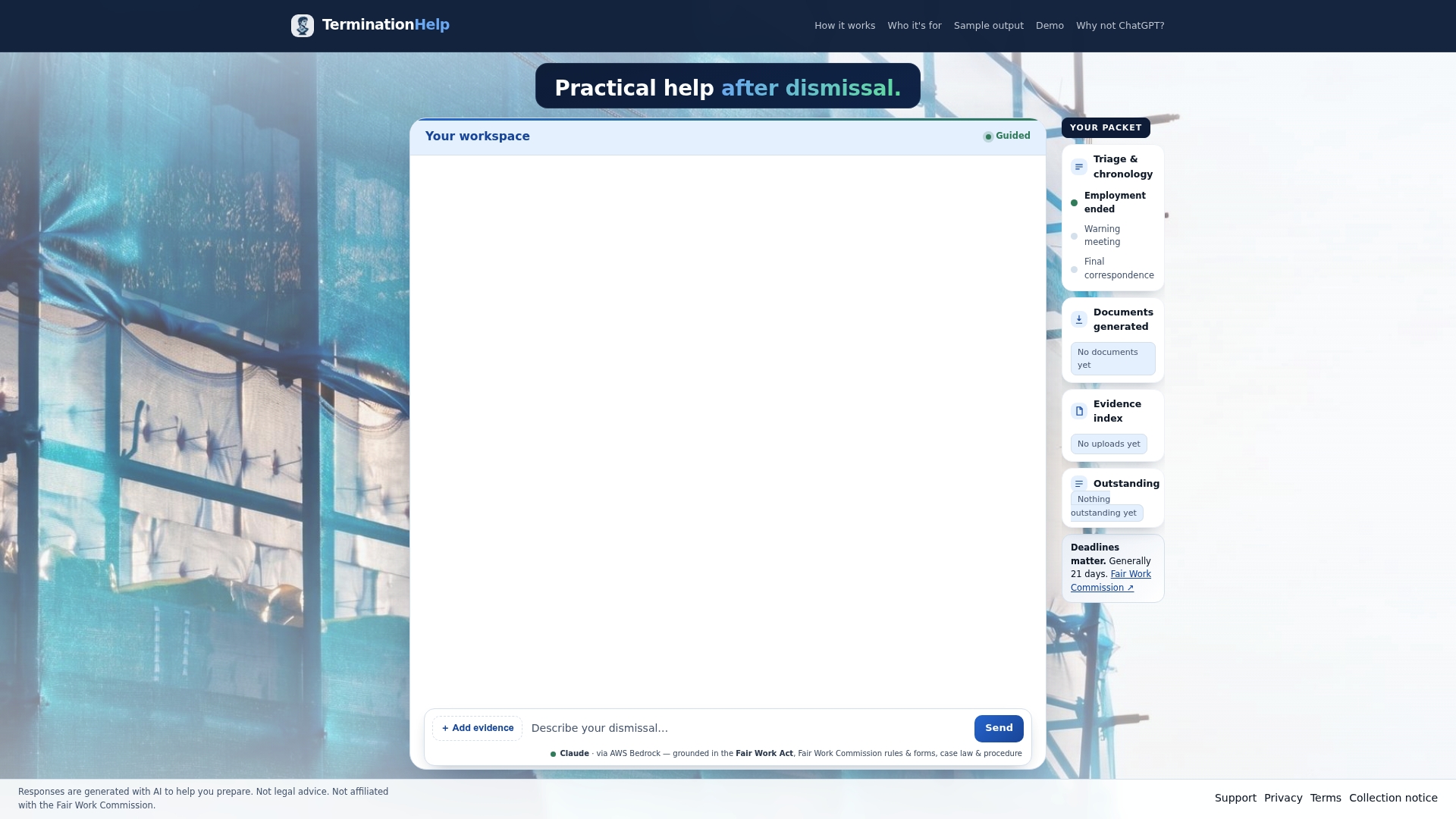
We built Terminationhelp for the moment this process turns into a possible claim. The tool is dedicated to Australian Fair Work claims and walks you through eligibility checks, organises your evidence and timelines, lets you upload documents, and generates the Fair Work forms you need. You get a structured packet you can file yourself or bring to a lawyer, union or community legal centre.
Our approach to a show cause letter
Most people who write to us wrote their reply in a hurry, with half their documents and no clear timeline. The reply and the claim are the same story told twice, so we say get the chronology right once. We built our tool on Australian legislation, Fair Work Commission rules and case law, so every step follows what the Commission asks for, and the evidence you collect for your reply carries straight into the forms if you are later dismissed.
We also keep your data onshore, and it is never used to train AI. A response that is specific, dated and referenced is easier for a decision-maker to accept and easier for you to rely on later.
Nicolas
Prepare your matter with our support
If you have received a show cause letter, or have already been dismissed and the 21 days are running, our preparation support takes you from eligibility check to a filing-ready packet.
You can also read our step-by-step guide to the Fair Work Commission process to see what comes after the application.
FAQ
How long do I have to respond to a show cause letter?
The law sets no fixed number of days. The time must be reasonable, and a factsheet from the NT Workers' Welfare Centre says that can range from a day to a month depending on complexity and urgency. If the deadline is too short, reply before it expires and ask in writing for a specific extension.
Is a show cause letter the same as being dismissed?
No. It is a request for your explanation before a decision is made. It does signal that dismissal or another disciplinary outcome is being considered, so treat it seriously and respond in writing.
Can my employer dismiss me without giving me a chance to respond?
The Fair Work Act requires the Commission to consider whether you were notified of the reason and given an opportunity to respond to conduct or capacity concerns before the decision was made. A missing or token opportunity can count towards a dismissal being found unfair, though the Commission looks at all the circumstances.
What if I am dismissed after I respond?
Check your eligibility and lodge an unfair dismissal application within 21 days after the dismissal takes effect. Gather your letter, your reply, the dismissal notice and your timeline now, since extensions are granted only in exceptional circumstances.
Sources
- Opportunity to respond, Fair Work Commission
- Notification of reason for dismissal, Fair Work Commission
- Unfair dismissals benchbook, Fair Work Commission
- Managing performance and warnings, Fair Work Ombudsman
- Fair Work Act 2009, section 387
- Disciplinary Meeting, Australian Unions
- Performance Management, NT Workers' Welfare Centre
- Legal: D for discipline, Queensland Teachers' Union
- Template for how to respond to a letter of allegations, Working Women's Centre SA
Recommended
- How to Write a PIP Response Letter in Australia
- Constructive dismissal in Australia: lodge within 21 days
- Check Unfair Dismissal Eligibility in Australia: 21 days to lodge
- File an unfair dismissal claim in Australia within 21 days
Article produced using AI. This is not legal advice.