

An unfair dismissal claim at the Fair Work Commission (FWC) runs in a fixed order. You check you are eligible, lodge Form F2 within 21 days of the dismissal taking effect, your employer responds, the Commission usually offers a conciliation, and if that fails a Commission Member decides the case. Either side can then appeal. This guide walks through each stage, what it costs in time and money, and where people most often trip.
It is general information about how the process works, not legal advice. If your situation is complicated (a resignation you say was forced, a contractor arrangement, a high salary), speak to a community legal centre, your union or an employment lawyer early, because the deadline is short.
TL;DR
- You have 21 days after the dismissal takes effect to lodge. Late applications are only accepted in exceptional circumstances.
- You must be a national system employee who has served the minimum employment period: 6 months, or 12 months at a small business with fewer than 15 employees.
- After lodging, the employer has 7 days to respond and the FWC usually offers an optional conciliation about 5 weeks in, often online.
- If conciliation fails, a Commission Member decides, usually after a hearing or conference. Appeals must be lodged within 21 days of the decision.
- Compensation is capped at $95,050 for dismissals from 1 July 2026, and most settled cases resolve for less.
Table of Contents
- Step 1: Work out whether you can apply
- Step 2: Mind the 21-day deadline
- Step 3: Lodge your application
- Step 4: The employer responds
- Step 5: Conciliation
- Step 6: Conference or hearing
- Step 7: Outcomes and remedies
- Step 8: Appeals
- Related questions that change the process
- Our perspective: preparation decides how the process feels
- Getting your claim ready with Terminationhelp
- FAQ
- Sources
Step 1: Work out whether you can apply
The FWC only hears unfair dismissal claims from people who meet the basic tests. According to the Commission's eligibility page, you must be a national system employee and have worked for your employer for the minimum employment period: 6 months, or 12 months if the business is a small business with fewer than 15 employees. Independent contractors, volunteers and interns are not covered.
Three questions come up constantly.
Probation. A probation period does not remove your rights. What counts is whether you have reached the minimum employment period, not what your contract calls the first months. We cover the checks in more detail in our guide to unfair dismissal on probation.
Casual employees. A casual can apply if they worked regularly and systematically and had a reasonable expectation of continuing employment, again according to the FWC. The evidence that usually matters is rosters, payslips and messages showing a steady pattern. Our page on casual employees and unfair dismissal lists what to gather.
Contractors and gig workers. Being called a contractor does not settle the question. Legal Aid NSW notes that someone labelled a contractor may in fact be an employee, depending on the circumstances. If you work through an app or an ABN, work out your real status before assuming you have no claim.
There is also an earnings test. If no modern award or enterprise agreement covers you, your earnings must be under the high income threshold, which the FWC sets at $190,100 from 1 July 2026.
For a fuller checklist, see our unfair dismissal eligibility guide and the page on the minimum employment period.

Dismissed, or did you resign?
Some employers say you resigned when you believe you were pushed out. An employee who was forced to resign because of the employer's conduct can still be treated as dismissed, but it is a harder argument to run and the facts matter. Keep the resignation email or letter, any messages that preceded it, and notes of who said what and when. Because the 21 days run from when the dismissal took effect, do not wait for the argument about the label to be settled before you lodge.
Step 2: Mind the 21-day deadline
The deadline is 21 days after the dismissal takes effect, which is usually the last day you had a contract, as the FWC deadlines page explains. Two practical points from the Commission's timeframe page:
- The day the dismissal took effect is not counted in the 21 days.
- If the last day falls on a weekend or a public holiday when the Commission is closed, the deadline moves to the next business day.
Do not plan around that grace. Treat the 21 days as 21 days, and count from the day you were told you were finished or your last day of employment, whichever is earlier, until you have confirmed the date.
Can you apply late?
Sometimes, but not often. The Commission may extend the deadline in exceptional circumstances. Examples it gives include serious illness, the death of a family member, or an error by a lawyer or paid agent. You must explain the reason for the delay, and the Commission also weighs other factors. It says time limits exist for a reason and an extension should not be assumed, as stated on its timeframe page. Our explainer on the 21-day rule covers how to present a late application if you are already past the date.
Step 3: Lodge your application
The unfair dismissal application is Form F2, and the employer's response is Form F3, according to the FWC forms page. Forms can be sent by email or post, and some can be submitted online. The application asks for your details, your employer's details, the date and circumstances of the dismissal, and the outcome you want.
The filing fee is $92.70 from 1 July 2026, according to the FWC's fee announcement. The same announcement lists the fee for other dismissal-related applications, including general protections dismissal disputes. The fee may be refunded if you discontinue before the matter is listed for conciliation, conference or hearing, or at least 2 days before the listed date, per FWC bulletin guidance. Check the Commission's fee page for any waiver or current amount before you pay.
What to put in the form
Write for a reader who knows nothing about your workplace. A strong application is short and factual:
- The date you were dismissed and how (meeting, email, phone call).
- What reason the employer gave, in their words if you have them.
- Why you say it was harsh, unjust or unreasonable: no valid reason, no chance to respond, no warning, a procedure that was not followed.
- The remedy you want: usually compensation, sometimes reinstatement.
Do not attach every document you own. Keep a tidy folder (contract, payslips, warnings, performance reviews, key emails and messages) in date order, and refer to it as needed.
Step 4: The employer responds
After you lodge, the FWC contacts you within 7 days, sends the application to your employer and asks them to respond within 7 days, as set out on the Commission's process page. The employer uses Form F3. This is where you find out their version of events, including any argument that you are not eligible, that you resigned, or that it was a genuine redundancy.

For small business owners on the receiving end, the same stage applies to you. Read the application carefully, and note that if you are a small business, the Small Business Fair Dismissal Code is part of the assessment. Respond on time, stay factual and gather your records of warnings, conversations and the reason for the dismissal.
Step 5: Conciliation
The Commission usually offers an optional conciliation about 5 weeks after it receives the application, often online, to help the parties reach a settlement, per the FWC process page. A conciliator, who is not the person who will later decide the case, speaks with each side and helps them look for terms.
What tends to happen in practice:
- The conciliator explains the process, then talks to each party, often in separate phone calls.
- They may test the strengths and weaknesses of each side's position, without giving legal advice.
- If you reach agreement, the terms are written down. Common terms are a payment, a reference, an agreed statement of the reason for leaving, and withdrawal of the claim.
- If you do not, nothing you said is held against you and the matter continues.
Go in with a number in mind and a floor below which you will not settle, and know what you want beyond money. Our pieces on Fair Work conciliation and on conciliation versus arbitration go deeper on preparing for the call.
Step 6: Conference or hearing
If conciliation does not resolve the case, it goes to a Commission Member who decides the outcome, usually after a formal hearing or conference, according to the FWC. Before that, the Member may deal with preliminary issues such as whether you were dismissed or whether you meet the minimum employment period.
The Member then asks whether the dismissal was harsh, unjust or unreasonable. The things they look at include whether there was a valid reason related to your capacity or conduct, whether you were told the reason and given a chance to respond, and whether warnings about performance were given. For a small business, the Small Business Fair Dismissal Code applies.
Do you need a lawyer?
Not necessarily, and legal representation in the Commission is not automatic. A party generally needs the Commission's permission to be represented by a lawyer or paid agent, and the Commission considers specific criteria in deciding that. Many applicants run their own case with help from a union or community legal centre. The Commission itself can explain its processes but cannot give legal advice, represent parties, offer an opinion on your situation or tell you whether to apply, as its online enquiry page states.
A note on using AI to prepare
AI tools can help you organise material, but you remain responsible for what you send. In a 2026 decision, FWC 835, the Commission observed that an applicant may use AI to prepare material, but responsibility for those communications rests solely with the applicant. Read and check everything before it goes to the Commission or the other side.
Step 7: Outcomes and remedies
If the Member finds the dismissal was unfair, the remedies are reinstatement or compensation. Reinstatement means getting your job back, sometimes with an order for lost pay. It is uncommon where trust has broken down, so most successful applicants receive compensation.
Compensation is limited. The cap is the lesser of your remuneration in the 26 weeks before dismissal (received or entitled to, whichever is higher) or half the high income threshold, according to the FWC's compensation cap page. For dismissals on or after 1 July 2026 the cap is $95,050, according to the Commission's 2026-27 announcement. That is a ceiling, not a typical result. Our guide to unfair dismissal remedies explains the factors that push an amount up or down.
Step 8: Appeals
Either party may appeal within 21 days of the decision, per the FWC process page. An appeal is not a rerun of the hearing. You need to show a error the Full Bench can act on, and permission to appeal is required. If you are weighing an appeal, get advice on the grounds first. The BMS Law article on what happens after an FWC decision is a useful outline of the appeal stage.
Related questions that change the process
Redundancy, performance and misconduct
The Commission looks at the reason given. A dismissal is not unfair just because it was a redundancy, but it may be if the redundancy was not genuine, for example if the job still exists or the employer could reasonably have redeployed you. Poor performance needs a fair process: being told what the problem is, a warning and a real chance to improve. Misconduct allegations need you to have had a chance to respond. Serious misconduct is treated differently from ordinary misconduct, but the employer must still be able to show what happened. Dismissal without warning is not automatically unfair, yet it is much harder to defend when the issue was performance rather than serious misconduct. Reading how past decisions treated similar facts helps; our short guide on reading unfair dismissal case law shows how.
Dismissal while on sick leave
Being sick does not make you immune from dismissal, but dismissing someone because of a temporary absence for illness, or because of a disability, can breach the general protections or discrimination provisions. This is a case where the type of claim you choose matters.
Unfair dismissal versus general protections
These are two different claims with different tests. Unfair dismissal asks whether the dismissal was harsh, unjust or unreasonable. General protections focus on whether the employer acted for a prohibited reason, such as exercising a workplace right or because of a protected attribute. Both apply to dismissals, and the fee page lists general protections dismissal disputes alongside unfair dismissal remedies. You cannot generally run both claims on the same dismissal as alternatives to each other without care, so get advice on which suits your facts before the 21 days pass.
Our perspective: preparation decides how the process feels
Most people who contact us are not short of grievance. They are short of order. They have a termination letter, forty text messages, an unclear start date and a deadline, and they do not know which of those matter. We built our tool around Australian legislation, Fair Work Commission procedure and case law because the stages above reward people who are organised: the right form, the right dates, a clear account, evidence in sequence.
We think the sensible way to use any AI in this area is to treat it as a preparation aid and not a decision-maker. It should be bounded to Australian sources, show you where a requirement comes from, and leave you in charge of what you file. The Commission has made clear that applicants remain responsible for what they send, and we agree with that approach.
We also think people should hear this plainly: preparation does not predict an outcome. Whether a dismissal was unfair depends on the facts and on a Member's assessment. What preparation can do is make sure the Commission sees your case at its clearest, and make any conversation with a lawyer, union or community legal centre faster and cheaper.
— Nicolas
Getting your claim ready with Terminationhelp
If you are facing the process above, our preparation support walks you through eligibility checks, organises your evidence and timeline, and generates the Fair Work forms you need at each stage, so you can file independently or take a structured packet to a lawyer, union or community legal centre. It is a one-time payment for your matter, and it is not legal advice. You can also start from our home page.
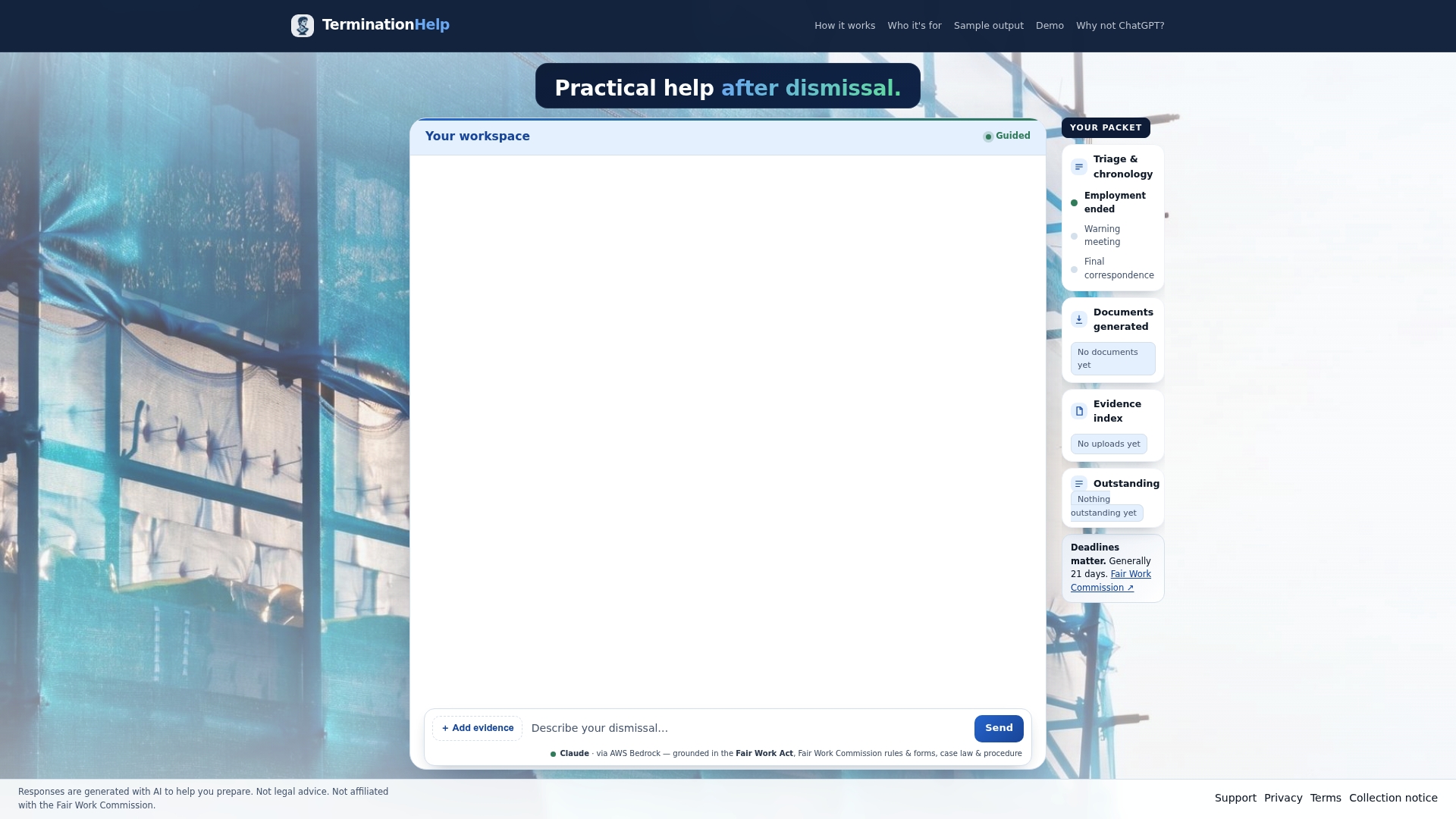
Small business owners responding to a claim, and lawyers or unions preparing member matters, can use the same workflow to keep material in order.
FAQ
How long does the Fair Work Commission process take?
There is no single answer, because it depends on whether the case settles. The Commission usually offers conciliation about 5 weeks after receiving your application, and many matters resolve there. Cases that go to a conference or hearing take longer, and an appeal adds further time.
Is the Fair Work Commission the same as the Fair Work Ombudsman?
No. The Commission is the national workplace relations tribunal that hears unfair dismissal applications, among other matters. The Ombudsman is a separate body that deals with compliance with workplace laws. Unfair dismissal applications go to the Commission.
Do I have to attend conciliation?
Conciliation is optional, as the Commission describes it. If you decline or it fails, the matter goes to a Member for decision. Going in prepared, with a clear view of what you would accept, gives you the best chance of a useful result.
Can I withdraw my application?
Yes. You can discontinue it, and a fee refund may be available if you do so before the matter is listed, or at least 2 days before the listed date. Check the Commission's current guidance before you rely on a refund.
Can I lodge if I am unsure whether I am eligible?
Yes, many people do, and the Commission can decide eligibility as a preliminary matter. But do not let uncertainty delay you past the 21 days. Lodge on time and sort out the eligibility questions with a lawyer, union or community legal centre.
Sources
- Unfair dismissal: can you apply? (Fair Work Commission)
- Can you apply (Legal Aid NSW)
- High income threshold (Fair Work Commission)
- Deadlines (Fair Work Commission)
- Timeframe for lodgment (Fair Work Commission)
- Forms (Fair Work Commission)
- Increase to the application fee for 2026-27 (Fair Work Commission)
- Fee refund bulletin (Fair Work Commission)
- The process for unfair dismissal claims (Fair Work Commission)
- Question? Ask us online (Fair Work Commission)
- Decision [2026] FWC 835 (Fair Work Commission)
- Compensation cap (Fair Work Commission)
Recommended
- Check Unfair Dismissal Eligibility in Australia: 21 days to lodge
- Australia: $95,050 payout cap and unfair dismissal remedies
- File an unfair dismissal claim in Australia within 21 days
- Employer obligations when dismissing an employee in Australia
Article produced using AI. This is not legal advice.