

Procedural fairness in a dismissal is about how an employer reached the decision to end your job, not only whether it had a reason. Under the Fair Work Act, the Fair Work Commission looks at whether you were told the reason, given a genuine chance to respond, and treated fairly through any investigation. A dismissal with a good reason can still be found unfair if the process was poor. This guide explains what that means for employees and for employers, step by step.
TL;DR
- Procedural fairness is the fairness of the process: notice of the reason, a real chance to respond, and a just investigation.
- The Commission weighs it alongside whether there was a valid reason related to capacity or conduct. A weak process can make an otherwise justified dismissal unfair.
- The reason must be given before the decision is made, and the chance to respond must be genuine, not a formality.
- Small businesses follow the Small Business Fair Dismissal Code instead of the usual process checks.
- If you were dismissed, you generally have 21 days to lodge an application, so organise your evidence early.
Table of Contents
- What procedural fairness means in a Fair Work dismissal
- The steps an employer should take before dismissing
- How the Commission treats procedural fairness in a claim
- What if you are an employee who thinks the process was unfair?
- Perspective: why process is where most claims are won or lost
- Small businesses: a different standard
- What happens if the dismissal is found unfair
- Getting your case ready
- FAQ
- Sources
What procedural fairness means in a Fair Work dismissal
In administrative and employment law, procedural fairness is sometimes called natural justice. It is concerned with how a decision that affects a person is reached, rather than with the answer itself. In an unfair dismissal case, the Commission considers whether there was a valid reason related to capacity or conduct, and whether the dismissal process and investigation were just, including whether the employee had a reasonable opportunity to respond.
The same page explains that a dismissal is broadly procedurally fair if the manner or process of dismissal, and the investigation leading to the decision, are just. The test is not whether the employer followed a perfect script. It is whether the process was fair enough that the employee knew what was being said against them and had a real opportunity to answer it.
Two points often get missed:
- Process and reason are separate questions. An employer can have a sound reason, such as repeated lateness, and still lose because it dismissed the employee on the spot without hearing their side.
- Unfairness is judged on the whole picture. The Commission weighs several factors together. Poor process does not automatically decide the case, but it often tips it.
The steps an employer should take before dismissing
The Commission's published guidance breaks procedural fairness into a few practical steps. They apply most obviously to dismissals for conduct or performance.
1. Tell the employee the reason, before deciding
An employee must be notified of the reason for termination before the decision is made, in explicit, plain and clear terms. Vague statements such as "it's not working out" do not do the job. The employee needs to understand precisely what conduct or performance problem is being relied on.
In practice that means putting the allegations in writing, with enough detail (what happened, when, and who was involved) for the person to respond sensibly.
2. Give a genuine opportunity to respond
The employee must be given an opportunity to respond to the reason before the termination decision is made. The Commission applies this in a common sense way. A short, informal meeting can be enough in a small workplace, while a serious allegation in a large organisation calls for more.
The word "genuine" matters. In Wadey v YMCA Canberra, Moore J said the opportunity to defend must be real: the employer must not have already made a firm decision to terminate regardless of what the employee says. A meeting held to announce a decision already made does not count.
3. Investigate fairly
Where a dismissal follows an allegation of misconduct, the investigation itself is part of the assessment. The Commission asks whether the investigation and the dismissal process were just. Useful habits include:
- keeping the investigator independent of the decision where possible;
- putting each allegation to the employee, not just the headline one;
- recording what the employee says and considering it;
- allowing a support person to attend meetings about the dismissal.
4. Warn about performance problems
If the issue is performance, employees are generally expected to be told that their job is at risk and given a fair chance to improve. A first-ever mention of poor performance in the dismissal meeting is difficult to defend.
5. Decide, and document
Only after hearing the response should the employer decide. A short written record of the allegations, the response and the reasoning is the best protection against a later claim, and it is exactly what the Commission will ask to see.
How the Commission treats procedural fairness in a claim
The usual path for a claim is an application, an optional conciliation, and, if unresolved, a Commission Member's decision, usually after a formal hearing or conference. The same page says three out of four unfair dismissal cases are resolved at conciliation, so the strength of your process argument often matters well before a hearing: it shapes what each side thinks the Commission would find.
When the Commission decides, it weighs the valid reason and the process together. Some situations show how the two interact:
| Situation | Valid reason? | Process | Likely concern |
|---|---|---|---|
| Employee caught stealing, dismissed after being shown the evidence and asked to explain | Yes | Fair | Low risk for the employer |
| Employee with a real performance problem, never warned, dismissed in one meeting | Arguably | Poor | Process may make the dismissal unfair |
| Employee told of allegations on the day and dismissed in the same meeting | Unclear | Poor | No genuine chance to respond |
| Employee dismissed on a reason never put to them | Unclear | Poor | Reason not notified before decision |
The table is a simplification. Each case turns on its facts, and the Commission looks at the full set of factors in the Act. If you want to understand how decisions are written and what to look for in them, our guide on how to read unfair dismissal case law walks through it.
What if you are an employee who thinks the process was unfair?
Start with the sequence of events. Write down, while it is fresh:
- When you first learned there was a concern, and how.
- What reason was given, by whom, and whether it was in writing.
- Whether you were offered a meeting, and whether you could bring a support person.
- What you said in response and whether anyone seemed to listen.
- When the decision was communicated, and whether it felt already made.
Keep emails, letters, messages, rosters, performance reviews and anything else that shows what you were told and when. Our page on employer obligations when dismissing an employee sets out what you can reasonably expect, which helps you test your own timeline against it.
Check you are eligible first
Procedural unfairness only helps if you can bring a claim at all. An employee must work for a national system employer, meet the minimum employment period, and either earn below the high-income threshold or be covered by an award or enterprise agreement. Contractors, unpaid volunteers and casuals without regular, systematic work and a good reason to expect it to continue are not protected.
The Fair Work Ombudsman states that you generally need six months' service, or 12 months for a small business. Independent contractors cannot make an unfair dismissal application. If your status is unclear, our eligibility check guide takes you through each requirement, and if your situation is complicated, speaking with a specialist in employment law representation can help you work out where you stand.
Watch the 21-day deadline
An employee applies to the Commission within 21 days of the dismissal. The Commission may extend the deadline only if exceptional circumstances caused the delay, for example serious illness, the death of a family member, or a lawyer's or paid agent's delay or error. Electronic lodgment is encouraged, and documents must be received by 11:59 pm on the deadline.
Do not spend your 21 days waiting for the employer to explain itself. Lodge, then keep gathering evidence. Our guides on the 21-day time limit and on how to file an unfair dismissal claim cover the practical steps.
Perspective: why process is where most claims are won or lost
We built Terminationhelp around Australian Fair Work claims only, and the pattern we see in how people describe their dismissals is consistent: the first question is "was it fair?" but the useful question is "what exactly happened, and in what order?" Procedural fairness is a sequence problem. Reason, notice, response, decision. If the order is wrong, or a step is missing, the argument is already there, but only if you can show it with dates and documents.

That is why our approach focuses on preparation: eligibility checks, evidence organised into a timeline, and the required Fair Work forms generated for the stage you are at, so you can file independently or bring a structured packet to a lawyer, union or community legal centre. Process arguments are won on specifics, and specifics are easiest to capture early, while emails are still in your inbox and memories are fresh.
For employers, the lesson runs the other way. Most process failures are cheap to avoid: a written allegation, a real meeting, a short record. The cost of skipping them is a claim that a good reason alone does not defend.
— Nicolas
Small businesses: a different standard
A small business employer has fewer than 15 employees, and regular and systematic casuals count towards that number, according to the Fair Work Ombudsman. Small businesses are not assessed on the usual process checklist if they follow the Small Business Fair Dismissal Code. Under the Act, a person has not been unfairly dismissed if the dismissal was consistent with the Code.
The Code treats serious misconduct differently. It is fair to dismiss without notice or warning when the employer believes on reasonable grounds that the conduct is serious enough to justify immediate dismissal. The Code describes serious misconduct as including theft, fraud, violence and serious breaches of occupational health and safety procedures. For other issues, the Code expects a warning and a chance to improve.
If you are a small business owner who has been named in a claim, the question is whether you can show you complied with the Code. Our guide to building a Commission-ready evidence file for the Code shows how to organise it.

What happens if the dismissal is found unfair
Procedural failures do not by themselves decide the remedy. If the Commission finds a dismissal unfair, it may order reinstatement, and compensation is considered only if reinstatement is inappropriate. When working out compensation, it considers the employer's enterprise viability, your length of service, your likely remuneration and your efforts to find other work.
That last factor catches people out, so start job-hunting records early. See our notes on mitigation of loss and the wider picture in unfair dismissal remedies.
Getting your case ready
Good preparation turns a feeling of unfairness into a clear account. If you want help with that, our preparation support walks you through eligibility, evidence and the forms for your stage.
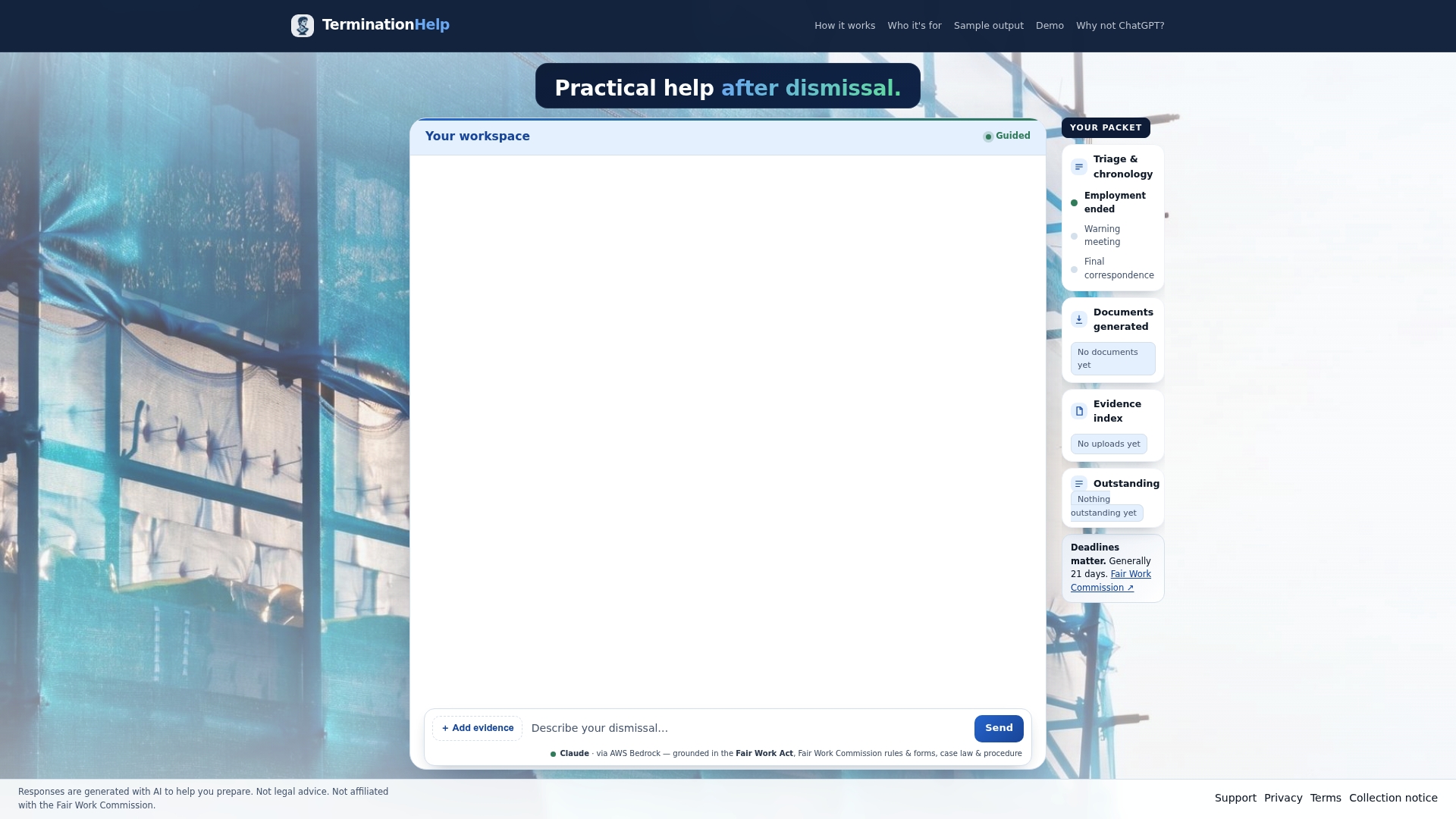
The Commission says people may use AI to prepare their case, but must tell the Commission and take care in how they use it. Our tool is bounded to Australian employment law and Fair Work Commission procedure, and it produces a structured packet for you to file yourself or hand to an adviser. You can see how it works on the Terminationhelp home page.
FAQ
Can a dismissal be unfair even if the employer had a good reason?
Yes. The Commission considers whether there was a valid reason and also whether the process and investigation were just. A solid reason handled through a poor process can still be found harsh, unjust or unreasonable, though the Commission weighs all factors together.
Does my employer have to warn me before dismissing me?
For performance concerns, a warning and a chance to improve are generally expected. For serious misconduct, particularly under the Small Business Fair Dismissal Code, an employer can dismiss without notice or warning if it reasonably believes the conduct justifies it. Either way, you should be told the reason and given a chance to respond.
What counts as a genuine opportunity to respond?
It is a real chance to answer the reason before the decision is made. If the employer had already decided to terminate whatever you said, the opportunity is not genuine. The Commission applies the requirement in a common sense way, so a brief conversation can suffice in a small workplace.
Is procedural fairness the same as natural justice?
They are closely related terms. Procedural fairness is sometimes called natural justice, and both concern the fairness of how a decision is made rather than the decision itself. In an unfair dismissal claim, the Commission assesses it through the factors in the Fair Work Act.
Sources
- Valid reason relating to capacity or conduct, Fair Work Commission
- Notification of reason for dismissal, Fair Work Commission
- Opportunity to respond, Fair Work Commission
- The process for unfair dismissal claims, Fair Work Commission
- Who the law protects from unfair dismissal, Fair Work Commission
- Unfair dismissal, Fair Work Ombudsman
- Unfair dismissal: can you apply?, Fair Work Commission
- Deadlines, Fair Work Commission
- What is the Small Business Fair Dismissal Code?, Fair Work Commission
- Compensation, Fair Work Commission
Recommended
- Unfair Dismissal Case Law in Australia: How to Read It
- Employer obligations when dismissing an employee in Australia
- Australia: $95,050 payout cap and unfair dismissal remedies
- 21 Days to Respond to Serious Misconduct Under Reg 1.07 in Australia
Article produced using AI. This is not legal advice.