

A modern award covers you when its coverage clause says it covers your type of work, your employer's industry and your classification, and no enterprise agreement or exclusion takes you out of it. For a dismissed worker, the answer matters because an employee earning above the high income threshold can only bring an unfair dismissal claim if an award or an enterprise agreement covers them. This guide shows how to work out which award applies, what happens when an agreement is in place, and how to record the answer so it supports a Fair Work claim.
TL;DR
- A modern award sets minimum pay and conditions for an industry or occupation, on top of the National Employment Standards (NES).
- Coverage turns on the award's coverage clause (usually clause 4), your duties and your classification, never on the award's title alone.
- If a registered enterprise agreement applies to you, the agreement is what counts, and the award generally drops out of the picture.
- For unfair dismissal, award or agreement coverage lets someone above the $190,100 high income threshold (for dismissals from 1 July 2026) still make a claim.
- Contractors are not covered by awards, but some have separate protections, including a route to challenge an unfair termination if they earn under the contractor threshold.
Table of Contents
- What modern award coverage actually means
- How to work out which award applies
- When an enterprise agreement applies instead
- Why coverage matters for unfair dismissal
- Casuals, probation and fixed-term staff
- Contractors and gig workers
- Recent changes that affect award coverage
- Recording your award coverage for a claim
- How Terminationhelp fits in
- Our view on award coverage
- FAQ
- Sources
What modern award coverage actually means
A modern award is a document that sets minimum terms and conditions of employment for an industry or occupation. The Fair Work Ombudsman explains that modern awards took effect on 1 January 2010 and cover matters such as pay, hours of work, rosters, breaks, allowances, penalty rates and overtime. They sit on top of the NES, the ten minimum entitlements that apply to every national system employee.
The Fair Work Act itself defines when an award covers someone. Under section 48 of the Fair Work Act 2009, a modern award covers an employee or employer if the award is expressed to cover them. It also covers a person where the Act, a Fair Work Commission (FWC) order or a court order has that effect, and it does not cover a person where one of those says it does not. An award that has stopped operating covers no one.
In plain terms, "coverage" is a yes-or-no question about your particular job. You might work in an industry that has an award and still not be covered by it. That is the part people get wrong.
What an award can regulate
Section 139 of the Act lists what a modern award may include. The main items are:
- minimum wages, including junior rates and rates for employees with a disability
- skill-based classifications and career structures
- types of employment, such as full-time, part-time, casual and shift work
- hours of work, rostering and rest breaks
- overtime and penalty rates
- allowances, leave and leave loadings
- superannuation
- consultation, representation and dispute settlement procedures
The last item matters in a dismissal. Many awards contain a dispute resolution clause and notice or termination provisions, and your award's terms can shape what your employer owed you on the way out.
How to work out which award applies
The Fair Work Ombudsman's award classifications page sets out the method. It is worth following in order, because skipping a step is how people end up reading the wrong award.
- Start with the employer's main industry and the work you do. Most awards are industry-based, and the Ombudsman's About awards page says industry awards should generally be considered before occupational ones. An occupational award follows the type of work you do, wherever you do it.
- Read the coverage clause. It is usually clause 4 and states who the award covers and who it does not.
- Check the exclusions. Many awards exclude certain roles, such as managers, or work that another award handles.
- Match your duties to a classification. Every award has a classification structure with levels and descriptions. Your actual duties decide your level, not your job title.
- Ask whether a different award fits better. Coverage depends on industry and type of work, and the award's name is not a reliable guide.
The Fair Work Commission's Find an award page points to the Fair Work Ombudsman's A to Z list of awards and its Pay and Conditions Tool, which lets you search by occupation or industry. If you are unsure, start there.
One workplace, more than one award
An award that covers a business may not cover every person in it. The Fair Work Ombudsman's guidance for businesses unsure of their award gives an example: a construction business whose carpenters are covered by the Building and Construction award may have office staff covered by the Clerks award. So a worker in the front office and a worker on site can be under different awards, with different rates and different classification levels.
A worked example
Priya works as an administration assistant for a plumbing company. She assumes the plumbing award applies because of the company's industry. Reading the coverage clauses, she finds the plumbing award is limited to plumbing trade work, while her duties (invoicing, scheduling, answering phones) fit a classification in the clerical award. She also checks that her role is not listed in the exclusions. Her answer is the clerical award at the level matching her duties. That one finding changes her minimum rate, her penalty rates and the dispute clause she can point to.
Write your own version of this reasoning down, with the clause numbers. It becomes useful evidence if the dismissal ends up before the Commission.
When an enterprise agreement applies instead
An enterprise agreement is a deal for one business or a group of businesses, reached through bargaining and approved by the FWC. The Fair Work Ombudsman states that awards do not apply when there is an enterprise agreement in place, and that an employment contract applies in addition to an award or agreement but cannot provide less than the NES or the minimum in the award or agreement.
Two details are worth knowing. First, the Modern awards fact sheet says that if an agreement's base rates are lower than the relevant award's, the award's base rates apply. Second, an employee covered by neither an award nor a registered agreement is called "award and agreement free". Their minimum terms come from the National Minimum Wage and the NES.
For your records, that gives three possible answers: an award covers you, an agreement applies to you, or you are award and agreement free. Each answer has a different consequence for your pay and, as the next section shows, for your right to claim.

Why coverage matters for unfair dismissal
Unfair dismissal protection has several gates. Section 382 of the Fair Work Act says a person is protected if they are an employee who has completed the minimum employment period and one of these is true:
- a modern award covers them
- an enterprise agreement applies to their employment
- their annual rate of earnings is below the high income threshold
The Fair Work Commission's guide adds that a dismissal is not unfair if it was a genuine redundancy or, for a small business employee, consistent with the Small Business Fair Dismissal Code. The high income threshold rose to $190,100 for dismissals on or after 1 July 2026. It is adjusted each 1 July, so check the Commission's page for the figure that applies to your dismissal date.
What this means in practice
Most people earn under the threshold, so for them the award question does not decide eligibility. They still need to satisfy the minimum employment period and the other requirements. Our guide to checking unfair dismissal eligibility walks through those and the 21-day deadline.
Coverage becomes decisive for higher earners. A senior employee on $210,000 who is covered by an award still has the right to apply. The same person with no award and no agreement does not. If you are near the line, our article on the high income threshold explains how earnings are counted.
The Commission has applied this logic in practice. In Cheikho v Insurance Australia Group Services Limited (21 July 2023), the applicant was found protected because she had almost 18 years of service and an enterprise agreement applied to her employment.
Do not let coverage delay your filing
The deadline to lodge an unfair dismissal application is 21 days after the dismissal takes effect. Working out your award can wait for a day or two, but lodging cannot. Gather the clause references while you prepare, and treat the coverage answer as one part of the file, not a precondition for starting it.
Casuals, probation and fixed-term staff
Award coverage and the casual or probationary status of a worker are separate questions. A casual employee can be covered by an award, which often sets out casual loadings and notice rules, but to claim unfair dismissal they must also show regular and systematic employment with a reasonable expectation of ongoing work. Our guide on evidence casual employees need covers that.
For workers still in their first months, the minimum employment period is the gate, not the award. See the three checks for a probation claim. For those on a set term, fixed-term contracts and unfair dismissal explains how an ending can still count as a dismissal.
Contractors and gig workers
Awards cover employees, so a genuine independent contractor is not covered. The Fair Work Ombudsman says contractors' pay and conditions come from their contract. They do not receive minimum pay rates or paid leave, but they do have some Fair Work Act protections, including protection from adverse action and coercion.
Two groups have more. From 26 August 2024, the FWC can make minimum standards orders or guidelines for employee-like workers (such as some digital platform workers) and regulated road transport contractors. A contractor is employee-like if they meet the statutory definition, which includes having two or more of: low bargaining power, pay at or below what an employee would receive, and little authority over how the work is done.
There is also a remedy for unfair termination or deactivation, but it has a ceiling. The Commission states the contractor high income threshold for the year starting 1 July 2026 is $190,100, and contractors above it cannot apply.
If you are unsure whether you are an employee or a contractor, settle that first. The answer decides whether any award can cover you at all. Misclassified workers often find that the label in their contract does not match how the work is actually done.

Recent changes that affect award coverage
Two changes are worth knowing. The Fair Work Ombudsman's industrial relations timeline records that the Fair Work Amendment (Protecting Penalty and Overtime Rates) Act 2025 took effect from 30 August 2025, requiring the FWC to ensure award penalty and overtime rates are not reduced. It also records the Closing Loopholes No. 2 Act 2024, which changed rules on casual employment, the definition of employment, independent contractors, sham contracting and minimum standards for employee-like workers, with many changes starting on 27 February 2024 and others in August 2024 or early 2025.
Award terms are also reviewed and varied from time to time, so use the current version of the award and check which version applied on the date of your dismissal.
Recording your award coverage for a claim
A clear coverage note takes about half an hour and saves confusion later. Include:
- your employer's name, main industry and your actual duties
- the award or agreement you believe applies, with the clause 4 wording that fits you
- the classification level and why it matches your duties
- any exclusion you checked and why it does not apply
- your pay slips and contract, so the rate can be compared with the award rate
- your annual earnings, in case the high income threshold is in play
Employers facing a claim need the same record. A small business owner who has been named in an application should be able to show which award or agreement covered the employee and that dismissal steps followed the Small Business Fair Dismissal Code where it applies. Our guide on employer obligations when dismissing and the article on procedural fairness in dismissal cover the steps.
How Terminationhelp fits in
When a dismissal has happened, the award question is one of many that need an organised answer, and the clock is running. Terminationhelp is an AI-powered preparation tool built only for Australian unfair dismissal and Fair Work claims. It guides you step by step through eligibility checks, helps you organise your evidence, lets you upload documents and generates the Fair Work forms needed at each stage, with timelines. The result is a structured packet you can file yourself or take to a lawyer, union or community legal centre.
Its content is grounded in Australian legislation, Fair Work Commission rules and case law, and it is designed to keep user data onshore and never use it to train AI. Pricing is a one-time payment per matter, and the details are on the preparation support page.
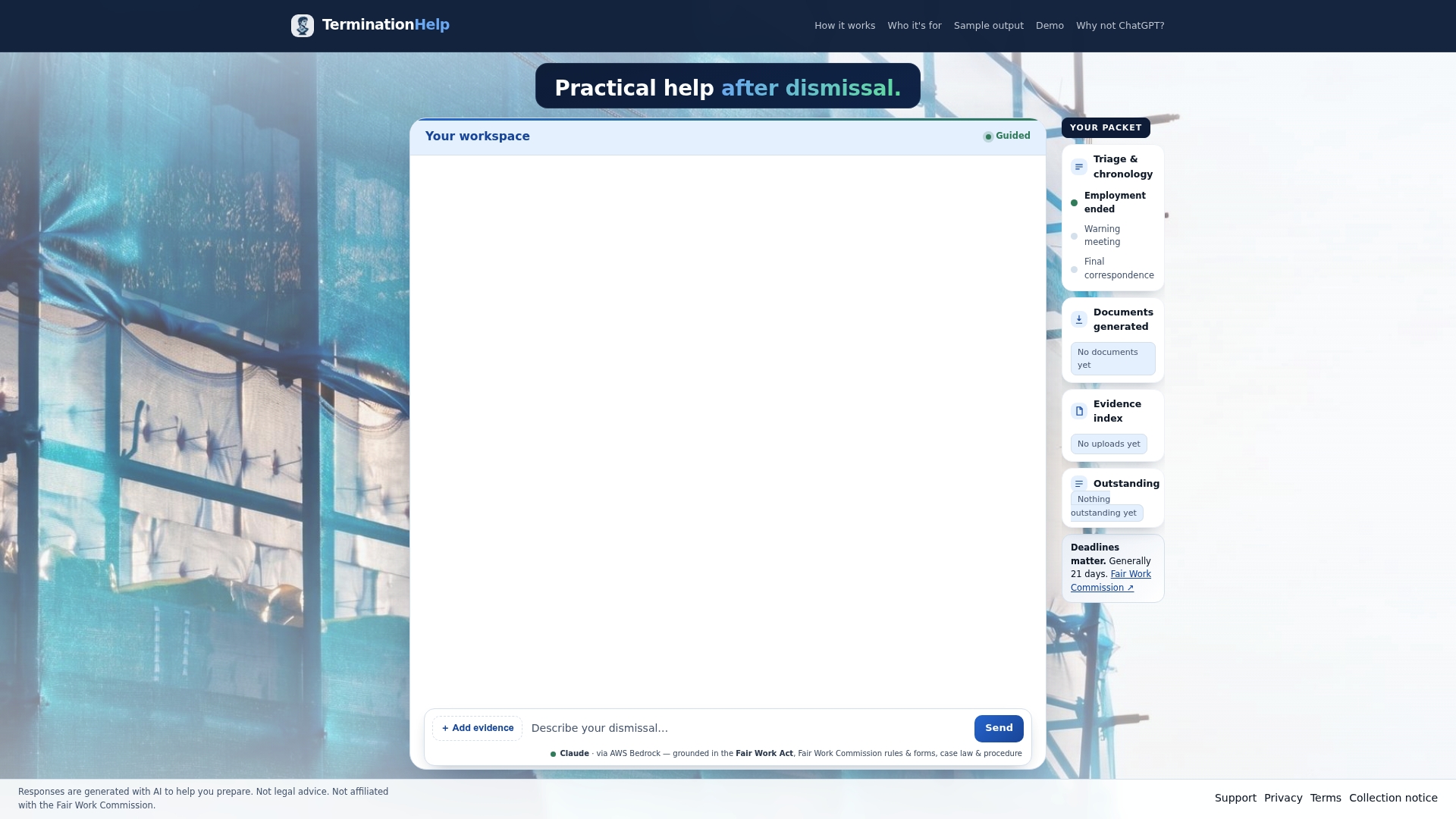
Lawyers, unions and businesses can also use the service to prepare matters for clients or members.
Our view on award coverage
Most of the confusion we see around awards comes from treating coverage as a label. People say, "I'm in retail, so the retail award applies," and stop there. Coverage is a reading exercise: the clause, the exclusions, the classification, and whether an agreement displaces it.
That matters because a Fair Work claim is built on documents. An application that sets out the facts in order, with the right provisions identified, is easier for everyone to follow, including you when you are under stress and counting days against a 21-day deadline.
We built Terminationhelp around Australian law only, so the eligibility check, the evidence and the forms all work from the same Australian sources rather than a generic template. Our aim is that you reach the Commission, a lawyer or a union with a clear, organised file, not a pile of emails.
Nicolas
FAQ
Can I claim unfair dismissal if no modern award covers me?
Yes, if you earn less than the high income threshold and meet the other requirements, including the minimum employment period. Award or agreement coverage only becomes essential when your earnings are above the threshold, which is $190,100 for dismissals on or after 1 July 2026.
Does my job title decide which award applies?
No. Coverage depends on the employer's industry, the work you actually perform and the classification that fits those duties. Read the coverage clause and exclusions, and do not rely on the award's name or your title.
What if my employer says an enterprise agreement applies, not an award?
If a registered enterprise agreement applies to you, the award generally does not apply, and the agreement sets your conditions. The agreement's base rates cannot fall below the relevant award's base rates. Ask for a copy of the agreement and keep it with your records.
Are independent contractors covered by modern awards?
No, awards cover employees. Contractors rely on their contract and certain Fair Work Act protections, and some, such as employee-like platform workers, can benefit from FWC minimum standards. If you think you are really an employee, resolve that question first.
Does the award change the 21-day deadline?
No. The 21-day limit for unfair dismissal applications runs from the date the dismissal took effect, whichever award or agreement covers you. Start the application while you confirm the award.
Sources
- Modern awards fact sheet, Fair Work Ombudsman
- Fair Work Act 2009 s 48, AustLII
- Fair Work Act 2009 s 139, AustLII
- Award classifications, Fair Work Ombudsman
- About awards, Fair Work Ombudsman
- Find an award, Fair Work Commission
- I'm not sure which award covers my business, Fair Work Ombudsman
- Fair Work Act 2009 s 382, AustLII
- Who is protected from unfair dismissal, Fair Work Commission
- Increase to the application fee for 2026-27, Fair Work Commission
- Cheikho v Insurance Australia Group Services Limited, Fair Work Commission
- Contractor entitlements and support, Fair Work Ombudsman
- Minimum standards for contractors, Fair Work Ombudsman
- Contractor high income threshold, Fair Work Commission
- Australia's industrial relations timeline, Fair Work Ombudsman
Recommended
- Commission Ready Evidence File for Small Business Fair Dismissal Code
- Unfair dismissal particulars: what to set out in your claim
- Genuine redundancy: evidence for an Australian unfair dismissal claim
- Alternative Dispute Resolution at the Fair Work Commission
Article produced using AI. This is not legal advice.