

The high income threshold for unfair dismissal claims is $190,100, applying from 1 July 2026 to 30 June 2027. If you earn at or above this amount and you're not covered by a modern award or enterprise agreement, you generally cannot apply for unfair dismissal, and the related compensation cap sits at half that figure.
TL;DR:
- Count base salary, guaranteed overtime, guaranteed allowances, and valued noncash benefits; exclude discretionary bonuses, commissions that are not guaranteed, superannuation, and expense reimbursements.
- A modern award or enterprise agreement preserves eligibility above the earnings limit; casual employees must also meet regular, systematic service and minimum employment requirements.
- File within 21 days of the dismissal taking effect, not written notice; late applications require exceptional circumstances, such as serious illness or genuine date confusion.
- Minimum service varies by employer size, while probation, sick leave, and pressured resignation can affect when the dismissal is treated as taking effect.
- For dismissals from July 1, 2026, compensation is capped at the lower of 26 weeks’ pay or $95,050, while reinstatement remains available.
Table of Contents
- What the high income threshold is and why it matters under the Fair Work Act
- How to calculate your 'annual rate of earnings': what counts and what doesn't
- Exceptions and edge cases: awards, enterprise agreements, contractors and casuals
- Eligibility and procedural time limits: minimum service, the 21 day deadline, and late applications
- Remedies and limits: compensation caps, reinstatement and alternatives
- How to check your status and gather the evidence the FWC expects
- Key decisions and regulations that practitioners rely on
- Publisher perspective: why a focused preparation pack matters for high income applicants
- How Terminationhelp's preparation support can help you prepare a Fair Work application
- FAQ
- Sources
- Official pages and decisions to check
What the high income threshold is and why it matters under the Fair Work Act
The high income threshold is a dollar figure set under the Fair Work Act that determines whether certain employees can access the unfair dismissal jurisdiction. The Fair Work Commission adjusts it every year on 1 July, so the figure that applied last financial year is not the one that applies now.
Three practical consequences flow from where your earnings sit against the threshold:
- It acts as a jurisdictional barrier: if you earn above the threshold and no award or enterprise agreement covers you, you're generally shut out of an unfair dismissal claim.
- It caps compensation: the maximum payout is the lesser of 26 weeks' pay or half the high income threshold, whichever is smaller.
- It affects guarantee of annual earnings arrangements and fixed term contract exceptions, both of which rely on the same figure.
Because the amount changes annually, always check the current figure directly with the Fair Work Commission before relying on a number you've seen elsewhere.
How to calculate your 'annual rate of earnings': what counts and what doesn't
Work out whether you're above or below the threshold is not as simple as checking your payslip total. Fair Work Regulations reg 3.05 sets out how to work out these amounts, including rules for piece rates and for estimating a notional value where benefits aren't paid in cash.
The calculation is narrower than your total remuneration package. Fair Work Commission guidance confirms what counts and what doesn't:
- Included: base salary, guaranteed overtime, and allowances that are guaranteed rather than conditional.
- Excluded: discretionary bonuses, commissions that aren't guaranteed, compulsory superannuation contributions, and reimbursements of actual expenses.
A 2026 Fair Work Commission decision, David Taylor v BAAM Property Group Pty Ltd, shows how contested this can get. The Commission had to work out whether certain bonus payments were guaranteed enough to count as earnings for threshold purposes, rather than discretionary payments that sit outside the calculation.
This matters because many salary packages blend a base rate with variable components. A worker on a substantial base salary with a discretionary bonus bringing their total package above the threshold may still sit below it, because only the guaranteed component counts. Where an employer offers non-cash benefits, such as a vehicle or equipment, the Commission can estimate a notional money value for them rather than ignoring them entirely.

Exceptions and edge cases: awards, enterprise agreements, contractors and casuals
Earning above the threshold doesn't automatically end your options. If a modern award or an enterprise agreement covers your role, you keep access to unfair dismissal protection regardless of how much you earn.
A few situations create confusion:
- Contractors: the contractor high income threshold is aligned with the standard high income threshold and is used as a benchmark in assessing certain remedies where a contracting relationship is in dispute, though contractors first need to establish they were genuinely employees to access unfair dismissal at all.
- Casual employees: casuals can claim unfair dismissal, but only once they've worked on a regular and systematic basis and meet the minimum employment period.
- Award coverage trumps earnings: a highly paid employee covered by an award isn't excluded just because their pay exceeds $190,100.
If you're a casual employee working out whether you qualify, our evidence checklist for casual employees sets out what you'll need to show regular and systematic engagement.
Eligibility and procedural time limits: minimum service, the 21 day deadline, and late applications
Even if you're under the threshold or covered by an award, three procedural hurdles apply before the Fair Work Commission will hear your claim.
- Lodge within 21 days of your dismissal taking effect. The Commission can accept a late application only in exceptional circumstances, such as a serious illness or genuine confusion about when the dismissal occurred.
- Meet the minimum employment period, which varies depending on whether the employer is a small business or another employer.
- Check how your situation is classified. Probation, sick leave, and a forced resignation can each affect when a dismissal is treated as having occurred, which in turn affects both deadlines above.
Pro Tip: Diarise the 21 day deadline from the date your dismissal takes effect, not the date you receive written confirmation, as these can differ by several days.
If you resigned under pressure, that may still count as a dismissal for these purposes rather than a voluntary resignation, which changes whether the clock has started at all.
Remedies and limits: compensation caps, reinstatement and alternatives
Where a claim succeeds, the Fair Work Commission has two primary remedies available: reinstatement to your former role, or compensation in place of it. A separate general protections claim is a different legal pathway entirely, used where the dismissal relates to a workplace right rather than unfairness alone.
- Compensation is capped at the lesser of 26 weeks' pay or half the high income threshold.
- For dismissals from 1 July 2026, that compensation cap is $95,050.
- Reinstatement is ordered less often than compensation, mainly because the employment relationship has usually broken down by the time a matter reaches a decision.
The Commission weighs practical factors, such as whether trust between you and your employer can realistically be rebuilt, before ordering reinstatement. Most matters that don't settle at conciliation end up resolved through a compensation order rather than a return to the job.
How to check your status and gather the evidence the FWC expects
Before lodging, work through these steps so you're not caught out on a jurisdictional technicality.
- Confirm whether a modern award or enterprise agreement covers your role, since this can override the threshold entirely.
- Calculate your annual rate of earnings at the date of dismissal, counting only guaranteed components.
- Strip out discretionary bonuses, non-guaranteed commissions, superannuation and reimbursements from that figure.
Collect your employment contract, recent payslips, any bonus or commission agreements, a payroll breakdown, and records of allowances such as a vehicle allowance.
Pro Tip: Ask your employer in writing for a breakdown of your guaranteed versus discretionary pay components. A written confirmation from them carries more weight than your own estimate if the calculation is disputed.
Our evidence checklist for high income earners walks through this in more detail.
Key decisions and regulations that practitioners rely on
Four statutory hooks underpin most threshold disputes: section 332 (what counts as earnings), section 333 (annual rate of earnings), section 382 (unfair dismissal protection generally), and reg 3.05 (how to calculate the amounts).
- David Taylor v BAAM Property Group Pty Ltd shows how bonus characterisation can shift a worker above or below the line.
- Section 382 sets the eligibility test itself, while regs 2.13 and 3.05 supply the calculation mechanics.
Either side can raise these provisions in a jurisdictional objection before the substance of a dismissal is even considered.
Publisher perspective: why a focused preparation pack matters for high income applicants
Jurisdictional objections based on the high income threshold are among the fastest ways a claim stalls before it's heard on its merits. The applicants who move through conciliation fastest are the ones who arrive with their earnings calculation already documented, not the ones who discover the dispute mid-hearing.
Preparation support, including what we build, compiles the relevant forms and evidence and maps them against the statutory points above. It doesn't replace legal advice or court representation, and a borderline threshold calculation often still benefits from a second opinion from a lawyer or your union before you lodge.
— Nicolas
How Terminationhelp's preparation support can help you prepare a Fair Work application
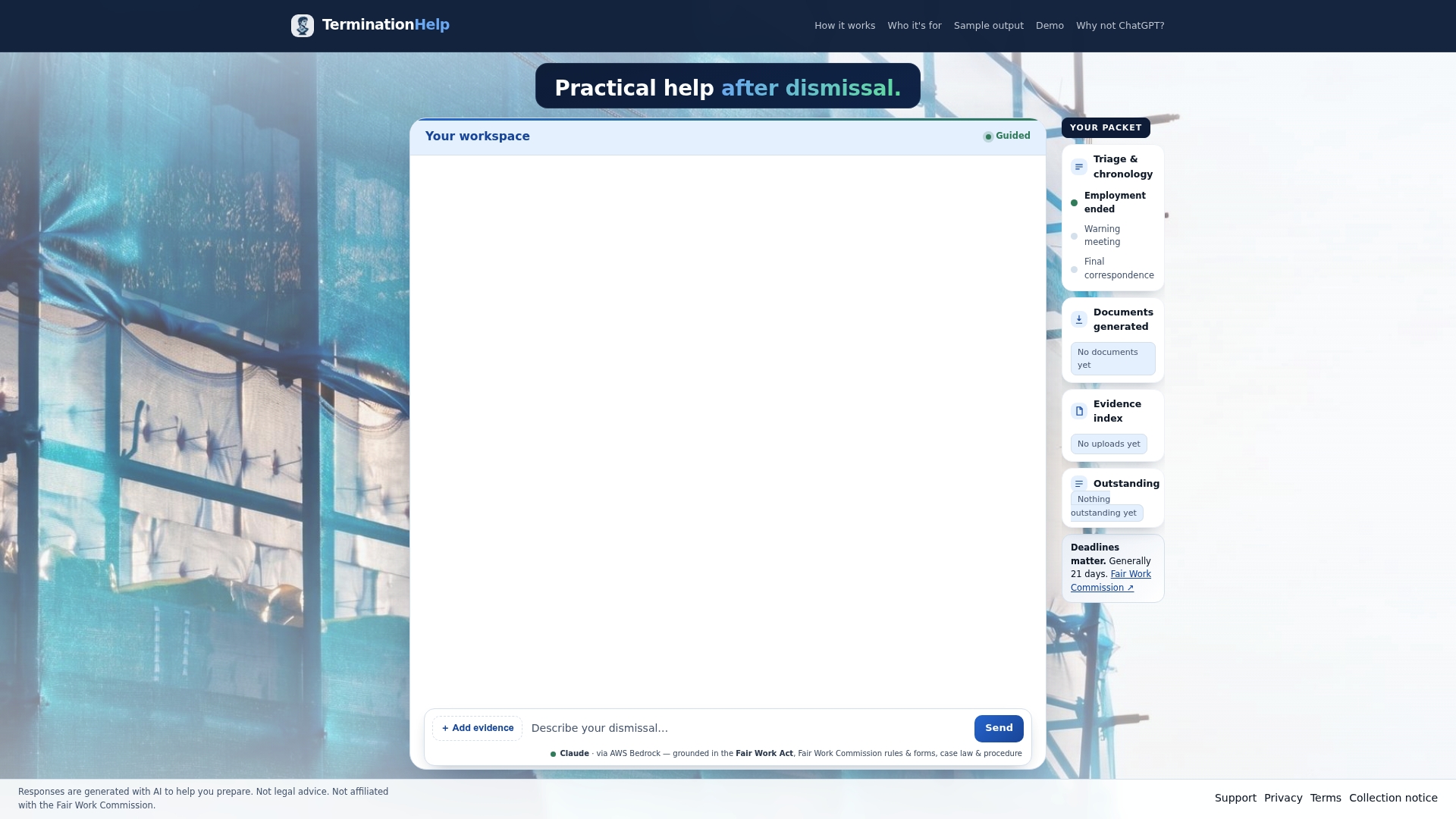
If you're above or near the $190,100 threshold and unsure whether you qualify, our Preparation support service helps you check eligibility and organise your payslips, contract and allowance records.
Once you purchase, we guide you through uploading your documents, generate the Fair Work forms your matter requires, and produce an FWC ready packet you can lodge yourself or hand to a lawyer, union or community legal centre. Our workflows stay grounded in Australian Fair Work legislation and current Commission procedure, and we focus on preparation rather than legal representation. If your earnings calculation is contested, start with a clear packet rather than a guess: check your eligibility now.
This article is general information, not a substitute for advice from a qualified lawyer. Consult a qualified legal professional about your own circumstances before acting on anything here.
FAQ
What is the income tax threshold in Australia?
The income tax threshold is a separate concept from the high income threshold and refers to the tax free amount under Australian income tax law, not the Fair Work eligibility figure discussed in this article. For current income tax brackets, check the Australian Taxation Office rather than Fair Work sources.
What is the salary threshold for unfair dismissal?
The salary threshold, properly called the high income threshold, is $190,100 for dismissals between 1 July 2026 and 30 June 2027. Earning above this figure without award or enterprise agreement coverage generally removes access to an unfair dismissal claim.
What qualifies as low income in Australia?
There's no single legal definition of "low income" tied to unfair dismissal eligibility: it's a general economic term used in tax and welfare contexts rather than a Fair Work threshold. For unfair dismissal purposes, what matters is whether your earnings sit below the $190,100 high income threshold or whether an award or agreement covers you regardless of pay.
Can I claim unfair dismissal if I earn above the threshold?
Yes, if a modern award or enterprise agreement covers your role, your earnings don't exclude you from an unfair dismissal claim regardless of how far above $190,100 you sit. Without that coverage, you'll generally need to show your guaranteed earnings actually fall below the threshold once discretionary bonuses and non-guaranteed commissions are stripped out.
How is the compensation cap calculated?
The cap is the lesser of 26 weeks of your pay or half the current high income threshold, which works out to $95,050 for dismissals from 1 July 2026. The Commission applies whichever of the two figures is smaller in your specific case.
Sources
- High income threshold | Fair Work Commission
- [FAIR WORK REGULATIONS 2009 — REG 3.05 When a person is protected from unfair dismissal--high income threshold](https://www.austlii.edu.au/cgi-bin/viewdoc/au/legis/cth/consol_reg/fwr2009223/s3.05.html)
- David Taylor v BAAM Property Group Pty Ltd 2026 FWC 1002 (24 March 2026)
Official pages and decisions to check
- High income threshold | Fair Work Commission
- Fair Work Regulations 2009, reg 3.05
- David Taylor v BAAM Property Group Pty Ltd [2026] FWC 1002
- Unfair dismissal | Fair Work Commission
- Check unfair dismissal eligibility: 21 days to lodge
- $190,100+ earners: protect your FWC claim with this evidence checklist
Recommended
- $190,100+ Earners: Protect Your FWC Claim With This Evidence Checklist
- Check Unfair Dismissal Eligibility in Australia: 21 days to lodge
- Australia: $95,050 payout cap and unfair dismissal remedies
- Australia FWC Checklist: General Protections Claim, Forms & Causation
Article produced using AI. This is not legal advice.