

A jurisdictional objection is an employer's argument that the Fair Work Commission has no power to hear your unfair dismissal claim at all, or that you are not eligible to make it. It is not an argument about whether the dismissal was fair. It is a threshold question, and if the employer wins it, your application is dismissed before anyone looks at the merits. This guide explains what employers can object to, when the Commission decides it, and how to prepare a response.
TL;DR
- A jurisdictional objection challenges your right to bring the claim (employee status, minimum service, casual status, lodgement time, the right employer). It does not challenge the fairness of the dismissal.
- Employers raise it in their response to your application, and the Commission's form asks the employer whether it has any jurisdictional or other objections.
- If the Commission upholds the objection, the application is dismissed. If it does not, the claim carries on to the merits.
- The strongest response is evidence: contracts, payslips, rosters, emails and a clear timeline, gathered before the employer's response arrives.
- Late applications are the one objection heard before conciliation.
Table of Contents
- What a jurisdictional objection actually is
- Jurisdictional objection or merits: the difference
- The objections employers most often raise
- Resigned or dismissed: a common dispute
- When and how the Commission decides the objection
- What happens if the objection succeeds or fails
- How to respond to a jurisdictional objection
- If you are the employer
- Preparing the objection response with Terminationhelp
- Perspective
- FAQ
- Sources
What a jurisdictional objection actually is
The Commission is a creature of statute. It can only hear an unfair dismissal claim if the person applying meets certain conditions set by the Fair Work Act 2009. Those conditions are the "jurisdiction". When an employer says you fall outside them, that is a jurisdictional objection.
The Commission's own guidance says an employer may object if it believes the Commission lacks jurisdiction or the applicant is ineligible. Employers commonly raise it in the response form (Form F3), which asks directly whether there are any jurisdictional or other objections.
Think of it as a gate. Until you are through it, nobody will ask whether the employer had a valid reason to dismiss you, or whether the process was fair.

Jurisdictional objection or merits: the difference
This is where many applicants get confused, so it is worth separating the two questions clearly.
| Jurisdictional objection | The merits | |
|---|---|---|
| Question asked | Are you allowed to bring this claim? | Was the dismissal harsh, unjust or unreasonable? |
| Examples | Not an employee, under minimum period, out of time, wrong employer | Valid reason, notice of the reason, chance to respond, warnings |
| Who raises it | The employer | Both sides argue it |
| If the employer wins | Application dismissed | Application dismissed, or remedy ordered if you win |
On the merits, the Act sets out what the Commission must take into account, including whether there was a valid reason related to capacity or conduct and whether you were notified of it. Those are fairness questions. A jurisdictional objection never gets to them. You can have a dismissal that was plainly unfair and still lose if you are out of time or the Commission finds you were not an employee.
If you want to understand the overall sequence, our step-by-step guide to the Fair Work Commission process shows where the objection sits.
The objections employers most often raise
The Commission lists the grounds an employer can object on. According to its guidance, the employer can say that the applicant was not an employee or a national system employee, was not a qualifying regular casual, did not meet the minimum employment period, earned above the high income threshold without award or agreement coverage, or applied against an entity that was not the employer. Lodgement time is the other classic ground. Each is worth understanding.
Not an employee
This arises for contractors, gig workers and anyone engaged through an ABN. The employer says you ran your own business and so cannot claim unfair dismissal.
The Commission looks at the whole relationship, not just the label in the contract. Government material on the Closing Loopholes reforms describes an interpretive principle, due to commence on 26 August 2024 or earlier by proclamation, that considers the totality of the relationship, not only the contract terms, in deciding whether someone is an employee.
Our guide to the whole of relationship test for contractors and employees walks through the indicators.

Minimum employment period
An employee generally must have worked at least six months, or 12 months if the employer is a small business. Employers raise this against people dismissed during a probation period or soon after starting. Probation does not remove the right on its own: what counts is the length of service and the size of the employer. We cover the detail in our guide to the minimum employment period and the probation checks.
The small business question matters here. Whether the employer counts as a small business changes whether you need six or 12 months, so employers sometimes dispute headcount as well as your start date.
Casual employment
The objection here is that you were not a qualifying regular casual. Casuals can claim, but the Commission's objection list specifically includes the argument that the applicant was not a qualifying regular casual. Rosters, shift history and evidence of regular, ongoing work are the core of your answer. Our guide on casual employees and unfair dismissal explains what evidence to collect.
High income threshold
If your earnings exceed the high income threshold, you can claim only if an award or enterprise agreement covers you. The threshold is indexed each year, so check the current figure on the Commission's website for the date of your dismissal rather than relying on an old number.
Wrong employer
The employer may say the entity you named is not your employer. This is common with labour hire, franchises and corporate groups. Check your payslips and contract for the exact legal name, and the ABN, of who paid you.
Out of time
An application must be lodged within 21 days after the dismissal takes effect. The Commission may allow more time only in exceptional circumstances. Our pages on the 21-day time limit and on how to file within 21 days explain how the clock runs.
Resigned or dismissed: a common dispute
Some objections are really about whether there was a dismissal in the first place. The employer says you resigned. You say you were pushed out. Because only a person who has been dismissed can claim, this is a threshold issue as well. The question is whether you resigned voluntarily or whether the employer's conduct left you with no real choice. Keep the resignation email, any messages that preceded it, and notes of meetings, because the way the exchange unfolded is the evidence.
When and how the Commission decides the objection
The Commission determines objections at a conference or hearing. It may require the employer to provide evidence or submissions, and it may hear the objection separately from the merits or together with them.
Timing depends on the objection:
- A hearing about a late application takes place before voluntary conciliation.
- Other objections are usually heard after conciliation.
- Most are dealt with during the main hearing.
This means a jurisdictional objection does not necessarily stop the process in its tracks. In most cases you will still go through conciliation, and the objection is decided later, often alongside the merits.
What happens if the objection succeeds or fails
The outcomes are simple. If the Commission upholds the objection, the application is dismissed. If it does not, the application continues, with the merits dealt with separately or in the same hearing.
So a failed objection does not mean you have won. It means you have cleared the gate and can argue that the dismissal was harsh, unjust or unreasonable.
How to respond to a jurisdictional objection
- Read the objection precisely. Identify which ground the employer relies on. A vague line in a form is often followed by detailed material later.
- Match evidence to that ground. For employee status, gather contracts, invoices, rosters, uniforms, tools supplied, and who controlled your work. For minimum period, gather your offer letter, first payslip and last day. For casual status, gather shift history.
- Show the whole relationship. In a contractor dispute, a Commission decision explains that an applicant should present evidence that the totality of the relationship was employment rather than a business-to-business contract, looking at control and integration into the employer's business, and asking whether the person was truly running their own business.
- Build a dated timeline. Dismissal date, lodgement date, key conversations. It answers time and resignation disputes at once.
- Be ready to file witness material and submissions on time. The Commission can require the employer to provide evidence, and it will usually set directions for you as well.
- Read similar decisions. Our guide to reading unfair dismissal case law shows how to find and use them.
If you are the employer
Small business owners who have been named in a claim should note the Commission's own point: an objection is raised in the response, and the Commission may require you to provide evidence or submissions. Raise every genuine objection at the start, support each with documents, and keep your own records of how the employee was engaged and paid. Our overview of employer obligations when dismissing an employee covers the process side.
Preparing the objection response with Terminationhelp
Objections turn on documents and dates, and that is where most people struggle. Terminationhelp is an AI-powered preparation tool built only around Australian unfair dismissal and Fair Work procedure. It checks eligibility, helps organise your evidence, generates the Fair Work forms you need at each stage, and produces a structured packet you can file yourself or take to a lawyer, union or community legal centre.
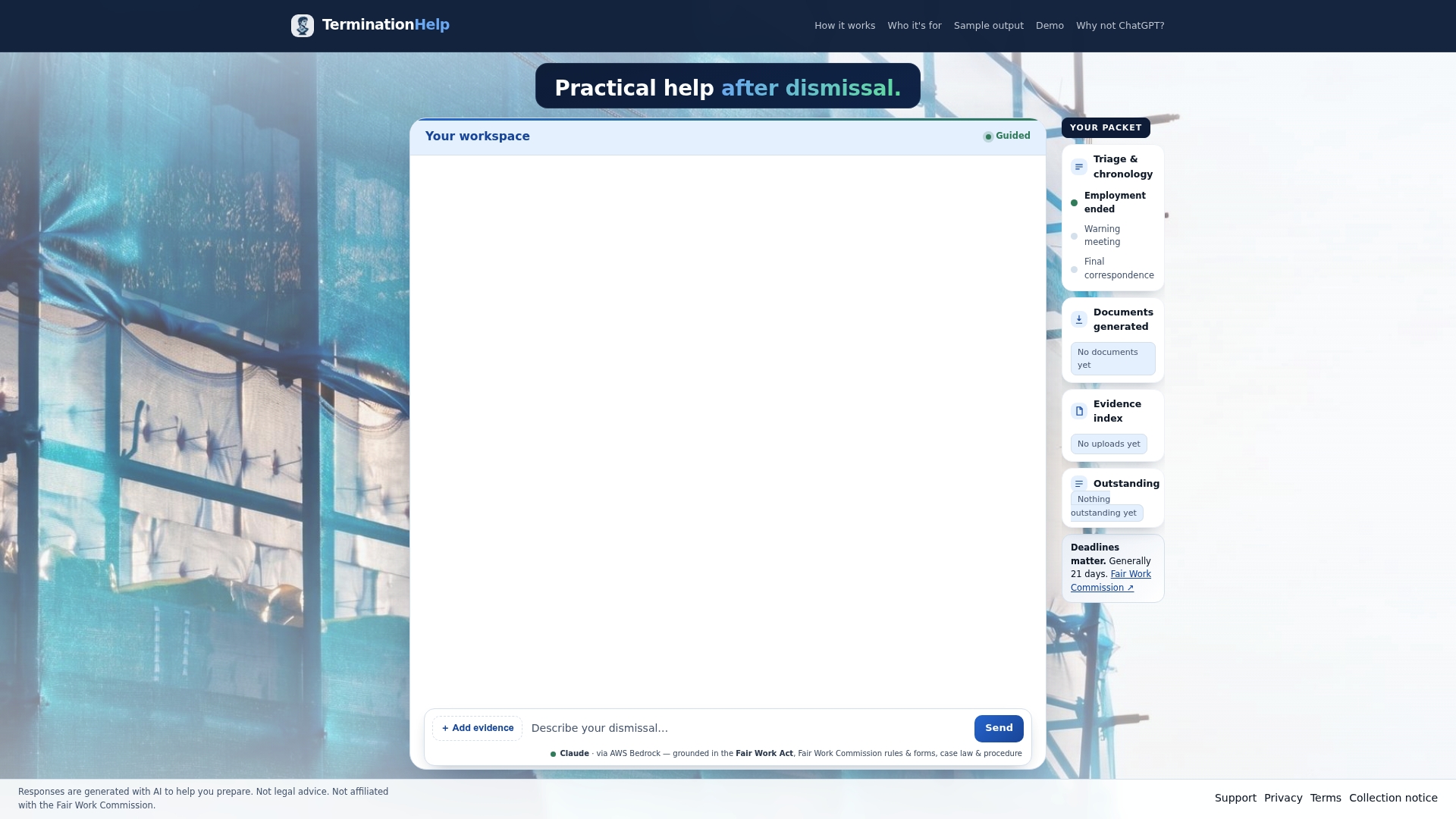
If you have received an objection, or want to know before you file whether one is likely, you can start with our preparation support. Pricing is not published on the page, so check it there for your matter.
Perspective
Most people who lose an unfair dismissal claim on a threshold point never really lost the argument about fairness. They lost because the paperwork that proved they were eligible was scattered across emails, phones and old payslips.
That is why we built Terminationhelp around preparation. We treat eligibility as the first job, not an afterthought: employee status, length of service, casual pattern, the right respondent and the 21-day clock are checked up front, and the evidence for each is organised before a form is generated.
We keep the tool bounded to Australian legislation, Fair Work Commission procedure and case law, because a jurisdictional objection is a legal question with precise rules. A person who walks into conciliation with a clear timeline and a tidy evidence packet is in a far stronger position than one improvising.
Nicolas
FAQ
Does a jurisdictional objection mean my claim will fail?
No. It means the employer is challenging your right to bring the claim. If the Commission does not uphold it, the application continues and the merits are dealt with. If it is upheld, the application is dismissed, so it deserves a proper evidence-based response.
When will the objection be decided?
It depends on the ground. A late application hearing happens before voluntary conciliation. Other objections are usually heard after conciliation, and most are dealt with in the main hearing. The Commission can also hear the objection separately or together with the merits.
Can I be an unfair dismissal applicant if I was a contractor?
Yes, if the Commission finds the real relationship was employment. It looks at the totality of the relationship, including control and integration into the business, not only what the contract says. Gather evidence on how the work was actually done.
Can the employer object after I have filed?
Yes. Objections are raised in the employer's response to your application, and the Commission's form asks directly whether there are any. Prepare your eligibility evidence before you lodge, so you are not scrambling afterwards.
Sources
- Objecting to an application | Fair Work Commission
- Who the law protects from unfair dismissal | Fair Work Commission
- Overview of unfair dismissal | Fair Work Commission
- Jurisdiction hearings in unfair dismissal cases | Fair Work Commission
- Small business measures, Closing Loopholes No. 2 Act 2024 | DEWR
- Fair Work Commission decision [2018] FWC 6836
- Fair Work Act 2009, section 387 | AustLII
Recommended
- Unfair dismissal particulars: what to set out in your claim
- Procedural Fairness in Dismissal: What Australian Law Requires
- Unfair Dismissal Time Limit: The 21-Day Rule Explained
- File an unfair dismissal claim in Australia within 21 days
Article produced using AI. This is not legal advice.