

An employer in Australia can dismiss you for poor performance, but only with a valid reason and a fair process. That means telling you what the problem is, hearing your response and, usually, giving you a real chance to improve first. If that did not happen, you may have an unfair dismissal claim, and you have only 21 days from the dismissal to lodge it. We built Terminationhelp to help people prepare that claim properly: eligibility check, evidence, timeline and the Fair Work forms.
This guide explains how performance management turns into dismissal, what the Fair Work Commission looks at, and how to tell whether your situation is likely to be unfair. It is written for employees first, with a short section for small business owners who have been named in a claim.
TL;DR
- Poor performance is a lawful reason to dismiss, but the employer needs a valid reason related to your capacity to do the job, and must follow a fair process.
- There is no "three warnings" rule. What matters is whether you were told about the concerns, could respond and had a reasonable chance to improve.
- You must apply to the Fair Work Commission within 21 days of the dismissal taking effect. Late applications are accepted only in exceptional circumstances.
- You need to meet the minimum employment period (6 months, or 12 months at a small business) and be covered by the system and the income rules.
- Start collecting your evidence now: performance reviews, emails, warnings, meeting notes and your reply to each.
Table of Contents
- Performance management and dismissal: how they connect
- Is there a three warnings rule?
- What a fair performance process looks like
- How the Commission decides if it was unfair
- Are you eligible to apply?
- The 21-day deadline
- What to gather before you file
- When performance is mixed up with something else
- If you are the small business owner
- What happens after you lodge
- Our perspective
- Prepare your claim with us
- FAQ
- Sources
Performance management and dismissal: how they connect
Performance management is the process an employer uses to address work that falls short of the standard. The Fair Work Ombudsman describes underperformance as not doing the job properly or behaviour that is not acceptable, such as not meeting standards or not following policies. It recommends a written performance management policy, private meetings where the employee is offered a support person, documented outcomes, and agreed steps for improvement.
Dismissal is meant to be the last step in that process, not the first. The Ombudsman says termination should be a final resort, with the correct notice and final pay.
The key distinction is between performance and conduct. The Fair Work Commission says unsatisfactory performance is more likely to relate to your capacity to do the job than your conduct, and includes factors such as diligence, quality of work and the care taken. Misconduct is about behaviour, for example breaking a lawful direction or policy. Serious misconduct is treated differently and can justify immediate dismissal, so employers sometimes label a performance problem as misconduct. How your dismissal was described matters, and the reason you were given should be written down.

Is there a three warnings rule?
No. This is the most common misunderstanding on both sides. The Fair Work Commission states that the law sets no fixed number of written warnings before a dismissal for poor performance. The Fair Work Ombudsman says the same: there is no general rule requiring three, or even one, warning.
What the law asks for is fairness in the circumstances. The Commission has consistently upheld claims where the employee had no opportunity to respond to performance concerns or to improve over a reasonable period. The Ombudsman adds that an employer should usually give you a chance to fix the issues, and the Commission takes that into account in an unfair dismissal claim.
So a single warning followed by a dismissal can be fair in some cases, and three warnings can still be unfair if the process was a sham. Count the substance of what happened, not the paperwork.
What a fair performance process looks like
Use this as a yardstick against what actually happened to you. The Fair Work Ombudsman's guidance and the NSW Business performance management guide point to the same core steps:
- A private meeting. The employer explains the issues and asks whether you want a support person with you.
- A clear explanation of the problem. You are told what the deficiencies are, with enough detail to understand them, and given time to prepare.
- A chance to respond. You can give your side, including any reasons for the difficulties, before any decision.
- Agreed improvement steps. These are documented, with a reasonable time to meet them and support where needed.
- Written warnings that explain the reason and what must change. They should also state what happens if things do not improve.
- Consistent treatment and timely action. Concerns are not saved up for years and then used at once, and other staff are held to the same standard.
- Dismissal as a final step, with correct notice and final pay.
The NSW guide also lists an impartial investigation and confidentiality among the procedural fairness steps. If you can tick most of these, a claim is harder. If several are missing, particularly the chance to respond and the chance to improve, a claim deserves serious preparation.
How the Commission decides if it was unfair
Under section 385 of the Fair Work Act, according to the Commission's Unfair Dismissals Benchbook, a dismissal is unfair if it was harsh, unjust or unreasonable, was not consistent with the Small Business Fair Dismissal Code (for small businesses), or was a sham genuine redundancy.
To decide whether it was harsh, unjust or unreasonable, the Commission works through the section 387 factors. For a performance dismissal, the ones that matter most are:
- whether there was a valid reason related to your capacity or conduct;
- whether you were notified of that reason and given a chance to respond;
- whether you were warned about unsatisfactory performance before the dismissal;
- whether there was a period between the warning and the dismissal that gave you a chance to improve;
- whether you were allowed a support person if you asked for one;
- the size of the business and whether it had dedicated HR expertise, which affects how much procedure it could be expected to follow.
The Commission weighs all of these together. A strong valid reason can outweigh some procedural gaps, and weak procedure can make a dismissal unfair even where the employer had real concerns.
Two examples from the Commission
In Small v Sharp N Stylish, the benchbook records that a six-year employee was summarily dismissed with no warnings and no procedural fairness. The Commission found the dismissal harsh, unjust and unreasonable, even though the employer was a small business.
The outcome can go the other way. In Safitri v International Capital Markets Pty Ltd (30 March 2026), the Commission found that ongoing punctuality and performance problems, plus a failure to communicate with managers, gave a valid reason that was sound, defensible and well founded. The case shows why your own records matter: the claim turned on what the evidence showed about the employee's performance and the employer's handling of it. If you want to understand how to read decisions like these, see our guide to unfair dismissal case law in Australia.
Are you eligible to apply?
A performance dismissal can be unfair, but the Commission can only hear your claim if you are eligible. The Fair Work Ombudsman sets out the requirements:
- at least 6 months of service, or 12 months if your employer is a small business with fewer than 15 employees (associated entities and regular, systematic casuals are counted);
- coverage by the national workplace relations system;
- either coverage by an award or enterprise agreement, or earnings below the high income threshold.
The Commission's benchbook gives the high income threshold as $190,100 a year from 1 July 2026 (it was $183,100 for dismissals on or before 30 June 2026). It is re-indexed every 1 July, so check the figure for your dismissal date.
Two groups often ask about this. Casuals can qualify if they were employed regularly and systematically and had a reasonable expectation of continuing employment, as noted in this unfair dismissal factsheet. Genuine independent contractors cannot make an unfair dismissal claim at all, because only employees can. Regulated platform workers who believe they were unfairly deactivated, and road transport contractors whose services contract was unfairly terminated, must not use Form F2 and have a separate pathway. If your status is unclear, our eligibility guide walks through the checks, and there is a dedicated page for casual employees and one on dismissal during probation.
The 21-day deadline
The Fair Work Commission says you must apply within 21 days after the date the dismissal took effect, and it grants extensions only in exceptional circumstances. Treat the 21 days as a hard stop. Count from the day your employment ended, not the day you were first warned or the day you received a letter about a possible outcome.
While you are still in a performance process, you cannot lodge yet, but you can prepare. Once dismissed, the clock is running, and preparation is what takes the time. Our articles on the 21-day time limit and on how to file cover the detail.
The Commission lists the unfair dismissal application as Form F1, with Form F2 ("can you apply?") under section 394 and Form F3 for the employer's response, on its forms page, last updated 20 October 2026. The filing fee changes each 1 July. For 2025-26 it was $89.70, and from 1 July 2026 it is $92.70. The Commission's page says it usually actions an application within 5 business days, sends it to the employer and organises a conciliation meeting.

What to gather before you file
In a performance case, the strongest evidence is a paper trail that shows what you were told and how you responded. Collect:
- your contract, position description and any performance policy;
- reviews, KPIs, targets and any feedback, good as well as bad;
- every warning, meeting invitation and outcome letter;
- your own written responses, and notes of what was said in meetings, with dates;
- emails or messages showing praise, bonuses or positive results in the period before the dismissal;
- evidence of how colleagues in similar roles were treated;
- the dismissal letter or message, and the reason given.
Write a short timeline in date order. Gaps in it are the questions the Commission will ask, and it is easier to see them early than at conciliation. Our guide to procedural fairness in dismissal explains how each missing step can count.
When performance is mixed up with something else
Sick leave, injury or disability
Performance management for genuine performance concerns is not unlawful discrimination. The Fair Work Ombudsman explains that adverse action, including dismissal, is unlawful under the general protections only if it is taken because of a protected attribute, such as physical or mental disability, age, pregnancy or family responsibilities. If you think your performance was being judged because of an illness, injury or caring role, that is a different legal question, and it can run alongside or instead of an unfair dismissal claim. Raise it in your preparation so the facts are recorded.
Misconduct
If the employer says serious misconduct, the process rules are different and notice may not be required. But the dismissal can still be unfair if the reason was not valid or the process was not fair. Our overview of employer obligations when dismissing sets out the baseline.
If you are the small business owner
If you have been named in a claim, the same factors apply to you, adjusted for your size and the HR resources you had. Documented concerns, a clear conversation, a fair chance to respond and time to improve are what the Commission looks for. The NSW Business guide notes that properly documented performance management provides the objective evidence an employer needs if a claim of unfair dismissal, adverse action or discrimination is later made. If you are responding to an application, the employer's response is Form F3, and the same organised timeline and evidence will help you.
What happens after you lodge
Your application is sent to the employer, and the Commission arranges a conciliation, usually a confidential conversation with a Commission conciliator to see whether the matter can be resolved. If it is not, the matter can go to a hearing. The Commission may order reinstatement or compensation if the dismissal is found unfair, as the Fair Work Ombudsman notes. Compensation is capped at the lesser of 26 weeks' pay or half the high income threshold, which is $95,050 for dismissals from 1 July 2026. For the steps in order, see our walkthrough of the Fair Work Commission process, and for outcomes, our page on remedies and the payout cap.
Our perspective
Most people who contact us after a performance dismissal have the same problem: they know it felt unfair, but they cannot show it. The claim is decided on dates, documents and what each side did, so the work that wins or loses it happens in the first days, when you are least able to do it.
We built Terminationhelp around that. It is an AI-powered preparation tool dedicated to Australian Fair Work claims, grounded in Australian legislation, Fair Work Commission rules and case law. It checks your eligibility, helps you organise your evidence into a timeline and generates the Fair Work forms you need, so you are not guessing at what goes where while the 21 days run down.
We also keep boundaries tight: our design is that your data stays onshore and is never used to train AI. And whether you file on your own or hand a structured packet to a lawyer, union or community legal centre, you start from organised facts rather than a pile of emails.
Nicolas
Prepare your claim with us
If you have been dismissed for poor performance and think the process was not fair, our preparation support takes you through eligibility, evidence, timeline and the forms for your matter. You can then file independently or bring the packet to a lawyer, union or community legal centre.
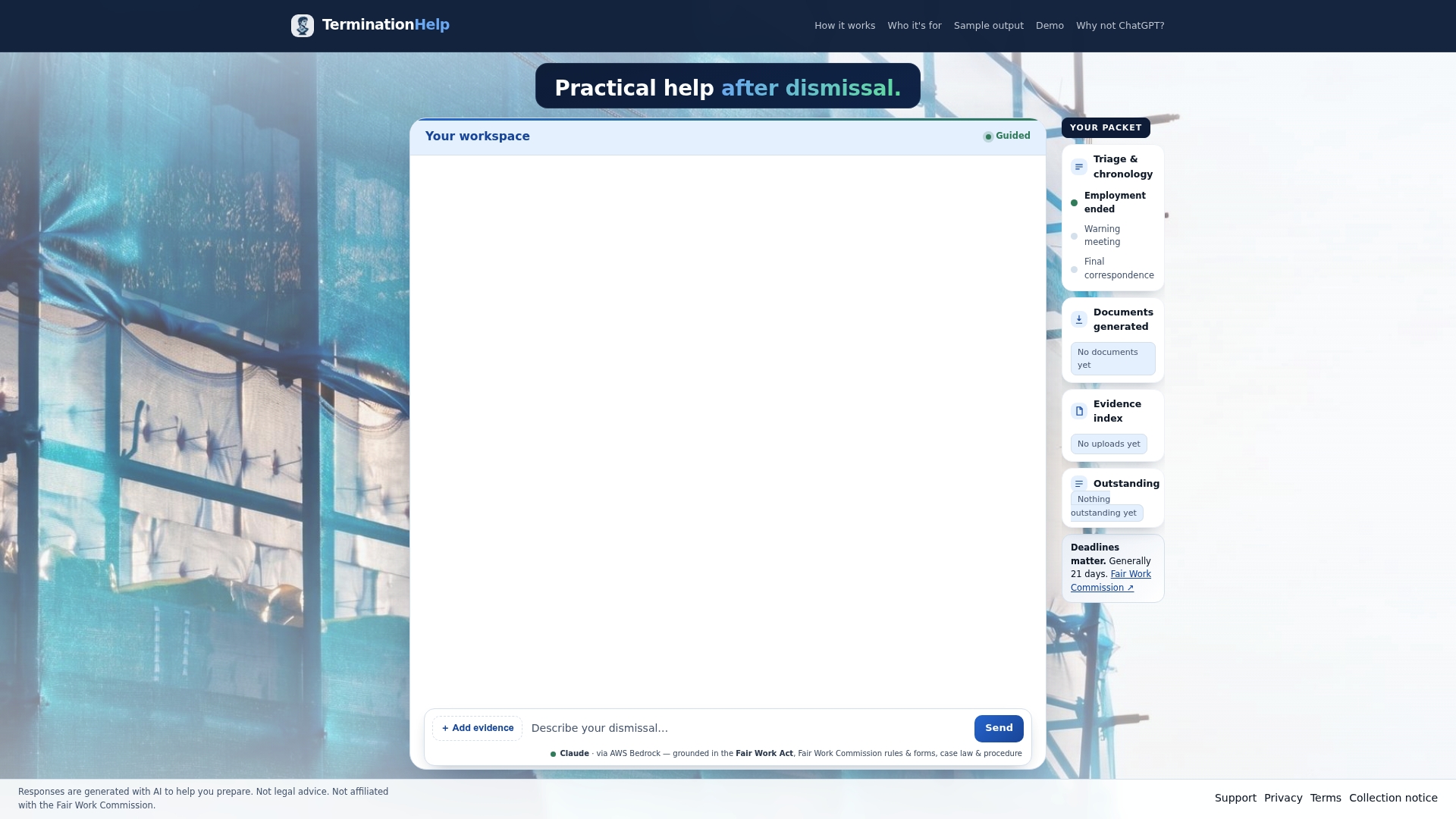
You can also start with the Terminationhelp homepage to see how the process works.
FAQ
Can my employer dismiss me for poor performance without a warning?
There is no fixed rule that a warning is required. But the Commission considers whether you were warned and whether you had a chance to improve. Dismissal with no warning and no chance to respond is much more likely to be found unfair, as in Small v Sharp N Stylish.
Is performance management the same as disciplinary action?
Not quite. Performance management addresses capacity, such as quality, diligence and meeting standards. Disciplinary action usually deals with conduct. Both can end in dismissal, but the reasons and the process the Commission expects can differ.
Can I claim if I was dismissed during a performance improvement plan?
Yes, if you meet the eligibility rules and apply within 21 days of the dismissal. The Commission will look at whether the plan gave you clear targets, support and a reasonable time to improve, and whether the employer followed it.
Can I be dismissed for poor performance if I am a casual or in a small business?
Yes, but you may still be protected. Casuals employed regularly and systematically, with a reasonable expectation of continuing work, can qualify. Small businesses must meet the Small Business Fair Dismissal Code, and the minimum period is 12 months.
Sources
- Managing performance and warnings, Fair Work Ombudsman
- Warnings: unsatisfactory performance, Fair Work Commission
- Performance Management Guide, NSW Business
- Unfair dismissals benchbook, Fair Work Commission
- Safitri v International Capital Markets Pty Ltd, AustLII
- Unfair dismissal, Fair Work Ombudsman
- Apply for unfair dismissal (Form F2), Fair Work Commission
- Forms, Fair Work Commission
- Unfair Dismissal factsheet, NT Work Health and Safety Commission
- Workplace discrimination fact sheet, Fair Work Ombudsman
Recommended
- Procedural Fairness in Dismissal: What Australian Law Requires
- Check Unfair Dismissal Eligibility in Australia: 21 days to lodge
- Employer obligations when dismissing an employee in Australia
- Australia: $95,050 payout cap and unfair dismissal remedies
Article produced using AI. This is not legal advice.