
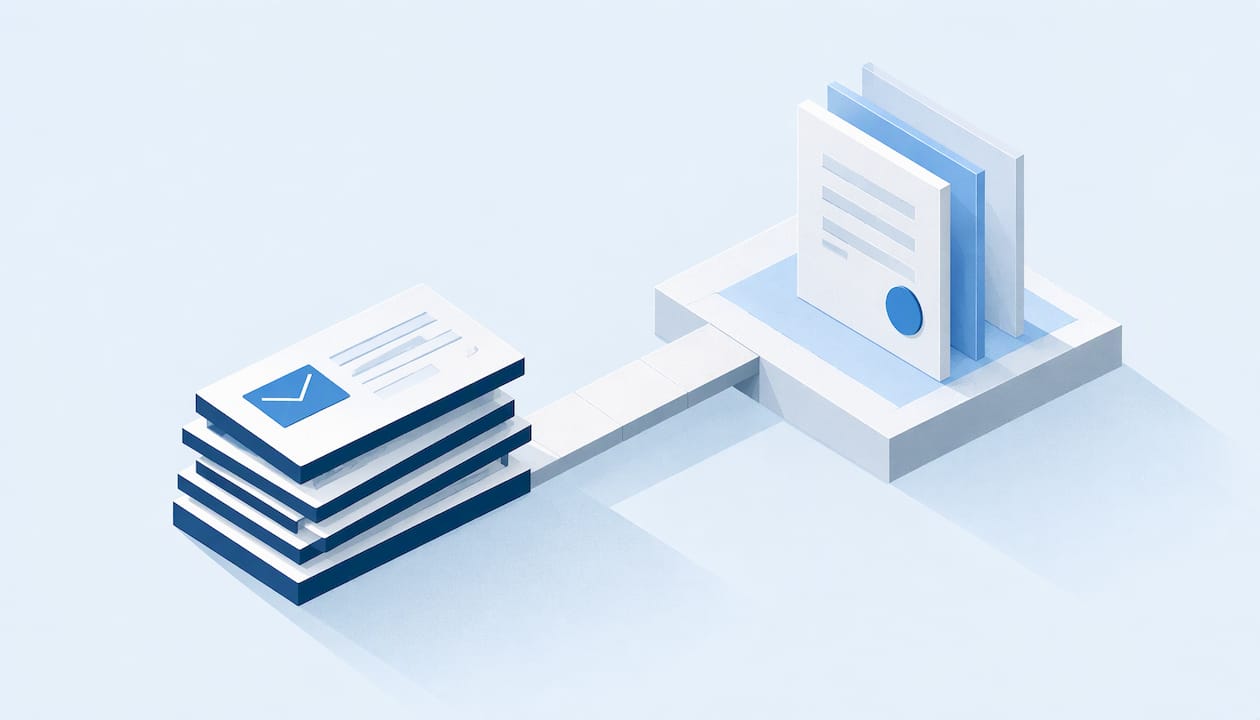
Yes, emails can be evidence in a Fair Work Commission matter. The Commission says evidence can include documents such as emails, text messages and letters, alongside witness statements. What matters is whether each email helps prove a fact in dispute, such as what happened, when it happened and what you lost. This guide covers which emails help, how to keep them intact, how screenshots fit in and how to attach them to your material.
TL;DR
- Emails, texts and letters between you and your employer can support an unfair dismissal or general protections claim, as long as they are relevant to the facts in issue.
- Keep the original message and the full thread, not just a cropped screenshot, and never edit or tidy anything.
- Attach emails to your witness statement, give each a letter (Attachment A, B and so on) and refer to each one in the statement.
- Do not wait to collect everything before you apply: the 21-day deadline still applies, and supporting documents can follow.
- Fabricated or altered evidence can hurt you badly, and in one reviewed case it was treated as serious misconduct.
Table of Contents
- Do emails count as evidence at the Fair Work Commission?
- Which emails help your case
- How to preserve emails so they stay reliable
- Screenshots and text messages
- Do not alter or fabricate anything
- How to organise and attach your emails
- Lodging documents by email
- The 21-day deadline and your evidence
- If you are the employer
- Our perspective
- Get your emails into a filing-ready order
- FAQ
- Sources
Do emails count as evidence at the Fair Work Commission?
They do. NSW Legal Aid's guidance on unfair dismissal evidence says letters, emails or texts between you and your employer may support your case. Its general protections page says the same for general protections dismissal matters, and adds that the evidence should support the facts in issue: what happened, when, and the loss claimed.
The Commission is also less rigid than a court. Under section 591 of the Fair Work Act 2009, the Commission is not bound by the rules of evidence and procedure. Those rules still remain relevant, and they cannot be ignored if doing so would cause unfairness between the parties. The same page explains that any conclusion of fact needs a basis in evidence with "rational probative force".
In plain terms: you do not need to present your emails like a barrister, but each one should connect to something the Commission has to decide, and it should be believable.

Which emails help your case
Start from the question the Commission will ask, then work backwards to the documents. The mix depends on your claim. The list below is a practical way to sort your inbox.
The dismissal itself. The Commission's own checklist for applying for unfair dismissal asks for the employer's reasons for dismissal and supporting documents such as the email or letter recording the dismissal. If you were dismissed by email, that message is usually your first exhibit.
Anything about the reason you were given. Emails raising performance or conduct concerns, emails showing you were never told about a problem, and emails praising your work can all matter. Our guide to procedural fairness in dismissal explains why the steps taken before a dismissal are scrutinised.
Warnings, or the absence of them. A thread showing a formal warning is useful. So is a thread showing that no warning was ever sent.
Redundancy communications. Messages about restructures, consultation, and whether other roles were discussed are the kind of material covered in our piece on genuine redundancy evidence.
Pressure to resign or disputes over how the employment ended. If your employer says you resigned and you disagree, the messages around that moment often decide the question. Keep the whole conversation, including anything you sent that could be read against you.
Evidence of loss. Emails about pay, hours, and your efforts to find new work help show the loss claimed.
Your own employer's records. Employment Law Handbook reported in 2025 that documents produced when a decision was made are often more valuable in contested factual disputes than later accounts, and that email exchanges and other decision records may need to be disclosed. That is relevant to you: contemporaneous emails from the time of the decision can carry more weight than recollections reconstructed later.

How to preserve emails so they stay reliable
An email is only as persuasive as it is credible. According to guidance from Red Bridge HR, evidence needs to be relevant, authentic and lawfully obtained. Build your file around those three tests.
- Act early. As soon as you are dismissed, or suspect you will be, note what exists and where it sits: work email, personal email, phone messages, HR portals.
- Keep the original, not only a copy. Leave the message in your mailbox. Export or save the email in its native format as well as printing it to PDF.
- Capture the whole thread. Messages are easily misread when stripped of what came before. Red Bridge HR advises reading digital evidence within the broader picture of behaviour and context, because messages are often taken out of context. Assume the other side will point to the missing parts.
- Record the details. Note sender, recipient, date and time, and subject line. Where possible, keep the header information that shows how the message travelled.
- Do not edit, annotate or delete. Put your notes in a separate document, not on the email.
- Make backups. Store copies somewhere you control, and keep a simple log of what you saved and when.
One caution before you start forwarding things. If you are thinking of sending work emails to a personal account, and they contain confidential business or customer information, get advice first from a lawyer, a union or a community legal centre. That is a specific situation where a quick conversation protects you.
Screenshots and text messages
Screenshots are common because many dismissals happen over text, WhatsApp or Teams rather than formal email. They are useful, but they are best treated as one layer of proof.
In Wibmer v Fujifilm Data Management Solutions, decided on 18 March 2026, the Commission dealt with digital communications in a fact-sensitive way. Messages have been relied on where they are relevant and supported by evidence from the person who made them or other authentication evidence. A screenshot can be good for showing that a message appeared on a device, or that it was later retracted. But on its own it may not prove the complete content or who actually wrote it.
The earlier Full Bench decision in [2017] FWCFB 990 shows how this works. The Full Bench accepted a WhatsApp transcript because the person who made the messages gave evidence about it, which meant it was not hearsay under section 64(3) of the Evidence Act 1995 (Cth), and because it was relevant. The lesson for you is that the message plus a person who can speak to it is stronger than an image on its own.
So when you screenshot:
- Capture the full conversation, with the contact name, number or account, and the dates visible.
- Keep the underlying message on your device and, where the platform allows, export the chat.
- Note the platform and account details.
- Be ready to explain in your witness statement how and when you took the screenshot.
Red Bridge HR also suggests that, when you are weighing screenshots or messages, you ask for metadata or full conversation threads to help confirm authenticity. If the other side relies on a screenshot against you, that is a fair point to raise.
Do not alter or fabricate anything
This is the section that protects you. A review of an FWC decision on digital deception leading to dismissal says that presenting fabricated or tampered evidence can amount to serious misconduct and give a valid reason for dismissal. In that case, the employee argued a forensic review of the other person's phone was needed to verify his claim, which shows how seriously authenticity is tested once it is challenged.
If an email is unhelpful, include it anyway or explain it. Cropping out an inconvenient line, changing a timestamp, or presenting a retyped message as the original can turn a good case into a credibility problem. A genuine but imperfect email beats a polished one that does not hold up.
How to organise and attach your emails
A pile of forwarded messages is hard to read. The Commission's decision-makers need to find the right email quickly and understand why it matters.
NSW Legal Aid describes the practical approach: attach documents to your witness statement, label each attachment with a letter, and refer to it in the statement. File and serve the statement by the Commission's deadline. It also recommends having at least four copies of supporting documents ready.
A simple structure:
| Attachment | What it is | Why it matters |
|---|---|---|
| A | Dismissal email, date and time | Shows how and when employment ended |
| B | Earlier email raising a concern | Shows what you were told, and when |
| C | Reply thread about the concern | Shows your response and the employer's reaction |
| D | Email about the termination process | Shows steps taken or missed |
| E | Screenshot of text with full thread | Supports your account of a conversation |
In your statement, write the story in date order and refer to each attachment where it fits, for example: "On 3 March I received an email from my manager (Attachment B)." Keep the statement to the facts you know first-hand, and let the attachments back them up.
Our guide on the Fair Work Commission process step by step shows where each document is used. If case law is part of your preparation, how to read unfair dismissal case law is a good companion.
Lodging documents by email
If you file by email, the Fair Work Commission Rules 2024 set out what is needed. Attach a document that is not a statutory declaration in Word, RTF, PDF or another approved format, without security restrictions. The covering email must include your name, address and telephone number, a contact email address, and the applicable matter details.
Then keep the evidence that you sent it. The Rules say to retain the sent item showing the destination and the date and time it was sent, or a delivery or read record showing the destination and the date and time it was delivered or read, and to produce it if required. Treat that sent item as an exhibit of its own.
The 21-day deadline and your evidence
Do not hold off applying while you chase documents. The Commission's page says an unfair dismissal application should still be filed within 21 days even if all supporting information is not yet available. The Rules say much the same: lodge on time, with further details and supporting documents to follow. Our guide to unfair dismissal eligibility and the 21-day limit covers the timing in more depth.
A sensible order is: lodge first, then use the following days to export threads, request anything you cannot access and build your attachments.
If you are the employer
Small business owners who have been named in a claim should take the same approach in reverse. The records made at the time of a decision matter, and relevant email exchanges may have to be disclosed. In Peters' case, the FWC found an employer's investigation incomplete after it ignored or misplaced physical and signed timesheets, and held the dismissal harsh and unfair. Records that are missing or overlooked can undermine a decision. Our article on the Small Business Fair Dismissal Code evidence file sets out how to organise yours.
Our perspective
Most people come to us with a phone full of messages and no idea which ones matter. Our view is that the problem is rarely a lack of evidence. It is that the evidence is scattered, cropped, undated and impossible for a decision-maker to follow.
That is why our service is built around preparation. We designed it to work only within Australian legislation, Fair Work Commission procedure and relevant case law, so the questions you are asked, the documents you organise and the forms you complete follow what the Commission actually expects at each stage. Evidence organisation and document upload sit inside that workflow, so your emails end up in a clear order, tied to the facts they prove.
We would rather you spend your first week saving original threads and building a timeline than rewriting a story from memory. A clean, honest file lets you file independently, or hand a structured packet to a lawyer, union or community legal centre and save them hours.
Nicolas
Get your emails into a filing-ready order
If you are facing a dismissal, you do not need to work out the structure alone. Our preparation support walks you through eligibility checks, evidence organisation, document upload, timelines and the Fair Work forms for your matter.
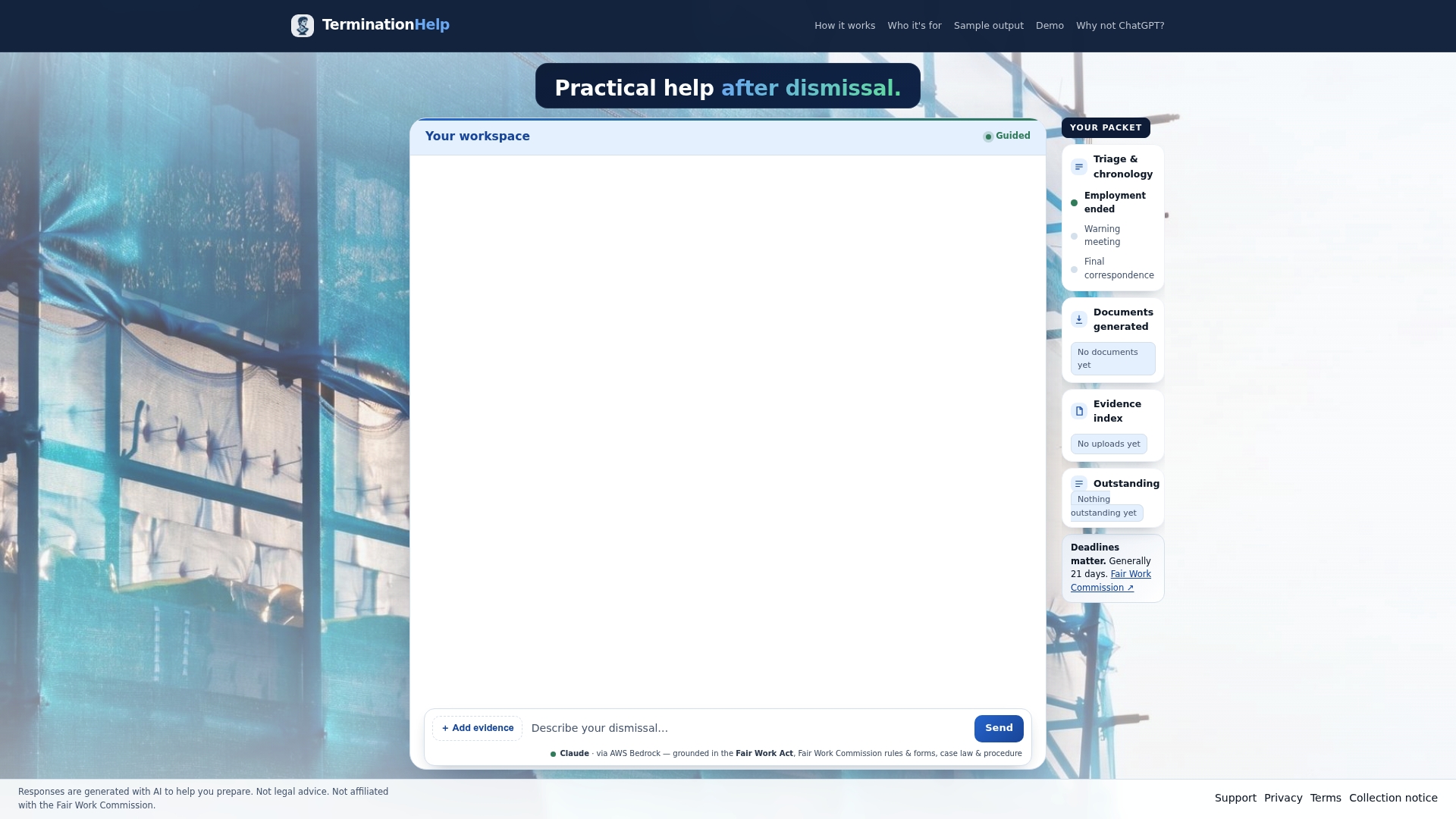
You can see how it works on the Preparation support page, then bring the finished packet to a lawyer, union or community legal centre if you want advice on strategy.
FAQ
Can I use emails from my work account if I have been locked out?
Start with what you already hold lawfully, such as emails sent to your personal address or messages on your own phone. If you need documents held by your employer, a lawyer, union or community legal centre can tell you how to ask for them in your matter. The Commission also looks for material from the employer, such as the email or letter recording your dismissal.
Is a screenshot of a text message enough?
It can help, particularly to show a message appeared on your device or was retracted. It is stronger with the full thread, the account details and the original message preserved, and with your own explanation in your witness statement. The Commission assesses digital communications case by case, so a screenshot on its own may not prove the full content or who wrote it.
How do I attach emails to my witness statement?
Attach each document to the statement, label it with a letter such as Attachment A, and refer to that label in the relevant paragraph. File and serve the statement by the Commission's deadline. NSW Legal Aid recommends having at least four copies of supporting documents.
Do I need all my evidence before I apply?
No. The Commission says to apply within 21 days even if some supporting information is not yet available. Lodge on time, then gather and organise your emails and other documents.
Can emails be used against me?
Yes. Relevant emails from either side may need to be disclosed, so keep your file complete and honest. Never edit or fabricate a message, because tampered evidence can be treated as serious misconduct.
Sources
- NSW Legal Aid: Unfair dismissal evidence
- NSW Legal Aid: Evidence for general protections dismissal
- Fair Work Commission: Evidence
- Fair Work Commission: Check you are ready to apply for unfair dismissal
- Fair Work Commission Rules 2024
- Wibmer v Fujifilm Data Management Solutions (2026)
- [2017] FWCFB 990
- Digital deception leads to dismissal: FWC case review
- Employment Law Handbook: The importance of documentation
- HC Online: Worker fired over absenteeism questions employer's faulty timekeeping system
Recommended
- $190,100+ Earners: Protect Your FWC Claim With This Evidence Checklist
- Australia: 21 Day Evidence Casual Employees Need for Unfair Dismissal
- Commission Ready Evidence File for Small Business Fair Dismissal Code
- Unfair dismissal particulars: what to set out in your claim
Article produced using AI. This is not legal advice.