
The best AI employment law tool in Australia depends on who you are. If you have been dismissed and need to prepare a Fair Work claim, you want a tool built around Australian law, Fair Work Commission forms and the strict deadlines, and that is what we built Terminationhelp to be. If you are a lawyer researching case law, the enterprise research platforms are a different category. If you only want a quick explanation of a term, a general chatbot can help, with care.
This guide sorts the options by job, so you can pick the right one quickly.
TL;DR
- For employees, contractors and small businesses facing a Fair Work matter, choose a tool grounded in Australian law that generates the Commission's forms and organises your evidence. That is our Terminationhelp preparation support.
- Lawyer research platforms such as Lexis+ AI, CoCounsel and Harvey are built for legal professionals doing research and drafting, not for a first-time claimant.
- General chatbots can explain concepts, but the Fair Work Commission warns they can produce incomplete or wrong content and invented authorities.
- Whatever you use, the 21-day deadline for an unfair dismissal application is strict, and you must tell the Commission if AI helped prepare a document.
Table of Contents
- What an AI employment law tool needs to do in Australia
- The main options compared
- Claim preparation tools: for the person who was dismissed
- Lawyer research platforms: for professionals
- General chatbots: useful for vocabulary, risky for filing
- Rules you must follow when AI helps with your claim
- Our perspective
- How to choose in five minutes
- Prepare your Fair Work matter with Terminationhelp
- FAQ
- Sources
What an AI employment law tool needs to do in Australia
Employment law here is national-system law with a lot of procedure. A tool that handles it well has to get a few things right, and these are the criteria we use below.
It reflects the eligibility rules. The Fair Work Commission says the minimum employment period is 6 months, or 12 months for a small business, and that casuals who do not work regularly and systematically cannot apply. The Fair Work Ombudsman also lists exclusions, including employees above the high income threshold who are not covered by an award or agreement. A tool that ignores these will send people into claims that fail at the first hurdle.
It respects the deadline. The Commission describes a strict 21-day deadline for a dismissal application, and says you can apply even if you do not yet have all the information or evidence. A good tool puts the clock first and helps you lodge on time rather than polishing a perfect document too late.
It produces the right forms. Applications are made on Form F2, which can be emailed to the Commission or posted or delivered to one of its offices. Employers responding to a claim use different forms. A tool should know which form belongs to which stage.
It treats your data carefully. The Commission advises against putting personal or confidential case information into public GenAI tools, because it may not stay private or secure. Where your data is stored, and whether it trains a model, matters.

It is honest about its limits. No AI tool is a lawyer. The best ones prepare you to file independently or to walk into a lawyer, union or community legal centre with an organised file.
The main options compared
| Option | Built for | Australian employment focus | What you get |
|---|---|---|---|
| Terminationhelp | Employees, contractors, gig workers, small businesses, and legal professionals, unions and businesses handling matters | Exclusively Australian Fair Work law and Commission procedure | Eligibility checks, evidence organisation, timelines, the Fair Work forms for each stage, structured packets |
| General chatbots (ChatGPT and similar) | Anyone wanting a plain-language explanation | None built in; depends on what you ask | Explanations and draft wording, with no guarantee the law or cases cited are real |
| Lexis+ AI / Protégé | Law firms and research teams | Broad legal research, including Australian content | Natural-language case law and legislation research |
| CoCounsel (Westlaw) | Law firms on Westlaw | Broad legal research | Research and drafting support inside a research platform |
| Harvey | Large firms and in-house teams | General legal work | Enterprise drafting, review and research |
| Official Commission and Ombudsman pages | Anyone | Fully Australian | Free, authoritative information, but no matter-specific preparation |
Note what is missing from most of this table: a tool that takes a dismissed worker from "was I even eligible?" to a lodged application. That gap is why claim-preparation tools exist.
Claim preparation tools: for the person who was dismissed
Most people reading about employment law AI are not lawyers. They have lost a job, they have days to act, and they have never seen a Commission form.
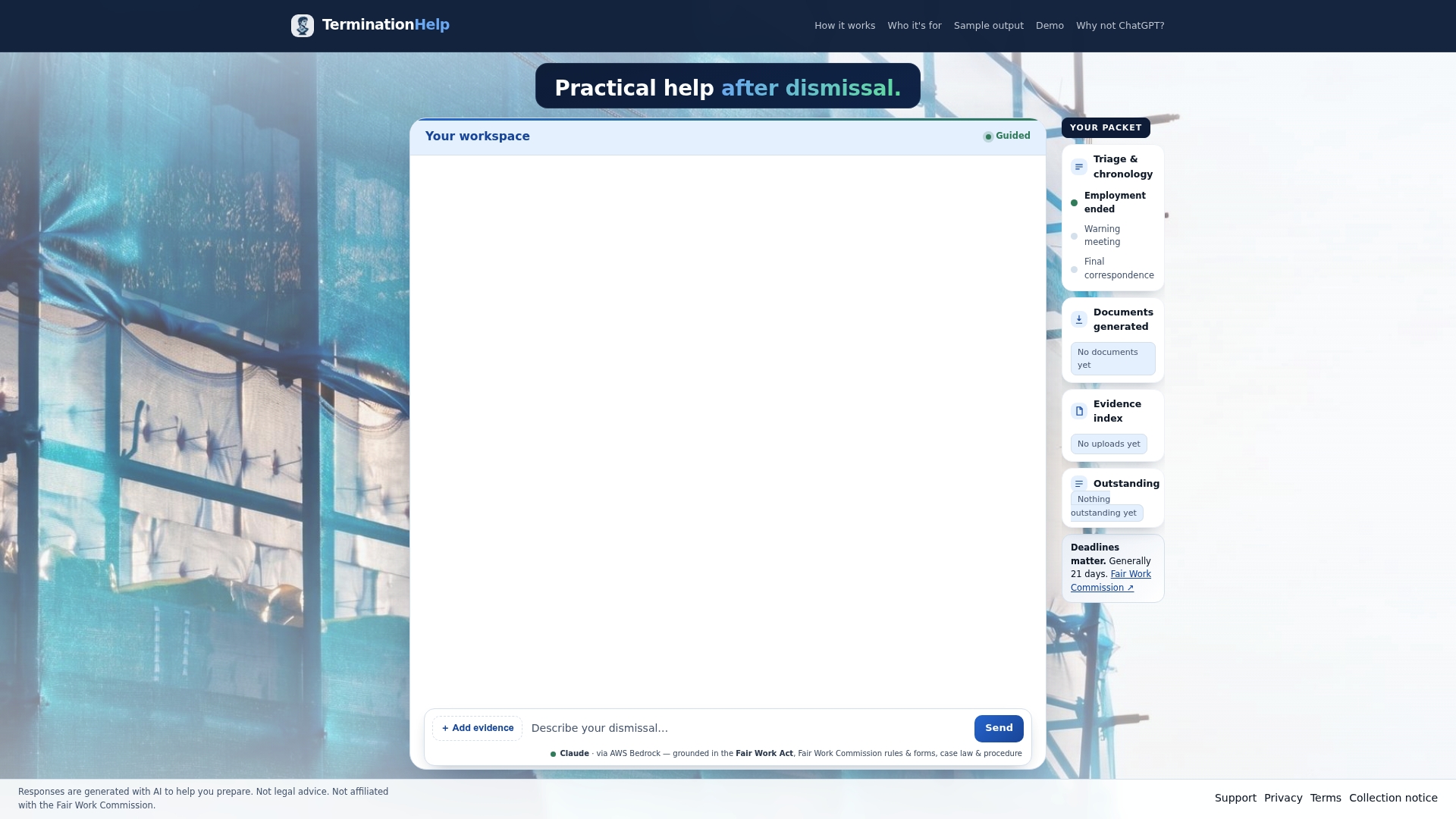
This is the job Terminationhelp is designed for. You work through a guided workflow: we check eligibility, you upload your documents, the evidence is organised into a timeline, and the Fair Work forms for your stage are generated for you. The output is a structured packet you can file yourself or hand to a lawyer, union or community legal centre. We charge a one-time payment per matter rather than a subscription, because most people have one dispute, not a year-round need.
Two things set this category apart from a chatbot. First, the tool is bounded to Australian legislation, Fair Work Commission rules and relevant case law, so it does not drift into UK or US concepts. Second, it is built around the workflow, not a conversation. You are not left to work out what to ask next.
The topics it walks through are the ones people most often search:
- Whether you can claim while on probation. Our guide covers three checks for probation claims.
- Whether a casual can claim. See the evidence casual employees need.
- Whether a forced resignation counts. We explain constructive dismissal and its 21-day limit.
- Whether the dismissal was procedurally fair. Read what procedural fairness requires.
Gig workers and contractors
A threshold question for many people is whether they are an employee at all. The Fair Work Ombudsman says the answer turns on factors such as control, financial risk, equipment, delegation, hours and expectations of ongoing work, as well as the contract terms. It also says it cannot decide the question for you; it can only give information and advice. An AI tool can walk you through those factors and help you write down the facts, which is useful preparation. For a firm answer, see a lawyer, community legal centre or union.
The Commission also notes that independent contractors are not covered by unfair dismissal laws, but employee-like workers whose access to a digital labour platform was changed, suspended or ended may be able to apply for unfair deactivation instead.
Small business owners
Being on the other side of a claim is stressful too. A small business owner who has received an application has to respond within the Commission's process and needs to pull records together: contracts, warnings, notes of meetings. Organising that material by date, and understanding what each stage of the Fair Work Commission process expects, is the same preparation job from the other side.
Lawyer research platforms: for professionals
Lexis+ AI (now branded with Protégé), CoCounsel on Westlaw, and Harvey are aimed at practitioners. They help search case law and legislation in natural language, summarise authorities, and assist with drafting and review. They are priced and sold for firms and in-house teams, and their value rises with the volume of legal work running through them.
For a dismissed employee, they are the wrong shape. They do not walk you through a first claim, they do not assume you are missing basic information, and they are not built around a 21-day clock. For lawyers, they are strong research aids, but the Commission still expects verification of every authority.
If you are a legal professional, union or business that handles member or client matters, the two categories can sit side by side: a research platform for the law, and a preparation workflow like ours for assembling each matter's forms, timeline and evidence.

General chatbots: useful for vocabulary, risky for filing
A general chatbot can explain what a "genuine redundancy" is or what conciliation involves in plain language. That has value. But the limits are well documented.
The Commission says GenAI is not a substitute for legal advice, may produce incomplete or wrong content, and that you should check that any laws and cases cited are real and relevant. A law firm commentary on AI-assisted claims lists the same pitfalls: hallucinated case law, incorrect factual evidence and repeated irrelevant arguments. Another Australian commentary says general AI cannot assess the merits of your specific claim or handle the strict time limit.
The practical rule: use a chatbot to learn the vocabulary, not to draft the document you lodge, and never paste in sensitive case details on a public tool.
Rules you must follow when AI helps with your claim
This applies to every option above, ours included.
If you use GenAI to create, write, edit or prepare a document in a Commission case, the Commission says you must tell it that you used GenAI and explain how. You must check the document yourself for accuracy and supporting evidence, and state in the document that you have done those checks. Legal practitioners and professional representatives must also include hyperlinks to case law they refer to.
A commentary on the Commission's draft guidance note describes the same three themes of disclosure, verification and consequences for non-compliance, and notes the amended Form F8 asks for a more rigorous articulation of the claim. So the question to ask of any tool is not only whether it writes well, but whether it makes checking easy: does it show where each statement comes from, and does it keep you in control of the final document?
Our perspective
We built Terminationhelp because the people who most need help with a Fair Work claim are the ones least able to pay for a research platform or wait for an appointment. They are in the first days after a dismissal, anxious, with a deadline running.
Our view is that a general-purpose AI is the wrong tool for that moment. A claim is not a conversation. It is a sequence: check eligibility, gather evidence, lodge the right form on time, respond at the next stage. We designed our preparation support around that sequence, and we limit it to Australian legislation, Fair Work Commission rules and relevant case law.
We also think preparation matters as much as the form. A clear timeline and an organised set of documents help whoever ends up reading your file, whether that is you, a lawyer, a union organiser or a community legal centre. That is why the output is a structured packet rather than a block of text.
And we think data handling is part of the product. We keep user data onshore and do not use it to train AI, because your employment history is among the most sensitive things you will ever put into a tool.
Nicolas
How to choose in five minutes
Ask yourself these questions in order.
- Do I have a live deadline? If you were dismissed in the last few weeks, start with the 21-day limit. Our guide to filing within 21 days sets out what to do first.
- Am I eligible? Run the checks on service length, casual status and income. Our eligibility guide covers them.
- Do I need forms or answers? If you need Form F2 completed and evidence arranged, choose a preparation tool. If you need to understand a concept, an official page or a chatbot will do. Our Form F2 walkthrough shows what the form asks.
- Am I a professional? Then pair a research platform with a matter preparation workflow.
- Where does my data go? Prefer a provider that states where data is stored and that it is not used to train models.
Prepare your Fair Work matter with Terminationhelp
Our preparation support takes you from eligibility check to a structured packet of forms, timeline and evidence, grounded in Australian Fair Work law. You pay once per matter, and you can file independently or take the packet to a lawyer, union or community legal centre.
We do not publish a price on the page, so the cost for your matter is shown when you begin the workflow. Start early: the sooner you begin, the more of your 21 days you keep.
FAQ
Can AI lodge my unfair dismissal claim for me?
No. You, or your representative, lodge the application. An AI tool can prepare the form and organise your evidence, but you remain responsible for checking every detail. If AI helped prepare a document, the Commission requires you to disclose that and confirm you have checked it.
Is ChatGPT good enough for a Fair Work claim?
It can help you understand terms, but it is not built around Australian procedure. The Commission warns that GenAI output can be incomplete or wrong and that cited cases must be checked. For a document you will lodge, use a tool bounded to Australian law and verify everything.
Do I still need a lawyer if I use an AI preparation tool?
Not necessarily, since many people file independently. But a lawyer, union or community legal centre can assess the merits and advise on strategy, which a tool cannot. A well-organised packet makes that appointment faster and more useful.
Are lawyer research platforms suitable for individuals?
Usually not. Lexis+ AI, CoCounsel and Harvey are designed for professionals doing research at volume. An individual with a single dismissal is better served by a guided preparation workflow and the official Commission information.
Sources
- Unfair dismissal: can you apply? (Fair Work Commission)
- Exclusions from unfair dismissal (Fair Work Ombudsman)
- I think I could be an employee not a contractor (Fair Work Ombudsman)
- Using AI to help you with your case (Fair Work Commission)
- AI-assisted Fair Work Commission claims: what employers need to know (Corrs Chambers Westgarth)
- Using AI for your unfair dismissal claim (Fair Workplace Solutions)
Recommended
Article produced using AI. This is not legal advice.