

There is no single official "success rate" for unfair dismissal in Australia. The closest published figures are the Fair Work Commission's (FWC's) hearing outcomes: in 2024–25, about half of decided hearings ended in a money payment to the employee and about a third were dismissed as fair. Most claims never reach a hearing, though. Around three quarters settle at or before conciliation. Your chances depend less on the headline percentage than on whether you are eligible, lodge on time and can show the dismissal was harsh, unjust or unreasonable, with the evidence organised before anyone asks for it.
TL;DR
- The FWC's 2024–25 hearing table records 263 outcomes: 89 dismissed as fair, 134 granted with a monetary remedy, and 9 involving reinstatement.
- That table counts decided hearings only. It is not a success rate across every claim lodged.
- Around three quarters of unfair dismissal cases settle at or before conciliation, so most outcomes are negotiated, not decided.
- Median compensation is five to seven weeks' pay, and the 2026–27 cap is the lower of half your annual wage or $95,050.
- Eligibility and the 21-day deadline decide many claims before the merits are ever looked at, so they are the first things to get right.
Table of Contents
- What the official numbers actually say
- Why this is not a "success rate" for your claim
- How a claim usually unfolds
- The questions that decide a claim before the merits
- What winning is worth
- What improves your chances
- If you are the employer
- Where preparation support fits
- FAQ
- Sources
What the official numbers actually say
The FWC publishes a table of what happened at unfair dismissal hearings. For 2024–25 it records 263 outcomes. Here is how the main categories break down, with the percentages calculated from those counts:
| Outcome at hearing, 2024–25 | Number | Share of 263 |
|---|---|---|
| Application dismissed as fair | 89 | about 34% |
| Granted, monetary remedy | 134 | about 51% |
| Granted, reinstatement | 4 | about 1.5% |
| Granted, reinstatement and lost remuneration | 5 | about 2% |
| Other (no remedy, remedy to be determined, parties settled on remedy) | 31 | about 12% |
Read plainly, of the cases a Commission Member actually decided, more were granted than rejected. The Commission Member decides each case on the law, so the figure reflects the cases that were strong enough, or contested enough, to go the distance.
Why this is not a "success rate" for your claim
A success rate answers the question "if I lodge, what are the odds I win?" The hearing table cannot answer that, for three reasons.
It only counts hearings. The FWC's 2024–25 annual report records 44,075 total lodgments, and unfair dismissal applications made up 37% of them. That is roughly 16,300 applications against 263 hearing outcomes. The table describes a small slice of cases.

Most claims end earlier. The FWC says around three quarters of unfair dismissal cases settle at or before conciliation. A settlement is not a win or a loss on the merits. It is an agreed result, and it never shows up in the hearing table.
"Success" has several meanings. Dismissed as fair, granted with no remedy, granted with compensation, reinstatement, remedy still to be determined, and parties settling on remedy are all separate lines in the table. Someone who is reinstated and someone who receives a modest payment are both counted as granted, but they are very different results for the person involved.
So treat the numbers as a picture of how the system works, not a forecast. Any site that gives you a precise percentage chance of winning your own case is guessing.
How a claim usually unfolds
The path matters because each stage has its own odds and its own demands on you. The detail is in our step-by-step guide to the Fair Work Commission process, but the outline is this:
- Lodge within 21 days. The FWC says an application must generally be lodged within 21 days of dismissal. After lodgment it contacts the applicant within seven days.
- Conciliation. This is voluntary and is aimed at helping you and your employer discuss the issues and agree on an outcome. The FWC says it is usually held about five weeks after your application is received.
- Decision by a Commission Member. If conciliation does not resolve the matter, it goes to a Commission Member, usually through a formal hearing or conference some months after the application was received.
Because three quarters of matters resolve at or before step 2, conciliation is where most claims are won or lost in practice. You walk in with whatever you have prepared: your timeline, your documents, your view of what a fair outcome looks like.
The questions that decide a claim before the merits
Many people who ask about success rates have a prior problem: they may not be able to claim at all. The FWC will look at these points first.
Minimum employment period
The FWC's eligibility page sets a minimum employment period of six months for employers with 15 or more employees and 12 months for small business employers with fewer than 15 employees. Probation does not switch off your rights as such, but you still need to have served the relevant period. If you were dismissed during probation, our three checks for probation claims set out what to confirm. Casual employees have their own questions about regular and systematic work, covered in our casual employee guide.
The high income threshold
The FWC says employees earning above the high income threshold must be covered by an award or enterprise agreement to qualify, and that the threshold changes over time. Check the FWC's current figure before you rely on any number you see in older articles.
Were you actually dismissed?
If you resigned because your employer left you no real choice, that can still count as a dismissal. Our guide to constructive dismissal in Australia explains how, and why the 21 days run just as tightly. Redundancy raises its own question, whether the redundancy was genuine, set out in redundancy versus dismissal.
If any of these fail, the claim does not reach the merits. That is why a basic eligibility check is the best first investment of your time. Our eligibility guide walks through it.
What winning is worth
The next question after "can I win?" is "what do I get?" Reinstatement is rare in the hearing table: 9 of 263 outcomes. Compensation is the usual remedy.
The FWC reports that median compensation is between five and seven weeks' pay, and that fewer than 0.4% of applicants receive the maximum limit. For 2026–27 that maximum is the lower of half the employee's annual wage or $95,050, and the cap changes on 1 July each year.
A worked example shows how to think about it. Suppose you earned $1,500 a week before tax. A median result of five to seven weeks' pay sits around $7,500 to $10,500 before any deductions. That is an illustration of the range, not a prediction for you. The FWC's compensation formula limits an order to the lower of the pay you likely lost (after relevant deductions) and the cap, and it considers whether you made reasonable efforts to reduce your loss. In practice, that means:
- Keep a record of every job you apply for after dismissal.
- Keep payslips and contracts so your pay can be calculated.
- Record any income you earn in the meantime, since it can be deducted.
We cover the remedies in more depth in our guide to the payout cap and remedies.
What improves your chances
No checklist guarantees a result, but these are the things within your control, and they are the things a Commission Member or a conciliator will ask about.
Lodge on time. The deadline is short and strict. Late applications need an explanation the FWC accepts, which is a hard argument to make. Our 21-day time limit explainer covers how the days are counted.
Build a timeline. Dates of the warnings, meetings, performance conversations and the dismissal itself. A clear sequence lets you explain what happened in a few minutes.
Gather the paper. Your contract, any award or agreement, the termination letter, emails and messages, performance reviews, and payslips. Gaps are much harder to fill after your access to work systems ends.
Understand the reason given. Whether the employer says misconduct, performance or redundancy, you need to know what they say and whether the process was fair. How tribunals treat these arguments is explained in our guide to reading unfair dismissal case law.
Fill in the forms accurately. The application is the foundation of everything that follows. Errors about your employer's name, your dismissal date or your employment status create avoidable problems.
Decide what you want. Compensation, a reference, a corrected record, or reinstatement. Knowing your goal before conciliation makes the discussion productive.
If you are the employer
Employers facing a claim read the same statistics and often draw the wrong conclusion. A third of decided hearings in 2024–25 went the employer's way, but most claims are settled before that point, so the practical question is whether your process was fair and documented. The same preparation applies on your side: a clear timeline, the documents behind each decision, and an understanding of what the FWC will ask. Small business owners in particular should confirm which employee-count threshold applies to them, since it changes the minimum employment period.
Where preparation support fits

Most people who lose ground on an unfair dismissal claim do not lose on the law. They lose time, miss the 21 days, submit incomplete forms or arrive at conciliation without an organised account. Preparation is the part you control.
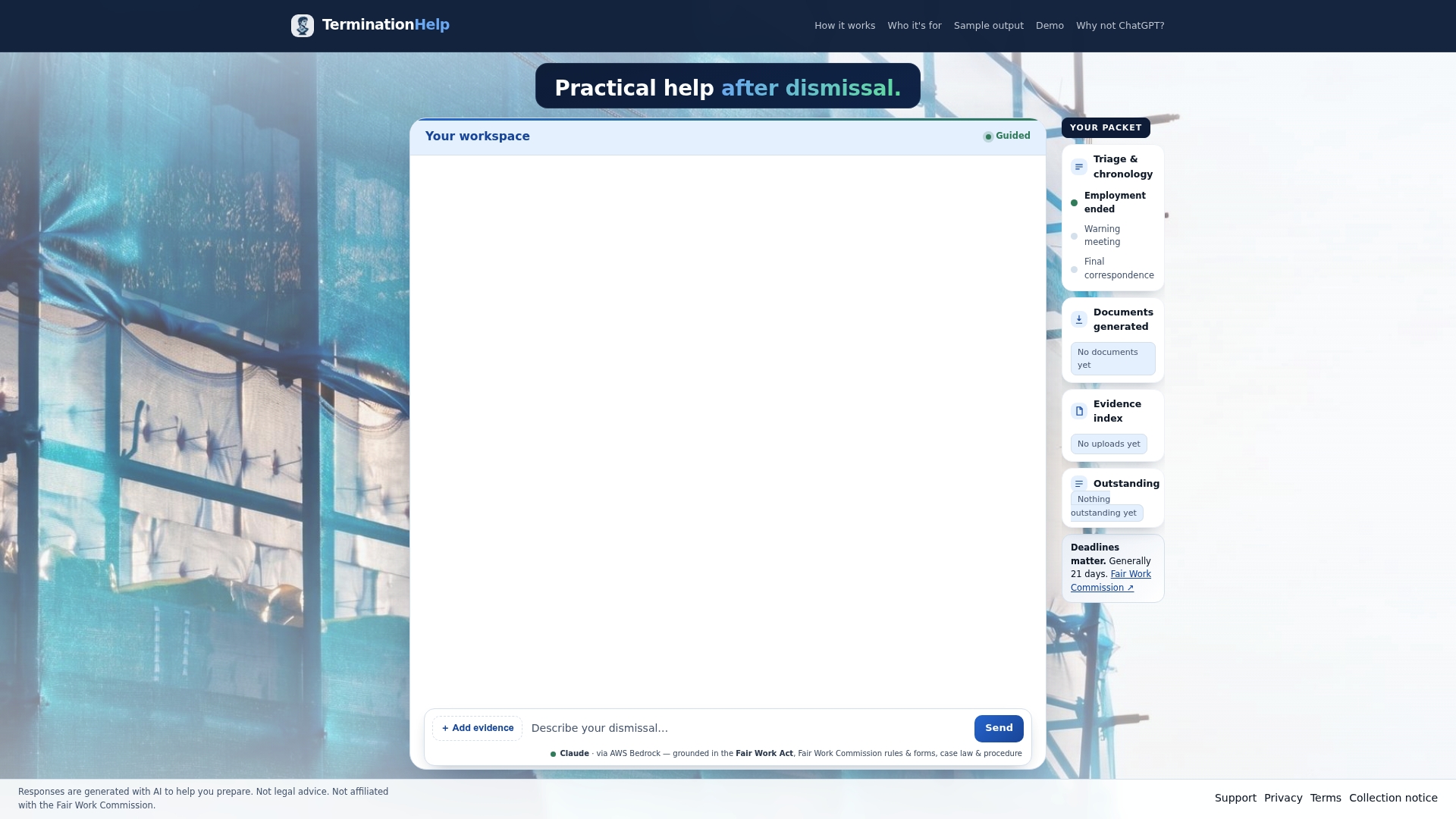
Our preparation support is built for exactly this stage. It runs eligibility checks, gives step-by-step guidance, helps you organise evidence and upload documents, and generates the Fair Work forms you need along with timelines and a structured packet. You can file independently or take the packet to a lawyer, union or community legal centre. Everything in it is grounded in Australian legislation, Fair Work Commission rules and relevant case law.
Lawyers, unions and businesses can also use it to prepare matters for the clients or members they support.
Our view on the numbers
People ask us for a success rate because they want certainty at a frightening time. We understand that, but we would be doing you a disservice if we pointed to one number and said it applied to you. What the data does show is that the system is built around early resolution, and that outcomes turn on facts: dates, documents, eligibility and the reasons given.
That is why we built our tool around preparation. It is dedicated to Australian Fair Work claims, drawing on a curated library of legislation, forms and case law, and it generates the forms required at each stage. We designed it so that your data stays onshore and never trains AI.
Whatever route you take, a clear timeline and organised evidence put you in a stronger position at conciliation than a loose recollection does. Our job is to get you there early, inside the 21 days.
Nicolas
FAQ
What percentage of unfair dismissal claims succeed in Australia?
There is no official overall percentage. In the FWC's 2024–25 hearing table, 134 of 263 outcomes were granted with a monetary remedy and 89 were dismissed as fair. That table counts only decided hearings, and around three quarters of cases settle before that stage.
Do most unfair dismissal claims go to a hearing?
No. The FWC says around three quarters of cases settle at or before conciliation. Cases that do not resolve go to a Commission Member for a decision, usually some months after the application was received.
How much compensation do successful applicants get?
The FWC reports median compensation of five to seven weeks' pay. The 2026–27 maximum is the lower of half your annual wage or $95,050, and fewer than 0.4% of applicants receive the maximum. The actual amount depends on your pay, deductions and efforts to find new work.
Is reinstatement common?
It is uncommon. In the 2024–25 hearing table, 4 outcomes involved reinstatement and 5 involved reinstatement with lost remuneration, out of 263. Compensation is far more frequent.
Sources
- Outcomes or remedies at an unfair dismissal hearing, Fair Work Commission
- Delivery of our services, Fair Work Commission Annual Report 2024–25
- Conciliation for unfair dismissal, Fair Work Commission
- The process for unfair dismissal claims, Fair Work Commission
- Unfair dismissal, Fair Work Commission
- Compensation for unfair dismissal, Fair Work Commission
- The formula to calculate compensation, Fair Work Commission
Recommended
- Unfair Dismissal Case Law in Australia: How to Read It
- Check Unfair Dismissal Eligibility in Australia: 21 days to lodge
- Australia: $95,050 payout cap and unfair dismissal remedies
- Employer obligations when dismissing an employee in Australia
Article produced using AI. This is not legal advice.