

Yes, an unfair dismissal settlement is taxed in Australia, but usually at concessional rates. Compensation paid to settle an unfair dismissal claim is generally an employment termination payment (ETP). Up to the ETP cap, it is taxed more lightly than ordinary wages. Above the cap, it is taxed at the top marginal rate. Unpaid wages and leave sitting inside the same payment are taxed differently, so how the payment is described matters.
This guide explains how each part is taxed, what your former employer must withhold, how the payment shows up on your tax return, and what to settle before you sign.
TL;DR
- Compensation to settle an unfair dismissal claim is generally an ETP, taxed concessionally up to the ETP cap ($270,000 for 2026-27) and at the top marginal rate above it.
- Employers withhold 32% if you are under preservation age and 17% if you are at or over it, up to the cap, and 47% above the cap.
- Unpaid wages and accrued annual leave are usually taxed as ordinary income, not as an ETP.
- Legal costs you incurred in the claim are not tax deductible, and the settlement deed's wording can affect how each amount is taxed.
- Get tax advice from a registered tax agent or accountant before you accept an offer, ideally before conciliation.
Table of Contents
- Is an unfair dismissal settlement taxable?
- How an ETP is taxed
- What the employer withholds
- What is not part of the ETP
- The 12-month rule
- How the settlement deed affects your tax
- Declaring the payment on your tax return
- Before you accept an offer
- Perspective
- Prepare your claim before you negotiate
- FAQ
- Sources
Is an unfair dismissal settlement taxable?
It is. The ATO's long-standing view in IT 2424 is that compensation received by settlement, or under a Fair Work Commission determination, for an unlawful dismissal qualifies as an eligible termination payment and is taxed under the special ETP rules.
The later ruling TR 2003/13 goes further. When a payment settles a claim for wrongful dismissal or a similar claim arising from the termination, it has a sufficient connection with the termination to be an ETP.
You do not need a court or Commission order for this to apply. The ATO explains in Applying the ETP caps that a payment to resolve a genuine dispute does not have to result from court proceedings. Its worked example is a $20,000 out-of-court settlement for unfair dismissal negotiated by a lawyer. That payment was a compensation payment subject to the ETP cap.
How an ETP is taxed
The ATO says an ETP can have up to three tax treatments, as set out in Employment termination payments for employees:
- Tax-free, for the part relating to invalidity or to work done before 1 July 1983.
- Concessionally taxed, up to a limit called the cap.
- Taxed at the top marginal rate of 45% plus the 2% Medicare levy on any amount over the relevant cap.
For most unfair dismissal settlements, the second and third treatments are the ones that matter. The first rarely applies.
The two caps
There are two caps, and they work differently. Schedule 11 gives them for payments from 1 July 2026:
| Cap | 2026-27 amount | Indexed? |
|---|---|---|
| ETP cap | $270,000 | Yes, annually |
| Whole-of-income cap | $180,000 | No |
The whole-of-income cap is the one that catches people who are still earning. It applies to ordinary ETPs such as pay in lieu of notice and some contractual payouts. Compensation for unfair dismissal is outside it. The ATO states that payments made mainly to compensate for a genuine dispute about unfair dismissal, personal injury, harassment or discrimination are excluded from the whole-of-income cap. They are subject only to the ETP cap.
The ATO's How ETP components are taxed page says the same: compensation for unfair dismissal is an excluded payment, concessionally taxed up to the ETP cap. The ETP cap applying to you depends on the income year in which the payment is made, so check the current figure on the ATO site.
The cap is rarely the limit in practice. Unfair dismissal remedies are modest compared with it. For how the Commission's compensation limit works, see our guide to unfair dismissal remedies and the payout cap.
What the employer withholds
Your former employer must withhold tax from the taxable component of an ETP. Under Schedule 11, for a life benefit ETP for unfair dismissal where you have given your tax file number (TFN), the rates are:
| Your situation | Withholding rate |
|---|---|
| Under preservation age, up to the ETP cap | 32% |
| At or over preservation age, up to the ETP cap | 17% |
| Any amount above the ETP cap | 47% |
Nothing is withheld from a tax-free component. If you have not given a TFN, the withholding rules differ, so give it to your former employer in writing before payment.
A simple illustration
Take a $20,000 settlement, the same size as the ATO's example, paid as a single ETP to someone under preservation age. At the 32% withholding rate, $6,400 would be withheld and $13,600 paid to you. At the 17% rate for someone at or over preservation age, $3,400 would be withheld.

This is withholding, not your final tax. Your actual tax is worked out when you lodge your return. Because the ETP is taxed separately from your other income, the outcome is not always the same as the amount withheld.
One point from academic commentary is worth knowing. Celeste Black's 2007 article argues that the ETP regime can tax settlement receipts at concessional rates higher than some taxpayers' marginal rates. If your total income for the year will be low, a tax agent can tell you how that plays out for you.
What is not part of the ETP
A settlement is rarely just compensation. It often bundles several things, and each is taxed in its own way.
Unpaid wages and leave. MKI Legal states that unpaid wages and unused annual leave are taxed as ordinary income at your marginal rate and are not part of an ETP. They normally come through payroll as usual pay, and they are in addition to any compensation.
Pay in lieu of notice and contractual payouts. These are taxed as ETPs, but they count towards the lower whole-of-income cap. They are different from the unfair dismissal compensation, which is excluded from that cap.
Reimbursed legal costs. MKI Legal notes that an amount reimbursing identified legal costs is not part of the ETP. Separately, the ATO's view in a private ruling on legal expenses is that legal expenses of an unfair dismissal action seeking reinstatement or damages are capital in nature. That means you cannot deduct them under section 8-1 of the ITAA 1997.
Amounts for injury or discrimination. Regency Partners notes that compensation for injury, illness, pain and suffering, or under anti-discrimination legislation, can be exempt from assessable income. They also note that any component identified as replacing lost income becomes assessable. Whether any part of your settlement fits this category depends on your facts and the claims actually made. It is a question for a tax professional, not something to assume.

The 12-month rule
Timing matters. The ATO states in Schedule 11 that a payment must generally be made within 12 months of the termination to be an ETP. A payment made outside that window is a delayed termination payment, unless the ATO has approved treating it as an ETP.
Most settlements reached at conciliation or soon after are paid well inside 12 months. If a dispute drags on, for example through a general protections claim running alongside, keep the date of termination and the date of payment in view.
How the settlement deed affects your tax
The wording of the agreement matters, but it does not decide everything.
MKI Legal explains that the ATO taxes identifiable back pay as income under TD 93/58. Where a dismissal claim settles for one undivided sum, the whole is usually taxed as an ETP under TR 2003/13. So how the deed describes each amount can change the result.
The Legal Practitioners' Liability Committee says in Tax issues to check before recommending a settlement that the tax character of a settlement depends on the whole deal, not the label in the agreement. It cites Sladden v Commissioner of Taxation, where the terms of the deed of release were not determinative.
Sladen Legal makes a practical point. Detailed discussion before the agreement is signed, and a written agreement that records the bargain and the conditions behind the payment, help to settle how it is characterised.
The ATO's TR 95/35 adds a warning. Where a receipt covers several heads of claim, it must be apportioned. If you do not make a reasonable apportionment, the ATO will make one from the information available.
In practice:
- Ask that the deed state clearly what each amount is for: wages, leave, notice, compensation, costs.
- Ask that the deed show a genuine dispute existed. The ATO says evidence of the dispute should be kept.
- Do not sign on the day if you can avoid it. Bentham Legal notes that time pressure at conciliation can lead to hasty decisions made without the tax consequences in view.
Declaring the payment on your tax return
The ETP is reported to the ATO by your former employer. It should appear in your income statement through single touch payroll (STP). If the employer is exempt or deferred from STP, you should receive a PAYG payment summary within 14 days, according to Schedule 11.
The ATO's 2025 individual tax return instructions explain how to report it at question 4, label I. You show the date of payment, the payer's ABN, the tax withheld, the taxable component and the ETP code. The code for unfair dismissal is R. If you receive two or more ETPs, you complete an ETP schedule, total the amounts, enter M in the code box and attach the schedule.
If you lodge through myTax, the ATO's myTax ETP instructions say to select the code shown on your income statement. If the statement has no code, contact the employer or pick the code that best describes the payment.
The instructions also note that if the code is O or P, the payment counts towards the whole-of-income cap. You may then pay more tax if you earn more after leaving work. A code R payment for unfair dismissal should not be in that group. If your statement shows a different code from the one you expected, ask the payer to correct it before you lodge.
Before you accept an offer
Tax is easiest to get right before the deed is signed. A sensible order of work:
- Confirm you are eligible and in time. Settlement only arises if you have a valid claim. Check eligibility and the 21-day deadline first.
- Understand what compensation can include. Lost pay is usually reduced by what you earned or could have earned elsewhere. Our guide to mitigation of loss explains how that shapes a realistic figure.
- Itemise the offer. Separate wages, leave, notice and compensation, and decide which parts you are negotiating.
- Ask a registered tax agent or accountant how the payment will be taxed in your situation, particularly if your other income is high or you are near preservation age.
- Check the deed wording with a lawyer, union or community legal centre before signing.
Perspective
Most people who contact us about a termination are thinking about the legal question: can I claim, and what might I get? Tax comes up late, usually when an offer is already on the table and the conciliation is hours away.
We think that is backwards. The figure in an offer is only useful once you know how it breaks down, and that breakdown starts with good preparation: a clear timeline, your evidence in order, and an honest picture of what you lost and what you have since earned.
That is what our platform is built for. It is designed around Australian legislation and Fair Work Commission procedure, so you can work out eligibility, organise your material and generate the Fair Work forms for each stage. You then walk into conciliation, or into a meeting with a lawyer, union or community legal centre, knowing your position.
The tax treatment of the final payment is a job for a registered tax professional. Our role is to make sure the claim and the facts behind it are well prepared first, so that the settlement you negotiate is built on solid ground.
Nicolas
Prepare your claim before you negotiate
A settlement is only as good as the claim behind it. Our preparation support walks you through eligibility checks, evidence organisation and document upload. It also generates the Fair Work forms you need and builds a structured packet you can file yourself or take to a lawyer, union or community legal centre.
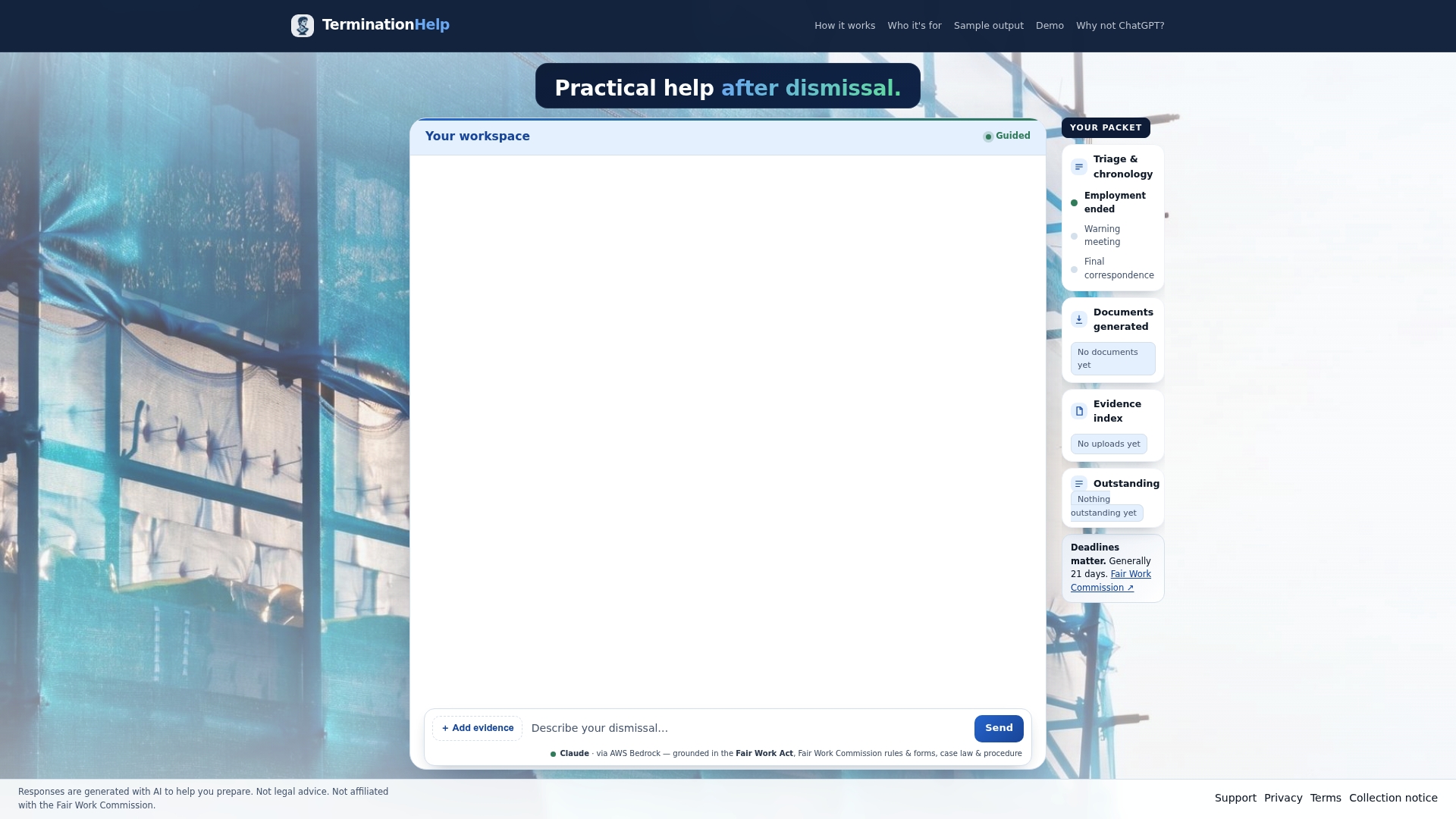
If you are weighing up an offer or about to lodge, start with our preparation support. If your income may be close to the limit that can block a claim, read about the high income threshold first.
FAQ
Is compensation for unfair dismissal taxed as ordinary income?
Generally no. It is usually an employment termination payment taxed concessionally up to the ETP cap, which is $270,000 for 2026-27. Unpaid wages and leave inside the same payment are the exception: they are taxed at your marginal rate.
How much tax is withheld from an unfair dismissal settlement?
Under Schedule 11, the employer withholds 32% if you are under preservation age and 17% if you are at or over it, up to the ETP cap. Anything above the cap is withheld at 47%. Your final tax is worked out when you lodge your return.
Can I deduct my legal costs from the settlement?
The ATO's view is that legal expenses of an unfair dismissal action seeking reinstatement or damages are capital in nature and not deductible under section 8-1. If the employer reimburses identified legal costs, that amount is not part of the ETP. Ask a tax agent about your own situation.
Does it matter how the settlement deed describes the payment?
Yes, but it is not the only factor. The ATO and the courts look at the whole arrangement as well as the label. A deed that clearly itemises wages, leave, notice and compensation gives you the most certainty.
What if the payment arrives more than 12 months after dismissal?
A payment made outside 12 months of termination is a delayed termination payment, unless the ATO has approved treating it as an ETP. Speak to a registered tax agent early if your matter is likely to run that long.
Sources
- IT 2424, ATO legal database
- TR 2003/13, ATO legal database
- Applying the ETP caps, ATO
- Employment termination payments for employees, ATO
- Schedule 11 tax table for employment termination payments, ATO
- How ETP components are taxed, ATO
- Employment Disputes: the Implications, Celeste Black, Journal of Australian Taxation
- Is unfair dismissal compensation taxable? MKI Legal
- ATO legal database ruling on legal expenses in an unfair dismissal action
- Tax treatment of compensation payments can be tricky, Regency Partners
- Tax issues to check before recommending a settlement, LPLC
- Is your settlement payment unsettling you? Sladen Legal
- TR 95/35, ATO legal database
- Are unfair dismissal payments taxable? Bentham Legal
- 4 Employment termination payments 2025, ATO individual tax return instructions
- myTax 2025 Employment termination payments, ATO
Recommended
- Unfair Dismissal Filing Fee in Australia: $92.70 and What Else It Costs
- Australia: $95,050 payout cap and unfair dismissal remedies
- Settlement Agreements in Unfair Dismissal Claims: What to Check
- Mitigation of Loss in Unfair Dismissal Claims in Australia
Article produced using AI. This is not legal advice.