

In Australia, no law gives you an automatic right to bring a support person to every workplace meeting. But if you ask for one in a discussion about your dismissal and your employer unreasonably refuses, the Fair Work Commission can weigh that refusal when it decides whether the dismissal was unfair. So ask, in writing, before the meeting.
This guide explains where the right comes from, who you can bring, what they can and cannot do, and what to do if the answer is no.
TL;DR
- There is no general law forcing an employer to offer a support person, but an unreasonable refusal of your request is a factor in an unfair dismissal case under s 387(d) of the Fair Work Act.
- Ask in writing, name your support person and keep the reply.
- A support person is there to support you, take notes and ask for a break. They are not your advocate and do not answer for you.
- If your employer won't reschedule so your person can attend, or refuses outright, note it. It can matter later.
- After a dismissal, the clock is tight: you generally have 21 days to lodge an unfair dismissal application.
Table of Contents
- Where the right to a support person comes from
- Which meetings count
- Who can you bring?
- What a support person can and cannot do
- How to ask for a support person
- When the person you chose can't make it
- If your employer says no
- What happens after a dismissal
- Perspective
- Get your file ready
- FAQ
- Sources
Where the right to a support person comes from
People often assume every employee can demand a support person at any meeting. The position is narrower. The Fair Work Commission says there is no positive obligation on an employer to offer a support person. What the Fair Work Act does is make the employer's conduct relevant: if you ask for a support person in a discussion relating to dismissal and the employer unreasonably refuses, that is a factor the Commission must consider under s 387(d).
Hall Payne Lawyers makes the same point in plain terms: no law expressly requires support persons at all disciplinary meetings. The legal protection is tied to unfair dismissal under Part 3-2 of the Act.
Your contract, enterprise agreement, award or the company's disciplinary policy may go further and promise a support person. Check them. Many workplaces include the right in their policies, and unions often negotiate it into agreements.

What this means in practice
The right works like a safety net after the fact. Your employer can run a poor process, but if it refused a reasonable request for support and then dismissed you, that refusal goes on the scale when the Commission looks at whether the dismissal was harsh, unjust or unreasonable. It is one factor among several, not a stand-alone ground for winning. Our guide to procedural fairness in dismissal shows how the factors fit together.
Which meetings count
The factor applies to discussions relating to dismissal. That includes a meeting where you are told you may be dismissed, a show-cause meeting about misconduct or performance, and the meeting where a decision is delivered. A routine catch-up with your manager is not the same thing, although asking for support at a disciplinary or warning meeting is still sensible. Employers often escalate from warnings to termination, and a request made early shows you have been consistent.
If you are not sure whether a meeting could lead to dismissal, ask the employer what the meeting is about and who will attend. A fair employer will tell you. A vague invitation with no agenda is a good reason to ask for details and for a support person.
Who can you bring?
You choose. Professionals Australia lists a friend or family member, a union delegate or official, or a trusted work colleague. A union representative is common, and being a member of a union generally gives you someone who knows the process.
Your employer can't pick your support person for you. There are limits, though. The same source says an employer may reasonably refuse a nominated person in limited situations, such as a clear conflict of interest or a health and safety risk. Bringing a direct competitor's employee, or someone who is a witness in the same matter, could fall into that category.
A practical test: choose someone calm, discreet and not personally involved. A partner who is furious at your boss is a poor choice. A steady friend or colleague who can take clear notes is a good one.
What a support person can and cannot do
The role is supportive, not adversarial. The Fair Work Commission notes that a support person does not act as an advocate: they don't present or defend your case. Professionals Australia describes the role this way: they can give emotional and moral support, take notes, ask clarifying questions, request a break, raise procedural fairness concerns, and step in if the meeting escalates or questions become inappropriate. They are not there to answer or argue for you.
Legal Aid NSW adds that the person may not be allowed to speak at all, but they can be a witness to what happens. That alone is valuable. If a dispute later arises about what was said, you have a second person with notes.
| Support person can | Support person generally should not |
|---|---|
| Sit with you and give moral support | Speak for you or answer questions on your behalf |
| Take notes of what is said | Argue your case or cross-examine managers |
| Ask for clarification | Disrupt or take over the meeting |
| Ask for a break so you can talk privately | Give their own opinions on the allegations |
| Flag unfair process or inappropriate questions | Record the meeting without agreement (check your state's surveillance laws first) |
Hall Payne Lawyers says a support person can ask you questions, seek clarification, and ask for a break so you can speak privately. Use that. If a meeting is long and draining, planning a pause in advance helps; this piece on why meeting fatigue happens explains why short breaks matter.
If you need someone who can argue your position, speak to your union, a community legal centre or a lawyer before the meeting. A support person and a representative are different roles.
How to ask for a support person
- Ask as soon as you get the meeting notice. Don't wait until you walk in the door.
- Put it in writing. An email is enough: you would like to bring a support person, and here is their name.
- Ask for details. Request the purpose of the meeting, any allegations, and any documents they will rely on.
- Keep the reply. If you hear nothing, follow up and keep a record of that too.
- Brief your support person. Tell them their job: listen, take notes, keep you steady.
- Write up the meeting afterwards. Compare notes the same day while memories are fresh.
A short example you could adapt: "I have received your invitation to a meeting on [day]. I would like [name] to attend as my support person. Please confirm, and let me know the purpose of the meeting and any allegations to be discussed."
When the person you chose can't make it
Timing is where many disputes arise. Professionals Australia says that if the support person cannot attend at the allocated time, you should be given a reasonable amount of time and the employer should accommodate this as far as is reasonable, including by adjourning or using video conference. A short delay of a day or two is the sort of request an employer should usually be able to meet.
There is a subtlety. The Fair Work Commission explains that refusing a request to adjourn a disciplinary meeting may be relevant to procedural fairness generally, but it is not relevant to the s 387(d) support person factor. In other words, a refused adjournment can still count against the employer on process, just under a different heading. Hall Payne Lawyers highlights the same practical point: whether the employer unreasonably refuses to reschedule where support is needed can feed into the fairness of the process.
So offer alternatives. If your first choice is unavailable, suggest a time that works, a video link, or a backup person. That shows you were reasonable and makes any refusal look worse for the employer.

If your employer says no
Legal Aid NSW advises you to ask to bring a support person and, if the employer refuses and you are then dismissed, notes that the refusal will be relevant to whether the dismissal was unfair. Here is what to do:
- Stay calm and ask why. Get the reason in writing if you can. A conflict of interest or safety concern is different from a blanket refusal.
- Offer another person or a new time. It tests whether the refusal is reasonable.
- Attend if you must, and say you've asked. Note at the start that you requested a support person and were refused. Avoid walking out, which can be used against you.
- Write a file note straight afterwards. Record the date, who was present, what was said, and how your request was handled.
- Don't sign anything on the spot. You can ask for time to consider documents.
If you are dismissed, collect the dismissal letter, the meeting invitation, your request for a support person, and the reply. These become evidence.
What happens after a dismissal
A refused support person doesn't win a claim by itself. The Commission considers whether there was a valid reason, whether you were notified of it and could respond, any warnings for performance issues, the size of the business and its HR resources, and other matters. Your request and the employer's response sit within that bigger picture. Our overview of employer obligations when dismissing an employee sets out what a fair process looks like.
The deadline is the part that catches people. You generally have 21 days from the day the dismissal takes effect to lodge an application, and you also need to meet the eligibility rules, such as minimum employment period and coverage. Read our guide to unfair dismissal eligibility and the 21-day limit the same week you are dismissed. For what follows lodgement, see the Fair Work Commission process step by step.
Perspective
We see the same pattern in people who come to us after a dismissal. The meeting went badly, they were alone, and months later they can't say exactly what was put to them or what they replied. A support person fixes much of that, because it gives you a witness and a set of notes.
The other pattern is the missing paper trail. Someone asked for a support person verbally, was told no, and has nothing to show for it. We built our preparation support around the idea that your case is only as strong as your organised evidence: dates, emails, the request, the reply, the outcome.
Our tool is dedicated to Australian Fair Work law and procedure. It checks eligibility, helps you organise evidence, tracks your timeline and generates the forms you need, so you or your lawyer, union or community legal centre can start from a clear, structured file.
Nicolas
Get your file ready
If you have been dismissed, or think a dismissal meeting is coming, preparation matters more than anything else you can do this week. Our preparation support walks you through eligibility, your timeline and your evidence, including the support person request and any refusal, and generates the Fair Work forms for your matter. You can then file independently or take the packet to a lawyer, union or community legal centre.
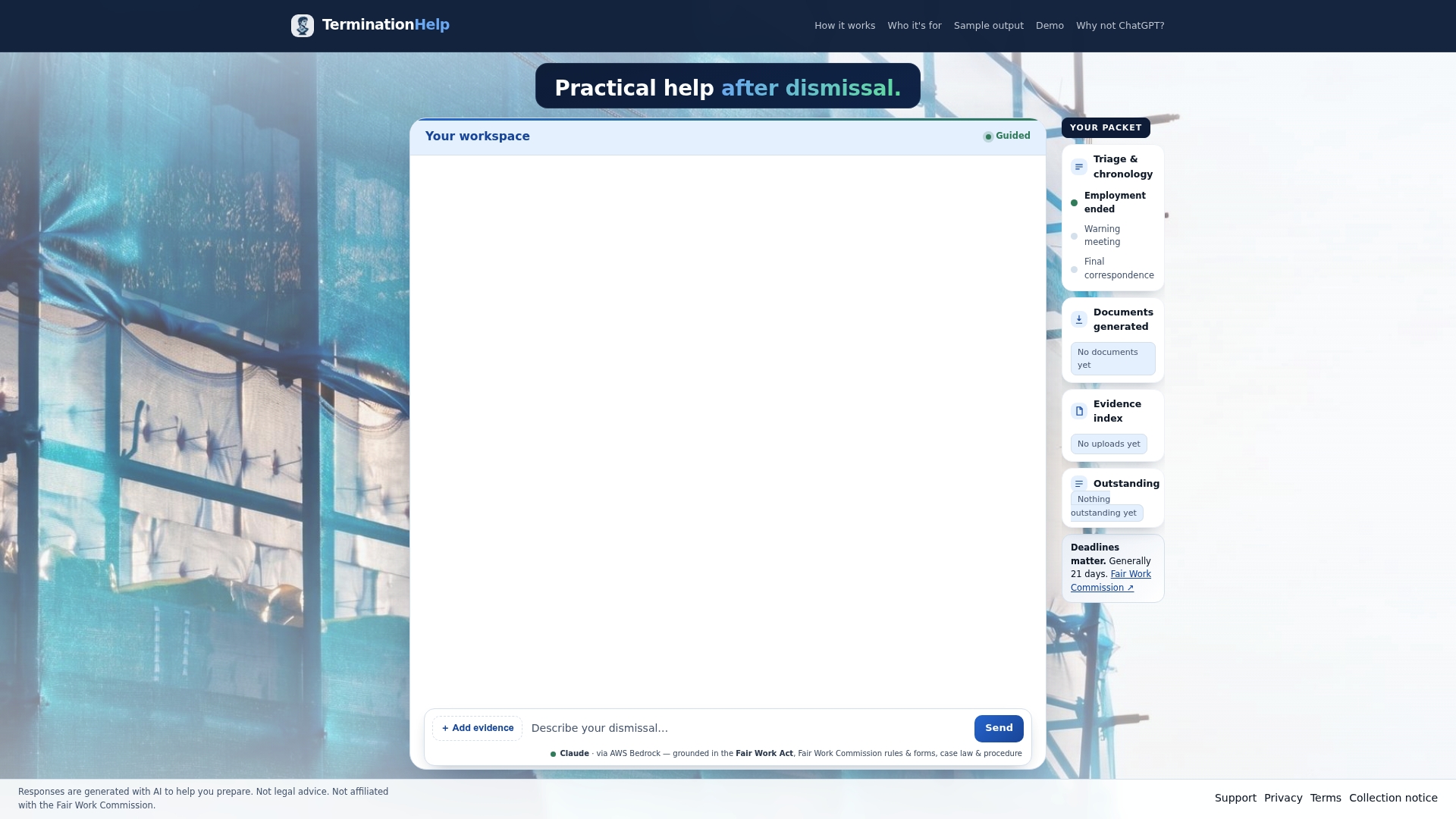
It is built around Australian legislation and Fair Work Commission procedure, so you spend your time on the facts of your case rather than on working out which form comes next.
FAQ
Can my employer refuse a support person?
It can say no, but not safely. If you ask for a support person in a discussion relating to dismissal and the refusal is unreasonable, the Commission can take it into account when deciding if the dismissal was unfair. Limited reasons, such as a clear conflict of interest or a health and safety risk, may make a refusal reasonable.
Can my support person speak for me?
Generally no. The Fair Work Commission says a support person does not act as an advocate. They can take notes, ask for clarification, request a break and raise concerns about process, but they don't answer questions or argue your case. If you want representation, talk to your union or a lawyer.
Can I bring a union representative?
Yes. A union delegate or official is one of the usual choices for a support person. If you are a union member, contact them as soon as you receive the meeting notice, as they may also be able to advise you on the process and your next steps.
What if I wasn't given a chance to ask for a support person?
If the employer called a sudden meeting and dismissed you without notice of its purpose, that may count against the employer on procedural fairness, and the s 387 factors look at whether you were told the reason and could respond. Write down exactly what happened straight away and check your 21-day deadline.
Sources
- Unreasonable refusal of a support person, Fair Work Commission
- Support Person at a Disciplinary Meeting, Hall Payne Lawyers
- I am being investigated at work, Legal Aid NSW
Recommended
- Procedural Fairness in Dismissal: What Australian Law Requires
- Employer obligations when dismissing an employee in Australia
Article produced using AI. This is not legal advice.