

Reinstatement is the Fair Work Commission's primary remedy for an unfair dismissal, but it is ordered in only a small share of decided cases. Your prospects depend on three things: whether the dismissal was unfair, whether you ask for your job back, and whether the Commission accepts that the working relationship can be repaired. You can prepare for all three before you lodge. Preparing the claim properly from the start is what keeps reinstatement open as an outcome.
TL;DR
- Reinstatement means the employer restores your job on the same pay and conditions, though not always the identical position.
- In 2024-25, 9 of 263 unfair dismissal outcomes involved reinstatement. Most others ended in compensation only.
- The Commission looks hard at trust, whether your role or an equivalent still exists, and whether the employer would probably dismiss you again.
- You say what outcome you want on the application form, and you have 21 calendar days from the dismissal taking effect to lodge it.
- Clear evidence and a well-organised claim give reinstatement its best chance.
Table of Contents
- What reinstatement actually means
- How often the Commission orders reinstatement
- What the Commission weighs
- Building a case that supports reinstatement
- Asking for it on the form
- When compensation takes the place of reinstatement
- Casual workers, contractors and gig workers
- If the employer ignores the order
- Preparing your claim with us
- Our view on reinstatement
- FAQ
- Sources
What reinstatement actually means
When the Commission finds a dismissal unfair, it first considers whether reinstatement is appropriate. The employer must restore your job with the same pay, benefits and working conditions. It need not be the same position.
The Fair Work Act sets out the two forms an order can take. Under section 391(1), the employer at the time of dismissal must either:
- reappoint you to the position you held immediately before the dismissal, or
- appoint you to another position on terms and conditions no less favourable than before.
There is a third route that surprises many people. If your old position no longer exists with the original employer, section 391(1A) allows the Commission to order reinstatement to an associated entity, such as a related body corporate, where that position or an equivalent one is available there.
What comes with a reinstatement order
Reinstatement is not only about returning to work. The Commission may also order that your continuity of employment and continuous service be maintained. It may order the employer to pay an amount for the remuneration you lost, or were likely to lose, because of the dismissal. That amount takes into account what you earned or reasonably could have earned between dismissal and reinstatement, as section 391 provides.

In practice that means a successful outcome can restore your service history, your accrued entitlements and your income for the gap. That is a different result from a lump sum alone.
How often the Commission orders reinstatement
The Commission publishes an outcomes table for unfair dismissal hearings. Two recent years show the pattern:
| Year | Total outcomes | Reinstatement only | Reinstatement plus lost pay | Compensation only |
|---|---|---|---|---|
| 2023-24 | 265 | 4 | 13 | 142 |
| 2024-25 | 263 | 4 | 5 | 134 |
Adding the two reinstatement columns, that is 17 of 265 outcomes in 2023-24 (about 6%) and 9 of 263 in 2024-25 (about 3%). These figures cover cases that went to a decision. They do not capture matters settled at conciliation, where the terms are whatever the parties agree.
Two lessons follow. First, reinstatement is realistic only when the facts line up for it. Second, many applicants who might want their job back never make it a clear part of their case. Whether you want the job, and why, is something to settle early.
What the Commission weighs
The Commission may decide not to order reinstatement. Its guidance lists situations such as these:
- the business no longer operates
- you cannot work because of illness or injury
- your position does not exist anymore
- you and the employer cannot work together because of your relationship
- the employer would probably dismiss you again
The same page of Commission guidance on reinstatement is the one to read before you decide what to ask for.
Loss of trust and confidence
This is the argument employers raise most often. The Commission's own reinstatement resource says loss of trust and confidence can make reinstatement inappropriate where re-establishing the employment relationship is not feasible. It also says the loss is a relevant factor that is not necessarily conclusive, and that the reason for it must be soundly and rationally based.
So an employer's statement that it no longer trusts you is not the end of the matter. The Commission considers for itself whether the loss of trust is real. What helps you is evidence that points the other way: a clean record, positive reviews, and the way you and your manager worked together before the dispute.
A decision that shows the other side is Barratt-Hassett v ScreenAway Australia Pty Ltd [2021] FWC 1504. The applicant was found to have been unfairly dismissed, but reinstatement was not sought and would not have been appropriate given the evidence about loss of trust and confidence. The lesson is that how you present the relationship, and whether you ask for the job back, shapes the remedy.

The job is gone
By the time a matter is decided, the role you held has often been filled or restructured. The Commission's resource says this is common, but that it is not enough on its own to find reinstatement inappropriate. Unavailability of a vacancy is one factor among several. Section 391(1A) is the reason an employer that has restructured into another company in the group cannot simply point to the empty desk.
Illness and injury
If you are unable to work because of illness or injury, the Commission may decline reinstatement. If your dismissal happened while you were unwell, think about your medical evidence early, including when you expect to be fit for work. A clear, current picture of your capacity matters more than a general statement that you want to return.
Building a case that supports reinstatement
Reinstatement is a forward-looking remedy. The Commission is asking whether the job can work again, so your evidence should answer that as well as showing the dismissal was unfair.
Gather material on:
- Your record. Performance reviews, awards, positive emails, length of service and the absence of prior warnings.
- The relationship. Evidence that you worked with colleagues and managers without incident before the events that led to dismissal.
- The reason given. Whether it was valid and whether it was put to you. The procedural fairness requirements and the employer's obligations when dismissing are the standard you test the dismissal against.
- Your availability. Your fitness and willingness to return, and any practical matters such as location.
- Your efforts since. What you have done to look for work, which also feeds into any mitigation of loss assessment if compensation ends up being the outcome.
While a claim runs, a gap in your work history is normal. When you apply for other work in the meantime, this guide to a career gap resume shows one way to present a break in employment on a CV.
An organised file also helps with a point many applicants overlook: the Commission decides on the evidence in front of it. If a document is not in the packet, it does not support you.
Asking for it on the form
Reinstatement does not arrive by default. The Form F2 unfair dismissal application asks whether you are applying within 21 calendar days of the dismissal taking effect, what outcome you are seeking, and why you say the dismissal was unfair. Those three answers frame your case from day one.
The deadline is strict. The eligibility guide covers how the 21 days are counted and which workers can apply. The step-by-step process shows what comes after you lodge, including conciliation. Conciliation is often where reinstatement is first discussed, so decide before you walk in whether you want your job back, would accept a different role, or would prefer a payment.
When compensation takes the place of reinstatement
If the Commission is satisfied that reinstatement is inappropriate and that compensation is appropriate, it can order payment in lieu of reinstatement. In deciding the amount it must consider all the circumstances, including:
- the effect of the order on the viability of the employer's business
- your length of service
- the remuneration you would have received
- your efforts to mitigate loss
- pay you earned, or are likely to earn, between dismissal and the order
Compensation is limited by law, and it cannot include an amount for shock, distress or humiliation caused by the manner of dismissal. Our guide to the cap and unfair dismissal remedies sets out the current limit.
This is why your preparation should serve both outcomes. If you ask for reinstatement and the Commission decides against it, the same evidence on your pay, service and job search carries into the compensation assessment.
Casual workers, contractors and gig workers
Your status decides whether you can claim at all, and so whether reinstatement is possible. Casual employees can claim in the right circumstances, and our guides on casual employees and probation explain the service tests.
For contractors, the question is whether the arrangement is really employment. In Franco v Deliveroo [2021] FWC 2818, the Commission found the applicant was an employee, found the dismissal harsh, unjust and unreasonable, and ordered reinstatement. The decision was later quashed by the Full Bench, so it shows how the question is argued rather than a settled rule. Separately, since 26 February 2025 some gig workers and contractors can apply under unfair deactivation provisions, where the remedy is reactivation rather than compensation instead.
If the employer ignores the order
A reinstatement order is not optional for the employer. If it does not follow an order, you can apply to the Federal Court of Australia or the Federal Circuit and Family Court of Australia to enforce it within six years of the breach. According to Legal Aid NSW, the courts can fine the employer, award compensation for loss suffered, order reinstatement, or make other orders.
Preparing your claim with us
Our preparation support is built for exactly this stage. It runs an eligibility check, helps you organise and upload your evidence, builds a timeline and generates the Fair Work forms your matter needs. You get a structured packet that you can file yourself or take to a lawyer, union or community legal centre. Everything is grounded in Australian legislation, Fair Work Commission rules and case law, and your data stays onshore and is never used to train AI. You can start at our preparation support page.
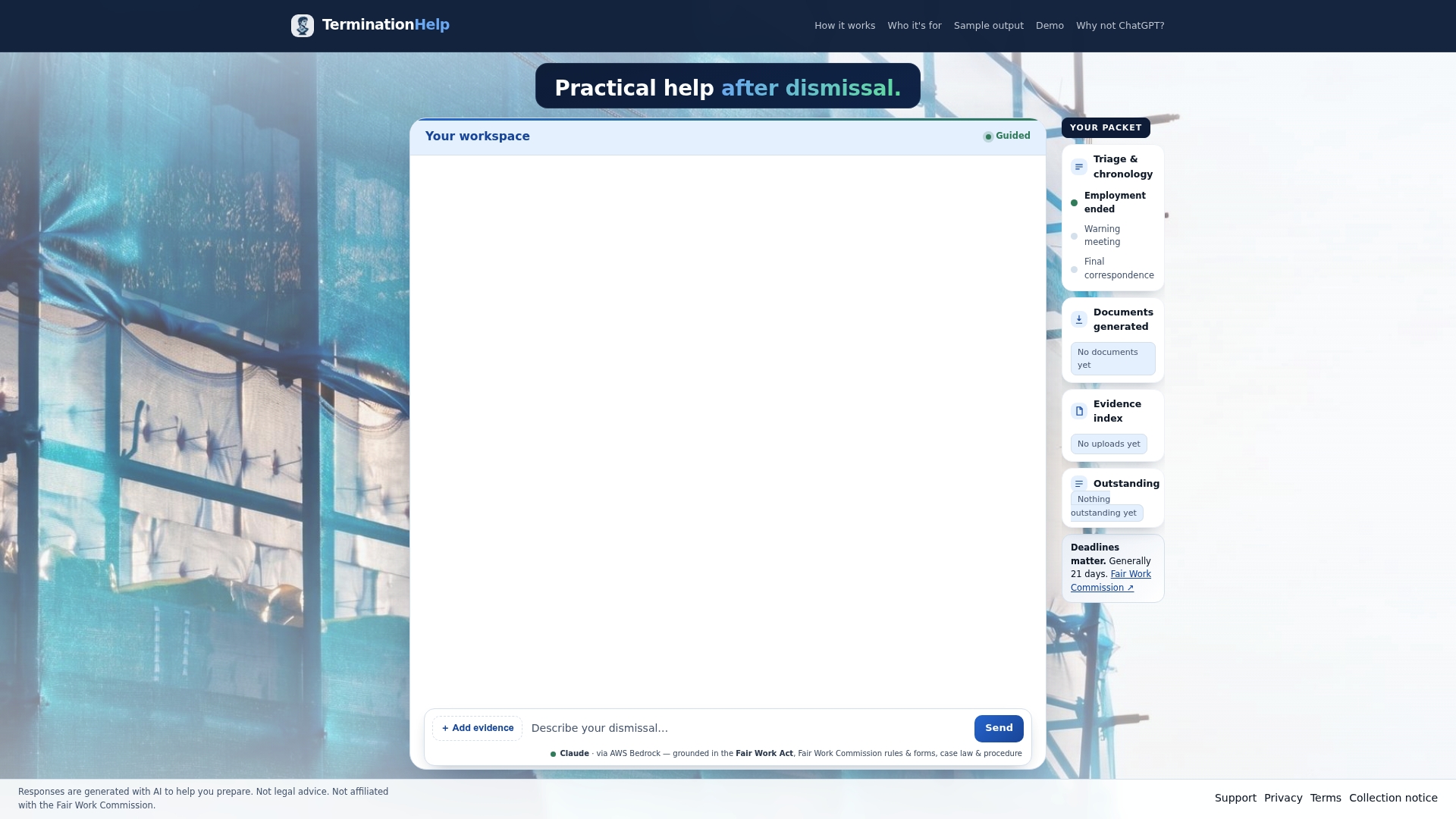
If you are inside the 21-day window, begin there first. If you are unsure whether you are eligible, the eligibility check comes before anything else.
Our view on reinstatement
Most people who contact us say they want their job back, then discover they have not thought about what that means. Do you want the same desk, the same manager, the same hours? Would you take an equivalent role elsewhere in the group? The Commission asks these questions, and it is far better to have your answers ready than to improvise them at conciliation.
We built our tool around Australian unfair dismissal law because the details matter. A reinstatement case turns on trust, on whether a role exists, on your record and on how the claim is framed on the form. Our preparation workflow is designed to bring those threads into one organised packet: eligibility, evidence, timeline and every form.
The outcomes table shows reinstatement orders are a small slice of decisions. We read that as a reason to prepare carefully, not a reason to skip the ask. A claim that is clear about the outcome, backed by documents and filed on time gives the Commission something to work with.
Nicolas
FAQ
Can I ask for reinstatement if I do not want my old job back?
Yes. Reinstatement can be to another position on terms and conditions no less favourable than before. If you would rather have compensation, you can say so on the application form, which asks what outcome you are seeking.
Does loss of trust stop reinstatement?
Not automatically. The Commission treats loss of trust and confidence as a relevant factor that is not necessarily conclusive, and the reason for it must be soundly and rationally based. The Commission considers for itself whether the trust has really gone.
Will I be paid for the time I was out of work?
If the Commission orders reinstatement, it may also order the employer to pay for remuneration you lost, or were likely to lose, because of the dismissal. It takes into account what you earned or could reasonably have earned in the meantime. It can also order your continuity of service to be maintained.
What if my position no longer exists?
That alone does not rule out reinstatement. The Commission treats the lack of a vacancy as one factor, and it can order reinstatement to an associated entity of the employer where the position or an equivalent one is available there.
Sources
- Reinstatement after unfair dismissal, Fair Work Commission
- Outcomes or remedies at an unfair dismissal hearing, Fair Work Commission
- Reinstatement, Fair Work Commission
- Fair Work Act 2009 s 391, AustLII
- Compensation and other remedies, Law Handbook SA
- Barratt-Hassett v ScreenAway Australia Pty Ltd [2021] FWC 1504
- Form F2 unfair dismissal application, Fair Work Commission
- Franco v Deliveroo [2021] FWC 2818
- Unfair dismissal Fair Work Commission decisions, Legal Aid NSW
Recommended
- Procedural Fairness in Dismissal: What Australian Law Requires
- Australia: $95,050 payout cap and unfair dismissal remedies
- Check Unfair Dismissal Eligibility in Australia: 21 days to lodge
- Unfair Dismissal Time Limit: The 21-Day Rule Explained
Article produced using AI. This is not legal advice.