

A PIP response letter is a short, factual, written reply to a performance improvement plan. It puts your side on the record, accepts what is fair, challenges what is inaccurate, and asks for the specifics you need to meet the plan. Send it within a few days of receiving the PIP, keep the tone professional, and attach evidence for every point you dispute. Below is how to structure it, what to say, and what to do if the plan is really a step towards dismissal.
TL;DR
- Reply in writing, calmly and factually. Acknowledge receipt, say you want to meet the expectations, and list what you dispute with evidence.
- Ask for vague goals such as "attitude" or "communication" to be replaced with specific, measurable targets.
- In Australia, an employer should have a valid reason and follow a fair process before disciplinary action. There is no set number of warnings required before termination.
- Keep copies of everything. If you are later dismissed, you generally have only 21 days to lodge an unfair dismissal application.
- A PIP response letter is different from a Form F3, which is the response an employer files when an employee claims unfair dismissal.
Table of Contents
- What a PIP response letter is (and what it is not)
- Know your position before you write
- Before you reply: the first 48 hours
- What to put in your PIP response letter
- A template you can adapt
- What evidence to attach
- Mistakes that weaken a PIP response
- If the plan is unfair or unreasonable
- Our perspective
- Get your records in order with Terminationhelp
- FAQ
- Sources
What a PIP response letter is (and what it is not)
A performance improvement plan is a document your employer gives you that sets out concerns about your work, the standard they expect and a period to reach it. A response letter is your written answer. It is not a resignation, not a complaint to a regulator, and not a legal claim. It is a record.
That record matters. One workplace-documentation guide describes a written response as one of the most important pieces of documentation an employee can create, because it makes sure your account of events is officially on file. If the situation later reaches the Fair Work Commission, the employer will tell its story using warning letters and reviews. Your letter shows you engaged in good faith and raised problems at the time, not months afterwards.
It also helps to separate it from the document with a similar-sounding name. When an employee lodges an unfair dismissal claim, the employer responds on Form F3. The Commission says the employer responds to the claims, sends the response to the Commission and the employee within 7 days, and includes supporting material such as warning letters or performance reviews. Your PIP response is the earlier document. It sits in your employment file long before any claim, and a Commission member may later read it alongside the employer's material.

Know your position before you write
Three minutes of context will make your letter sharper.
Your employer needs a valid reason and a fair process. The Fair Work Ombudsman says employers should have a valid reason and follow a fair process before disciplinary action such as a warning. That gives you a frame: is the stated reason accurate, and has the process been fair? Your letter can raise both without sounding legalistic.
There is no magic number of warnings. The same Ombudsman page explains there is no general requirement for an employer to issue a specific number of warnings before ending employment, although they should usually give you an opportunity to fix performance issues. So do not assume you are safe until three letters have been issued. Treat a PIP as serious from day one.
A PIP is not a dismissal. You cannot lodge an unfair dismissal application over a PIP alone. The right to apply arises if your employment ends. Our guide to procedural fairness in dismissal explains what Australian law expects before an employer reaches that point, and the page on employer obligations when dismissing an employee covers the other side of the table.
Eligibility depends on your circumstances. Whether you could ever claim depends on things like how long you have worked there, your pay and the size of the employer. You can check unfair dismissal eligibility now, without waiting for a crisis. If you are on probation or casual, the guides on claiming unfair dismissal on probation and casual employees and unfair dismissal are worth reading first.

Before you reply: the first 48 hours
Do not respond in the meeting where the PIP is handed over, and do not sign anything that says you agree with every point. You can sign to acknowledge receipt only. Say something like: "Thank you, I would like time to read this properly and will respond in writing."
Then:
- Ask for the full document and any attachments if you only saw a summary.
- Write down what was said in the meeting, with date, time and who was present, while you remember it.
- Gather your records: emails, project files, performance reviews, targets, KPIs, messages praising your work, training records.
- Read your contract, position description and any workplace policy on performance management. A PIP that applies a standard not found in your role description is worth noting.
- Cool down. A letter written the same evening tends to carry anger. One summary of PIP-response advice warns that emotional language weakens a rebuttal and recommends sticking to factual actions. That is sound whatever country you work in.
What to put in your PIP response letter
Keep it to one to three pages. Address it to the manager who issued the plan and consider copying HR, so there is no doubt it was received. Use headed sections so the reader can follow.
1. Acknowledge receipt and set the tone
State the date you received the plan and that you take it seriously. Say you are committed to meeting the reasonable expectations of the role. This is not an admission of poor performance. It shows good faith.
2. Say what you accept
Identify the parts of the plan you agree with. One guide to writing PIP responses advises that naming what you accept makes the contested parts easier to read as a considered, serious response. If a deadline was missed once, say so plainly and explain what you have changed. Honest concessions make your disputes more believable.
3. Correct inaccurate statements, point by point
Go through each allegation separately. For each, give the date, what actually happened and the evidence. Date-stamped emails, performance data, earlier reviews and witness accounts are the sort of material recommended for matching each allegation to proof. Stick to what can be checked.
A useful pattern for each point:
- What the PIP says: quote the line.
- What the record shows: one or two factual sentences.
- Evidence: attachment number and description.
4. Ask for specifics where goals are vague
Phrases like "poor attitude", "needs to communicate better" or "lacks ownership" cannot be passed or failed. A formal response can request the specific observable behaviour, situation and time period behind a vague claim and ask for the evidence. You can also propose measurable versions yourself, so the target becomes something you can clearly meet.
For example, replace "improve communication" with "respond to client emails within one business day, measured over the 60-day plan period".
5. Request the support you need
List anything that would help you meet the plan: training, a clearer priority list, regular check-ins, access to systems, adjusted workload. Put it in writing now. It is much harder to argue later that you were given a fair chance if you asked for help and received none.
6. Propose a follow-up meeting
The Fair Work Ombudsman suggests discussing and agreeing on clear and reasonable improvement steps, documenting the meeting and considering support such as training at follow-up. Ask for fortnightly or weekly check-ins with written notes sent afterwards, and offer to prepare the notes yourself.
7. Close politely and list attachments
Thank the reader, confirm you want to resolve the matter constructively, and list your attachments by number.
A template you can adapt
Dear [Manager's name],
Thank you for providing me with the performance improvement plan dated [date]. I received it on [date] and have reviewed it carefully. I am committed to meeting the reasonable expectations of my role and want to work with you on this.
Points I accept: [e.g. the report due on 4 March was submitted two days late.]
Points I would like to clarify:
- The plan states [quote]. My records show [facts, dates]. See Attachment 1.
- The plan states [quote]. [Facts]. See Attachment 2.
Measurable targets: The plan refers to [vague goal]. Could you please confirm what specific behaviour or result is expected, how it will be measured, and by when? I suggest [your proposed measure].
Support requested: [training, resources, clearer priorities].
I would appreciate a meeting on [proposed dates] to agree on the steps and review progress regularly, with a short written summary after each meeting.
Kind regards, [Name]
Change the content to fit your facts. Do not copy a template word for word. A letter that sounds like you is more credible.
What evidence to attach
Choose evidence that answers a specific allegation. A pile of unrelated documents dilutes your case.
| Allegation in the PIP | Useful evidence |
|---|---|
| Missed deadlines | Email threads showing when work was requested, delivered and approved; project tracker screenshots |
| Low output or targets not met | Sales or performance data, comparisons using the same measure for your team, changes to targets mid-period |
| Quality problems | Examples of accepted work, client feedback, sign-offs |
| Behaviour or attitude | Names, dates and incidents you can respond to; written feedback from colleagues |
| "Never told" about expectations | Your position description, onboarding documents, previous reviews with no concerns noted |
Only attach documents you are entitled to hold. Do not forward confidential client or commercial information to a personal email account. If you are unsure, describe the document and say where it can be found.
If you want to understand how to organise and present evidence properly, a guide from an employment law practice on questions to ask an employment lawyer can help you work out which records to collect and how to correct the record with objective facts.
Mistakes that weaken a PIP response
- Attacking the manager personally. Criticise facts, not character.
- Disputing everything. If every line is contested, none stands out.
- Using your work email for personal complaints you would not want read. Assume the employer can read it.
- Resigning in frustration. Resigning can end your right to claim unless you were forced to leave, and that is hard to prove. Talk to a lawyer, union or community legal centre before you decide.
- Missing the deadline for reply. If the plan sets a date for a response, meet it. If you need longer, ask in writing.
- Not keeping copies. Store your own copy of the PIP, your response and every follow-up note outside work systems where this is legitimate.
If the plan is unfair or unreasonable
Sometimes the PIP is not a real chance to improve. Warning signs include targets that were set impossibly high, no support offered, shifting goals, a very short timeline, or a PIP that follows a sick-leave absence, a complaint or a pregnancy announcement. In those cases:
- Say in your letter that you consider the plan unreasonable and explain why, factually.
- Raise any concern about bullying, discrimination or adverse action with HR in writing, with dates.
- Seek advice early from the Fair Work Ombudsman, your union, a community legal centre or an employment lawyer.
- Keep performing and documenting. A good-faith effort is usually better evidence than a refusal.
If the employer then dismisses you, the timeline is short. An unfair dismissal application generally has to be lodged within 21 days of the dismissal taking effect. Our guide to filing an unfair dismissal claim within 21 days walks through the steps, and the page on what to set out in your claim explains how the PIP and your response letter can feed into your particulars. Your PIP correspondence becomes part of the evidence, which is another reason to write it carefully now. If you want to know how Commission decisions treat performance cases, see how to read unfair dismissal case law. For what a successful claim can lead to, read about the payout cap and unfair dismissal remedies.
Our perspective
Most people write their PIP response late, emotionally, or not at all. Then the dismissal arrives and they are trying to rebuild a timeline from memory in a 21-day window.
We built Terminationhelp around the idea that preparation starts before the dismissal. Our tool is dedicated to Australian Fair Work claims and is designed to be bounded by Australian legislation, Fair Work Commission procedure and relevant case law. It helps you organise your evidence, understand where you stand, and prepare the documents you will need at each stage.
A strong PIP response and a strong unfair dismissal application draw on the same material: dates, documents, the reason given, and the process followed. If you keep those in order from the start, you are never scrambling. And if you decide to take the matter to a lawyer, union or community legal centre, you arrive with a structured packet instead of a shoebox of emails.
Nicolas
Get your records in order with Terminationhelp
If your PIP looks like the first step towards a dismissal, you do not have to wait for the dismissal to start preparing. Our preparation support walks you through an eligibility check, helps you organise your evidence and timeline, and generates the Fair Work forms you may need, so you can file independently or take a structured packet to a lawyer, union or community legal centre.
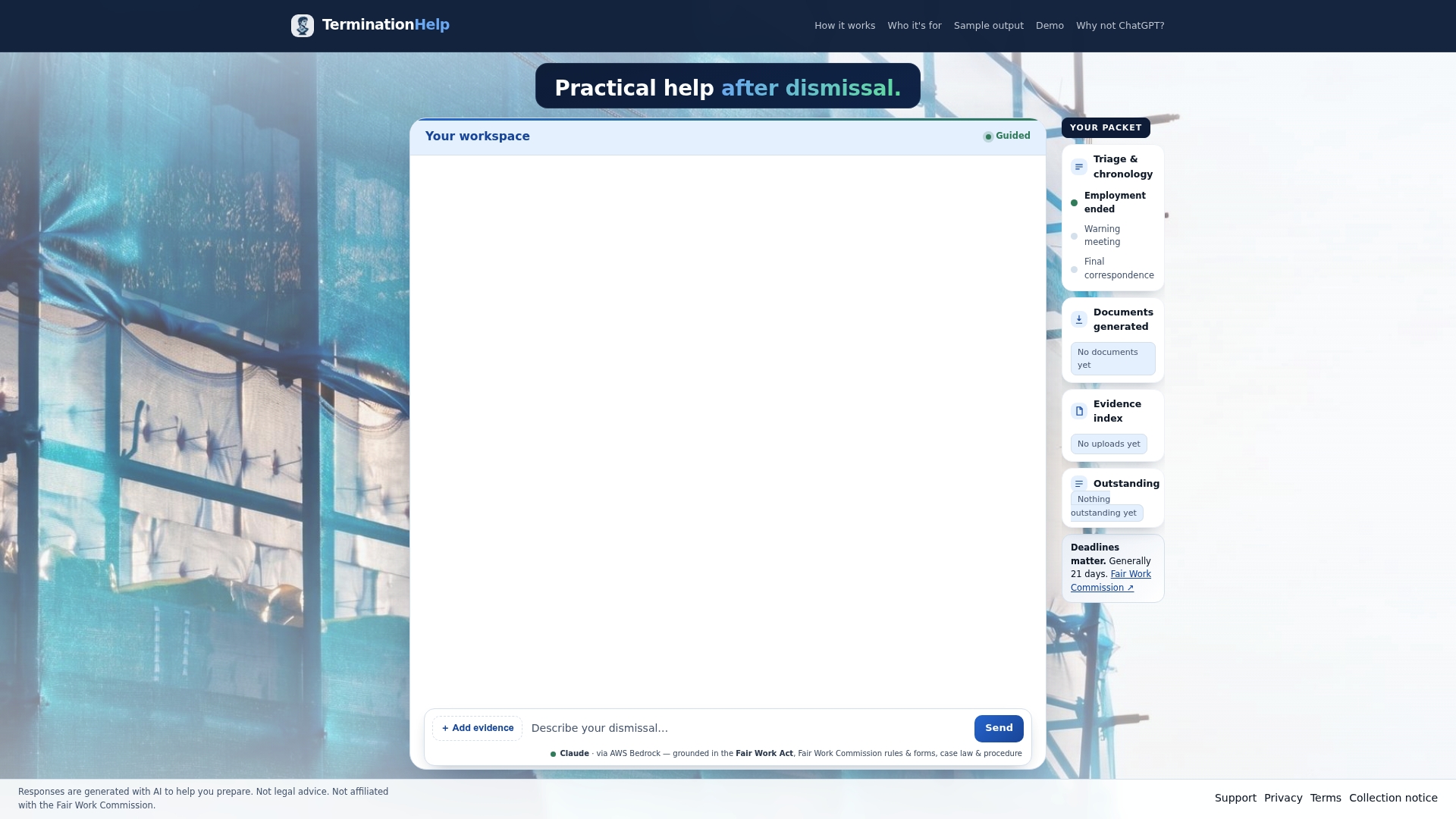
See how preparation support works, or start from the Terminationhelp home page.
FAQ
Should I respond to a PIP in writing even if I disagree with it completely?
Yes. Even if you reject most of it, a written response keeps your account on the record. Stay factual, identify any parts you accept, and ask for the specific evidence behind the claims you dispute. Refusing to engage can be used against you later.
How long do I have to respond to a PIP?
There is no single legal deadline. Check the plan itself, as many set a date for comments. If none is given, aim to reply within a few working days, and ask in writing for more time if you need it.
Can I be dismissed after a PIP without further warning?
Possibly. The Fair Work Ombudsman says there is no general requirement for a set number of warnings, though employers should usually give you a chance to address performance concerns. Whether a dismissal is unfair depends on the facts, including the reason and the process. Seek advice quickly if you are dismissed.
Is a PIP response the same as responding to an unfair dismissal claim?
No. A PIP response is your written reply to a performance plan during employment. Responding to an unfair dismissal claim is something an employer does on Form F3 after an employee lodges a claim with the Fair Work Commission.
Sources
- Managing performance and warnings, Fair Work Ombudsman
- What to do when an employee claims unfair dismissal, Fair Work Commission
- How to Respond to a PIP: The First 48 Hours, WorkProof
- How to Write a Rebuttal Letter to Your Employer, LegalClarity
- How to respond to a PIP in writing: the five parts, FairHanded
- When Your PIP Is Political: How to Respond, Shirisha Nagendran
Recommended
- Check Unfair Dismissal Eligibility in Australia: 21 days to lodge
- File an unfair dismissal claim in Australia within 21 days
- Mitigation of Loss in Unfair Dismissal Claims in Australia
- Constructive dismissal in Australia: lodge within 21 days
Article produced using AI. This is not legal advice.