

A notice of discontinuance is the Fair Work Commission (FWC) form that tells the Commission you want to stop your application. It is Form F50. Once you send it, the claim stops and the case is closed. You email it to the team or Chambers handling your matter, copy in lodge@fwc.gov.au, and send a copy to the other side.
That sounds simple, and the form is. The hard part is the decision behind it. A discontinuance is difficult to undo, and the 21-day clock on a dismissal claim keeps running while you decide. This guide covers who can file, how to lodge, what happens next, what a settlement changes and what to think through first.
TL;DR
- Form F50 (Notice of discontinuance) is the FWC form used to stop an application. After it is sent, the claim ends and the case is closed.
- Email it to the team or Chambers handling your case, copy lodge@fwc.gov.au, and send a copy to the respondent as soon as practicable.
- If you have settled your dispute, you do not need to lodge Form F50, but you must still tell the Commission the matter is finished.
- The Commission cannot simply set aside a filed notice. A new dismissal application is only possible if it is still within 21 days of the dismissal taking effect.
- Think before you file. Check your options and your deadline first, ideally with a lawyer, union or community legal centre.
Table of Contents
- What a notice of discontinuance does
- Who can discontinue, and why people do
- How to complete and lodge Form F50
- What happens after you lodge
- Can you claim again after discontinuing?
- Settlements and discontinuance
- Before you file: a checklist
- Our perspective
- Get your matter organised first
- FAQ
- Sources
What a notice of discontinuance does
When you apply to the FWC (for example for an unfair dismissal remedy), the application becomes a live matter. The Commission contacts the employer, lists the matter for conciliation and may later list it for a hearing. A notice of discontinuance ends all of that at the applicant's request.
The FWC describes Form F50 as the way to tell it you want to stop an application or withdraw a claim. The FWC's guidance on withdrawing an unfair dismissal claim says an employee can withdraw an unfair dismissal application at any time. The legislative basis it points to is section 588 of the Fair Work Act 2009.
In practice, the Commission does not need the employer's agreement. You are the one who started the claim, so you decide whether to continue it. The employer must still be told, and that part is your job (see below).
Who can discontinue, and why people do
The person who made the application, the applicant, is the one who files the notice. In an unfair dismissal matter that is the dismissed employee. The FWC lists two common reasons on its own page: you have changed your mind and no longer want to claim, or you want to submit a different claim.
Other reasons we see people weigh up:
- Settlement. You and the employer reach an agreement, often at or after conciliation.
- Wrong claim type. You realise the facts fit a different application better, for example general protections rather than unfair dismissal. Our FAQ touches on this.
- Wrong or incomplete application. You filed in a hurry to meet the deadline and want to start again properly.
- Personal reasons. Stress, health, a new job or a decision that the fight is not worth it.
If you are a small business owner who has been named as a respondent, note that Form F50 belongs to the applicant. Your role is to respond to the claim (the FWC uses Form F3 for responding to an unfair dismissal application) and to take notice when the applicant stops it.
How to complete and lodge Form F50
The form itself is short. It asks who you are, which application you are stopping and who the respondent is. Before you fill it in, have your matter number from the FWC's letter or email in front of you.
- Download Form F50 from the FWC's notice of discontinuance page.
- Complete the details. Use the same names and matter number that appear on your original application.
- Email it to the team or Chambers handling your case and copy lodge@fwc.gov.au. You can instead send or deliver it to a Commission office.
- Send a copy to the respondent as soon as practicable. This is the employer or the person you made the application against.
- Keep a record. Save the sent email and any reply, in your own case folder.
The FWC says it stores the information you provide in line with the privacy notice for the form, which is set out on its forms page.
What if you do not tell the employer?
The FWC's guidance is that you should send the employer a copy. If you do not, the Commission will write to the employer to say the claim has stopped. So the employer will find out either way. Sending it yourself is quicker, cleaner and avoids confusion about what is happening.
Can you phone or email instead of using the form?
The FWC's withdrawal page says you can fill out Form F50 or contact the Commission by phone, email, letter, fax or in person to say you want to discontinue. If you want a clear paper trail, which we recommend, use the form and keep the email.
What happens after you lodge
Once the notice is in, the application stops and the case is closed. The conciliation or hearing falls away. There is no decision on whether the dismissal was unfair and no remedy is ordered.
The legal position is worth understanding before you file. In a Full Bench appeal, [2013] FWCFB 2530, an applicant had filed a notice of discontinuance after contacting the registry to withdraw before conciliation, then later tried to reopen the matter. The Full Bench held that section 586 of the Act is a power to correct or amend an application. It is not a power to revoke or set aside a notice of discontinuance. The decision also noted that discontinuing leaves no impediment to a subsequent application, subject to time limits.
The same decision records the point that a notice affected by mistake or duress may be treated as a nullity under general law. That is an exceptional argument, not a plan. Treat a filed notice as final.

Can you claim again after discontinuing?
Possibly, but only on narrow terms. The FWC says you may be able to make a different application about the same dismissal, and only if all three of these hold:
- you have stopped your existing application using Form F50
- a Commission Member has not yet made a decision about your unfair dismissal case
- you are still within 21 days of the date the dismissal took effect
The 21-day limit does not pause while your first application sat with the Commission. The FWC also states that there is a strict 21-day deadline for a dismissal application. If you have already used most of those 21 days, discontinuing may leave you no time for a second application.
Two practical consequences follow:
- If your reason for withdrawing is that you filed the wrong type of claim, act quickly. Every day counts against the 21 days from the dismissal date.
- If you only want to fix an error in your application (a wrong name, a wrong date), ask about correcting or amending it rather than discontinuing. The 2013 decision describes section 586 as the correction and amendment power.
On the narrower question of whether you can drop only part of an application and keep the rest, we have not found an FWC page that sets out a partial-withdrawal process. If that is your situation, contact the Commission team handling the matter or get advice before you file. A full F50 ends the application you name on it.
For how the deadline and eligibility work in detail, see our guides on filing an unfair dismissal claim within 21 days and checking unfair dismissal eligibility.
Settlements and discontinuance
Many unfair dismissal matters settle, often at or soon after conciliation. A settlement and a discontinuance are related but not identical.
The FWC's guidance is that if you have settled your dispute, you do not need to lodge Form F50. That comes from Rule 10 of the Fair Work Commission Rules 2024, cited on its withdrawal page. You must still advise the Commission that the matter has finished, so that it can close the file.
A few things to get right in a settlement:
- Get the terms in writing and signed before you stop the claim. Once the application is gone, you have lost your leverage.
- Check what is covered. Payment amount, tax treatment, reference wording, a non-disparagement clause and a release of other claims all matter.
- Match the order of events. Agree what happens first: payment, then the notice, or the reverse. Put it in the agreement.
- Do not discontinue on a verbal promise. A notice cannot be set aside by the Commission just because the other side did not follow through.
If you are unsure what a fair outcome looks like, our guide to unfair dismissal remedies and the compensation cap explains what the Commission can order, which helps you judge any offer. For the order of events at the Commission, see the Fair Work Commission process step by step.
Before you file: a checklist
Because a discontinuance is so hard to reverse, run through these questions first.
- How many days are left? Count from the day the dismissal took effect. If you are inside 21 days, you still have room to file a different application. If not, you probably do not.
- Is there a better claim? Unfair dismissal and general protections are different applications with different requirements. Know which one fits before you drop either.
- Is there a written settlement? If yes, you may not need F50 at all, but the Commission must be told.
- Have you spoken to someone? A lawyer, union or community legal centre can check the decision with you in a short call.
- Do you have your evidence saved? Even if you stop, keep your emails, payslips, termination letter and notes, in case another claim or negotiation follows.
- Is the employer informed? Plan to send them the notice, not leave it to the Commission.
Our perspective
We see the same pattern again and again. People file an unfair dismissal application in a rush to beat the 21 days, then lose confidence when the paperwork gets heavier, and the notice of discontinuance starts to look like the easy exit.
The problem is that the exit is one way. The Commission has said it cannot simply set aside a notice, and the clock on a dismissal claim does not stop for you. The form takes five minutes. The consequences can last for good.
That is why we built our tool around preparation. Our platform is designed to be grounded in Australian legislation, Fair Work Commission rules and procedure, so that you can see your eligibility, your timeline, your evidence and the right forms at each stage before you decide to carry on or step back. In our view, a claimant who has organised their material is in a far better position to settle well, or to make a clear choice to stop, than one working from panic.
Whatever you decide, decide with the facts in front of you and in writing.
Nicolas
Get your matter organised first
If you are weighing whether to continue, change or stop a claim, it helps to see the whole matter laid out. Our preparation support walks you through eligibility checks, timelines and evidence organisation, and generates the Fair Work forms your matter needs, grounded in Australian legislation and FWC procedure. You can file independently or bring the packet to a lawyer, union or community legal centre.
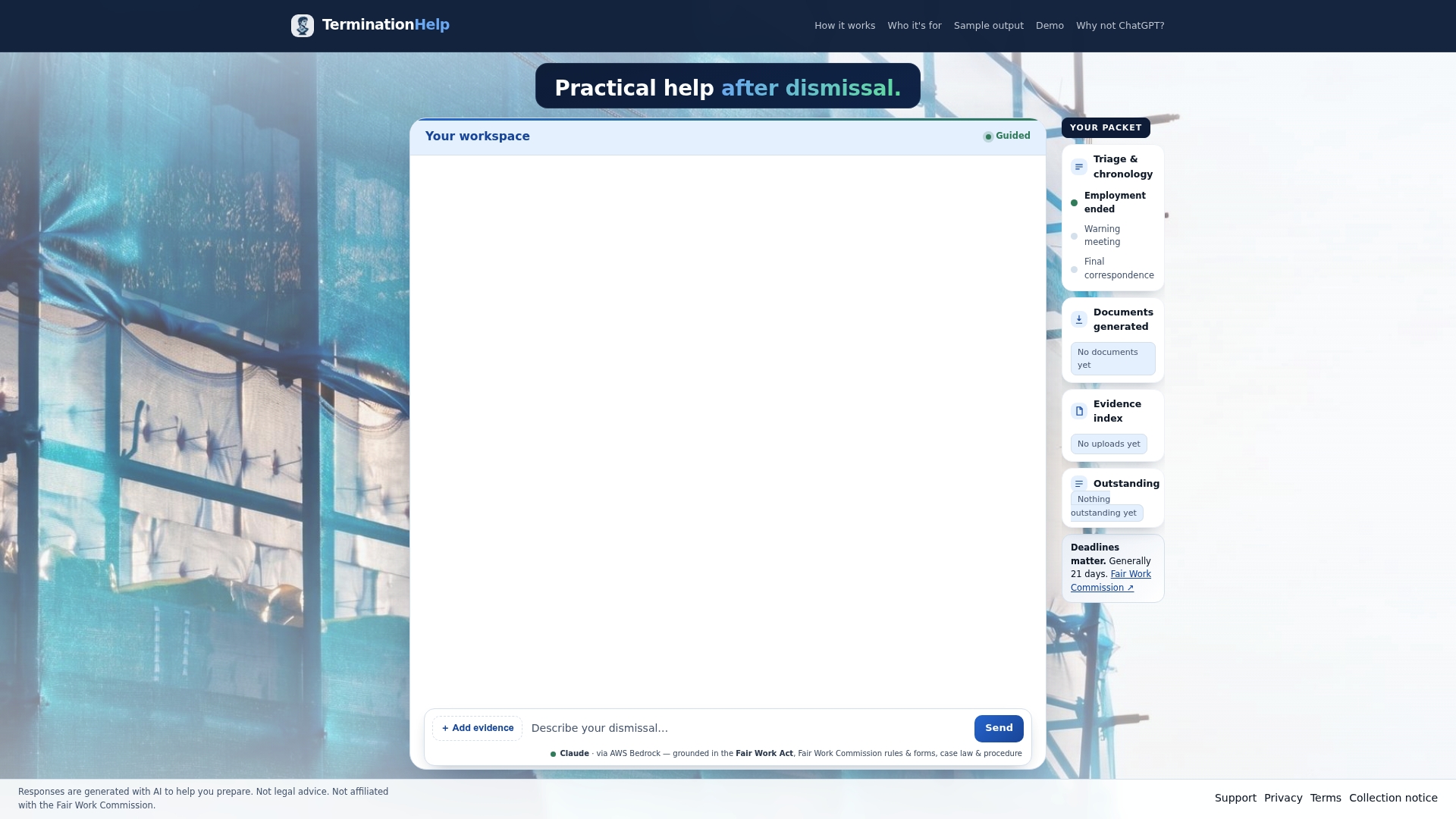
Start with our preparation support and get a clear view of your position before you send anything to the Commission. If you are still at the early stage, our guide to Form F2 for unfair dismissal shows what a properly lodged application involves.
FAQ
Does the employer have to agree to my notice of discontinuance?
No. The applicant decides whether to continue, and the FWC says an employee can withdraw an unfair dismissal application at any time. You should send a copy of the notice to the employer as soon as practicable. If you do not, the Commission will write to the employer to say the claim has stopped.
Can I undo a notice of discontinuance?
Generally no. A Full Bench has held that section 586 does not let the Commission revoke or set aside a notice. The same decision recognises that mistake or duress could make a notice a nullity under general law, but that is an unusual argument and you should get legal advice before relying on it. Your safer path is a new application, if you are still within the time limit.
Do I need Form F50 if I settled?
The FWC says you do not need to lodge Form F50 if you have settled your dispute, under Rule 10 of the Fair Work Commission Rules 2024. You must still tell the Commission the matter is finished. Get the settlement terms in writing first.
Can I lodge a different claim after withdrawing?
You may be able to make a different application about the same dismissal. The FWC says this is only possible after you stop the existing application with Form F50, before a Commission Member decides your case, and within 21 days of the dismissal taking effect. If you have missed the 21 days, seek advice quickly about whether any other option remains.
Sources
- Notice of discontinuance (Form F50), Fair Work Commission
- Withdraw your application for unfair dismissal, Fair Work Commission
- Forms, Fair Work Commission
- [2013] FWCFB 2530, Fair Work Commission Full Bench decision
- Respond to a claim for unfair dismissal (Form F3), Fair Work Commission
- General protections dismissal: can you apply?, Fair Work Commission
Recommended
- Lodge Form F2 in 21 Days: Unfair Dismissal Steps for Employees
- Unfair dismissal particulars: what to set out in your claim
- Australia FWC Checklist: General Protections Claim, Forms & Causation
- The Fair Work Commission process for unfair dismissal, step by step
Article produced using AI. This is not legal advice.