

If legal aid won't take your dismissal or Fair Work matter, you still have real options. The main ones are the Fair Work Commission's free Workplace Advice Service, community legal centres, your union, the Fair Work Ombudsman (for pay issues, not dismissal), a workplace lawyer found through your state law society, and a guided preparation tool such as ours. Which one fits depends on your income, your type of claim and how much time you have left. For unfair dismissal that time is short: the deadline is 21 days from the date you were dismissed.
This guide compares each option on cost, who qualifies and what you actually get, so you can pick the right one today and not lose a week searching.
TL;DR
- Legal aid commissions often don't advise on general employment matters. Victoria Legal Aid, for example, says it doesn't, though it may refer you elsewhere.
- The FWC Workplace Advice Service gives free advice of up to one hour on dismissal and general protections if you qualify.
- Community legal centres and unions are the next stop for free or member-funded help.
- You don't need a lawyer at the Commission. Many people prepare and lodge their own application.
- Our preparation support helps you check eligibility, organise evidence and generate the forms, then file yourself or hand the packet to an adviser.
Table of Contents
- Why legal aid is often the wrong door for dismissal claims
- The options at a glance
- Free advice from the Fair Work Commission's Workplace Advice Service
- Community legal centres
- Your union
- The Fair Work Ombudsman: useful, but not for dismissal
- Representing yourself at the Commission
- The National Self-Representation Service
- A workplace-law lawyer through your law society
- Gig workers and contractors
- Where AI preparation tools fit
- How our preparation support works
- How to choose: a quick decision path
- FAQ
- Sources
Why legal aid is often the wrong door for dismissal claims
Legal aid commissions in each state and territory focus on criminal, family and some civil matters, and they apply means and merit tests. For work disputes the picture is narrower. Victoria Legal Aid states that it does not give legal advice about general employment matters but may refer you to other organisations. It can help where you have experienced discrimination, sexual harassment, victimisation, or racial or religious vilification at work.
That is why so many people searching for legal aid alternatives are really searching for where employment help actually lives. The good news is that Australia has a dedicated set of services built around the Fair Work system. Most of them are free or cheap, and none of them require you to hire a lawyer on day one.
The options at a glance
| Option | Cost to you | Who it suits | What you get |
|---|---|---|---|
| FWC Workplace Advice Service | Free if you qualify | Employees and small business employers with dismissal or general protections issues | Up to one hour of legal advice from a volunteer lawyer |
| Community legal centre | Free (some may charge court filing fees if a case goes to court) | People who can't afford a private lawyer | Information, referral, advice, sometimes casework |
| Union | Membership fees | Union members | Possible representation by a union employee |
| Fair Work Ombudsman | Free | Underpayment and entitlement disputes | Dispute assistance, not unfair dismissal |
| National Self-Representation Service | Free | Unrepresented people in the Federal Court or Federal Circuit and Family Court | Advice and help preparing court documents |
| Law society referral | Lawyer's fees | People who want a specialist | Referral to a workplace-law lawyer |
| Guided preparation tool (ours) | One-time payment per matter | People filing or responding themselves | Eligibility checks, evidence organisation, generated forms, timeline |
Free advice from the Fair Work Commission's Workplace Advice Service
This is the first place to look for a dismissal. The Commission's Workplace Advice Service organises free legal help for employees and employers who qualify. It covers dismissal, general protections, workplace bullying and sexual harassment at work. Appointments run for up to one hour, and the lawyers volunteer their time through organisations that have an agreement with the Commission.
Small business employers can use it too. The same page says you may qualify if you have fewer than 15 employees, no in-house legal or HR staff, no lawyer or paid agent, and you are not a member of an employer association.
One hour is useful but short. Go in with your dismissal letter, contract, payslips and a one-page timeline, and you will get far more from it. If you want help building that timeline before the appointment, our guide to checking unfair dismissal eligibility lists what to gather.

Community legal centres
Community legal centres (CLCs) are independent community organisations. The Federal Circuit and Family Court describes them as providing free legal help including information, referrals, advice, casework and representation, and says many cover employment law.
The peak body, Community Legal Centres Australia, supports more than 160 community-based legal services but doesn't serve the public directly, so you need to contact a local centre. In NSW, Community Legal Centres NSW says all its centres provide free legal help and usually assist people who can't afford a private solicitor or can't access Legal Aid NSW. Some may charge court filing fees or disbursements if a case goes to court, under a costs agreement signed upfront.
The catch is capacity. Centres have eligibility criteria, and employment law may be one of many areas they cover. The Fair Work Commission lists community legal centres in every state and territory as a source of free help for people who meet their criteria. Ring early and ask whether they do employment advice and how long the wait is. Mention your deadline.
Your union
If you are a union member, ask whether a union employee can represent you. The Commission's guidance notes that union members can ask whether an employee of their union can represent them. Do this before anything else if you are a member, since it may cost you nothing beyond your existing fees.
Not a member? Joining after you've been dismissed won't necessarily get you help with that dispute, so ask the union directly before paying.
The Fair Work Ombudsman: useful, but not for dismissal
The Fair Work Ombudsman's Dispute Assistance service is a free way for employees and employers to resolve workplace issues with an FWO officer. It usually takes about two to four weeks. It suits unpaid wages, entitlements and similar problems.
The same page states the Ombudsman cannot help with unfair dismissal claims, bullying claims, tax and superannuation disputes, workplace health and safety, workers' compensation, or issues from more than six years ago. If your problem is a sacking, go to the Commission route instead. If you have both a dismissal and unpaid entitlements, you may need two pathways.
Representing yourself at the Commission
You are allowed to. The Commission states that you do not have to have a lawyer when you appear before it, and that many people represent themselves. It can't give legal advice or recommend a lawyer.
The Commission also publishes free self-help material:
- The Unfair dismissals benchbook has examples of previous cases and decisions to show how the Fair Work Act may apply. It doesn't replace professional advice.
- The Online Learning Portal covers preparing for an unfair dismissal conciliation and for a hearing, among other topics.
The application fee for 2026-27 is $92.70, and it changes on 1 July each year. If you are in serious financial hardship, you can ask the Commission to waive it by sending a waiver form with your application. For the full sequence from lodging to decision, see our step-by-step Fair Work Commission process.
If you are the employer
Small business owners are often on the other side of these claims. An employer must respond within 7 days using Form F3, there is no fee to lodge a response, and no lawyer or paid agent is required. The Commission's small business page says owners often represent themselves, can ask a friend or family member to act for them, or can seek advice from a lawyer or paid agent. The 7-day window is tight, so start the day the claim arrives.
The National Self-Representation Service
If your matter reaches the Federal Court or the Federal Circuit and Family Court, the National Self-Representation Service may help. It is funded under the Community Legal Services Program 2025-2030 and assists unrepresented people in priority areas that include employment law. It provides legal advice, help preparing court documents and help understanding the legal system. Most unfair dismissal claims never get this far, but it is worth knowing about for general protections disputes that go to court.
A workplace-law lawyer through your law society
If you can pay something and want a specialist, the law institute or law society in your state or territory can refer you to a lawyer who specialises in workplace law. Ask about fixed-fee options for specific tasks, such as reviewing your application or preparing you for conciliation, rather than full representation. Our article on choosing an employment law firm covers what to ask before you engage one.
Gig workers and contractors
Status matters first. The Commission states that independent contractors are not covered by unfair dismissal. There are two exceptions: road transport contractors whose services contract is terminated may be able to apply for unfair termination, and employee-like workers whose platform access is changed, suspended or terminated may be able to apply for unfair deactivation.

If you aren't sure whether you are an employee or a contractor, the Workplace Advice Service and your nearest community legal centre are sensible first calls, because the answer decides which claim, if any, you can make. Keep every contract, invoice, message about hours and rate, and any deactivation notice.
Where AI preparation tools fit
An AI tool can't be your lawyer and shouldn't pretend to be. What a well-built one can do is the groundwork: sort your documents, work out whether you appear to meet the basics, and turn your facts into correctly completed forms. The limits to check with any tool are whether it is built for Australian law specifically, where your data is stored, whether your data is used to train models, and whether it says plainly that it doesn't replace advice. Then use it to arrive prepared at a lawyer, union or legal centre, so the limited free time you get with them is spent on strategy, not on sorting paperwork.
Our view on filling the gap
We built Terminationhelp because we saw the same pattern again and again: someone is dismissed, legal aid can't help, and the 21-day clock is already running. The free services above are good, but they are stretched, and an hour with a volunteer lawyer goes quickly when you walk in with a shoebox of unsorted documents.
Our approach is preparation. We focus only on Australian Fair Work claims, and our workflows are grounded in Australian legislation, Fair Work Commission rules, case law and procedure. Our service is designed to take you from eligibility check, to organised evidence, to the forms required at each stage, so that you can file on your own or bring a complete packet to a lawyer, union or community legal centre.
We think preparation is the most underrated step. A claim that is clear, well evidenced and on time gives every adviser, and the Commission, something solid to work with. We keep user data onshore and never use it to train AI, because the facts of someone's sacking are among the most sensitive things they will ever write down.
Nicolas
How our preparation support works
Our preparation support is a one-time payment per matter. You answer guided questions, upload your documents, and we help you check eligibility, organise evidence, build a timeline and generate the Fair Work forms your matter needs. The result is a structured packet.
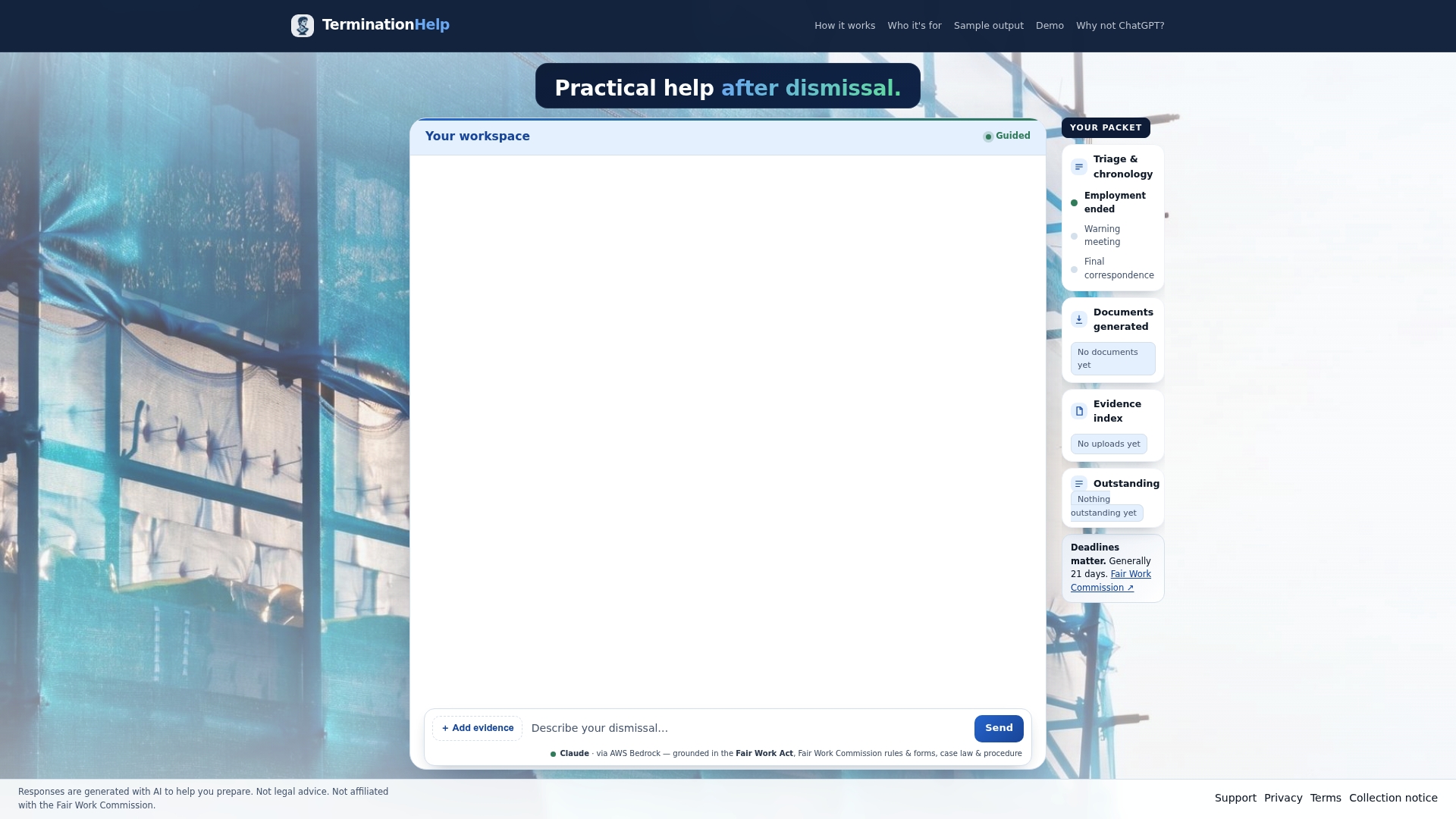
It is built for individuals who have been dismissed, contractors and gig workers working out where they stand, small business owners facing a claim, and professionals preparing a matter for a client or member. It isn't a substitute for legal advice or a prediction of the outcome. Use it alongside the free services above, not instead of them. Start at the preparation support page when you are ready.
How to choose: a quick decision path
- Check your deadline. For unfair dismissal, the 21 days run from the date of dismissal. Minimum employment is 6 months for most employees, or 12 months at a small business with fewer than 15 employees. Our guide to filing within 21 days explains how to move fast.
- Are you a union member? Ask the union first.
- Book the Workplace Advice Service if you qualify, ideally before you lodge.
- Ring a community legal centre in parallel. Waiting lists vary, so don't rely on one.
- Prepare your documents so every appointment is productive. This is where our tool fits.
- Pay for a lawyer selectively if the matter is complex, for example when you are also considering a general protections claim.
What to bring to any free appointment
- Your dismissal letter or the messages that ended your job
- Employment contract and any policies you were given
- Payslips and your start date
- A dated timeline of events, warnings and conversations
- Names of witnesses
Casual employees should read our piece on what evidence casual employees need, and anyone dismissed in their first months should check the probation rules.
FAQ
Is free legal help available for unfair dismissal in Australia?
Yes, for people who qualify. The Fair Work Commission's Workplace Advice Service arranges free advice of up to one hour with a volunteer lawyer, and community legal centres and some unions also help. Eligibility criteria differ, so contact them early.
Do I need a lawyer to lodge an unfair dismissal application?
No. The Commission says you don't need a lawyer to appear before it, and many people represent themselves. It can't give you legal advice, so it helps to use a free advice service and prepare your documents carefully.
Can the Fair Work Ombudsman help with my dismissal?
No. Its dispute assistance service doesn't cover unfair dismissal claims, though it can help with issues such as underpaid wages. For a dismissal, go to the Commission and its advice service.
Can I get the application fee waived?
If you are in serious financial hardship, you can ask the Commission to waive the fee by completing its waiver form and sending it with your application. The standard fee for 2026-27 is $92.70.
Sources
- Other support for employment | Victoria Legal Aid
- Legal advice from the Workplace Advice Service | Fair Work Commission
- Where to find legal help | Fair Work Commission
- Community legal centres | Federal Circuit and Family Court
- Community Legal Centres Australia
- Frequently asked questions | Community Legal Centres NSW
- Get our help with your workplace issue | Fair Work Ombudsman
- Unfair dismissals benchbook | Fair Work Commission
- Assistance for small business | Fair Work Commission
- Fees and costs | Fair Work Commission
- What to do when an employee claims unfair dismissal | Fair Work Commission
- National Self-Representation Service | Attorney-General's Department
- Unfair dismissal: can you apply? | Fair Work Commission
Recommended
- Check Unfair Dismissal Eligibility in Australia: 21 days to lodge
- Australia: $95,050 payout cap and unfair dismissal remedies
- Alternative Dispute Resolution at the Fair Work Commission
- Australia: 21 Day Evidence Casual Employees Need for Unfair Dismissal
Article produced using AI. This is not legal advice.