

An unfair dismissal claim asks whether your dismissal was harsh, unjust or unreasonable. A general protections claim asks whether you were dismissed (or treated badly) for a prohibited reason, such as exercising a workplace right, taking part in union activity or being discriminated against. Both can be made about the same dismissal, but not at the same time, and both have a tight deadline. Choosing the right one first matters, because the choice decides who hears your case and what you must prove.
This guide sets out the difference in plain terms, who can use each claim, how the process and outcomes differ, and how to prepare so you lodge the right application within time.
TL;DR
- Unfair dismissal is about fairness: was the dismissal harsh, unjust or unreasonable? It has eligibility tests (employee status, minimum employment period, income threshold or award coverage).
- General protections is about the reason: was the dismissal, or other adverse action, because of a protected reason or right? It is not limited by the unfair dismissal eligibility tests.
- You cannot run both claims about the same dismissal. Pick one before you lodge.
- Both dismissal claims generally need to be lodged within 21 days after the dismissal takes effect, and the 2026–27 fee is $92.70.
- Unfair dismissal is decided by the Fair Work Commission (FWC). An unresolved general protections dismissal claim usually goes to court unless both sides agree to arbitration at the FWC.
Table of Contents
- The core difference: fairness versus reason
- "Adverse action" is the term to know
- Who can make each claim
- You can only pick one
- Deadlines, fees and where you lodge
- What happens after you lodge
- If you are a small business owner who has been named
- Preparing the claim well
- Where Terminationhelp fits
- Our perspective
- FAQ
- Sources
The core difference: fairness versus reason
The FWC describes unfair dismissal as requiring three things: you were dismissed, the dismissal was not a genuine redundancy, and it was harsh, unjust or unreasonable. For a small business employer, the Commission also looks at whether the Small Business Fair Dismissal Code was followed.
General protections work differently. The FWC explains that general protections laws prohibit adverse action taken for a prohibited reason. Adverse action covers more than dismissal: it can include demotion, discriminatory treatment, refusing to hire someone, changing a job to the worker's disadvantage and threats.
In practice:
| Unfair dismissal | General protections (dismissal) | |
|---|---|---|
| Central question | Was the dismissal harsh, unjust or unreasonable? | Was the dismissal for a prohibited reason? |
| Covers | Dismissal only | Dismissal and other adverse action |
| Eligibility tests | Yes: employee, minimum period, income or award coverage | Not the same tests; needs a protected reason |
| Who decides if conciliation fails | The FWC | Usually the Federal Circuit and Family Court, or the FWC by consent |
A useful way to think about it: in an unfair dismissal claim, you are arguing the employer handled it badly or had no good reason. In a general protections claim, you are arguing the employer acted because of something the law protects.
"Adverse action" is the term to know
People searching for adverse action versus unfair dismissal are usually looking at the same comparison. Adverse action is the legal label for the harmful conduct in a general protections claim. Dismissal is one form of it.
The Fair Work Ombudsman lists the kinds of prohibited reasons: workplace rights, industrial activity and discrimination. Examples of workplace rights include making a complaint or enquiry about your employment, asking about pay or entitlements, or taking sick leave or other leave you are entitled to. The protections can also apply to prospective employees and to independent contractors in specified relationships.
The point of difference is causation. A general protections claim needs a link between the protected reason and what the employer did. Ask yourself: what did I do or what am I (a union member, a person who raised a safety concern, a person who took carer's leave), and what happened soon after? Your timeline of events is the heart of the claim. Our general protections checklist walks through forms and causation evidence.
Who can make each claim
Unfair dismissal eligibility
To make an unfair dismissal claim you must clear several hurdles:
- Employee status. Only employees can bring an ordinary unfair dismissal application, as Legal Aid NSW explains.
- Minimum employment period. The FWC states it is 6 months for an employer with 15 or more employees and 1 year for a small business employer, meaning one with fewer than 15 employees.
- Income or award coverage. For dismissals taking effect on or after 1 July 2026, the high-income threshold is $190,100. If you earn above it, you generally need to be covered by an award or enterprise agreement.
Casual employees can qualify, but not all do. The FWC's eligibility guidance says irregular casuals are not covered, while regular and systematic casual work with a reasonable expectation of continuing employment may count. Our guide on evidence casual employees need shows how to document that pattern, and the eligibility check covers the rest.
General protections eligibility
General protections claims are not a back door for anyone who misses the unfair dismissal tests. The FWC is clear that the pathway needs an alleged prohibited reason and its own legal foundation. If you were dismissed after four months in a large business, for example, you will not meet the minimum period for unfair dismissal. But if you were dismissed because you made a workplace complaint or took protected leave, general protections may be open to you.
This matters for contractors and gig workers too. Legal Aid NSW notes that some independent contractors may bring a general protections dismissal claim, whereas only employees can bring an ordinary unfair dismissal application. Be careful with labels, though. The ATO says an ABN or a short, casual engagement does not by itself make you a contractor: what counts is the real working arrangement, including control, payment basis, equipment and commercial risk. Your status can decide which doors are open, so gather the contract, invoices, rosters and instructions you actually worked under.

You can only pick one
Legal Aid NSW says a person cannot make both claims about the same dismissal, although unpaid wages and entitlements can still be pursued separately. That makes the choice a strategic one, and it is why the first week after dismissal is about collecting facts, not rushing a form.
A practical way to decide:
- Write the timeline. Dates of dismissal, any warnings, what you raised or requested beforehand and when.
- Test the reason. Is there a protected reason (a complaint, leave, union activity, discrimination) that plausibly connects to the dismissal? If yes, general protections is worth serious consideration.
- Test unfair dismissal eligibility. Employee, minimum period, income or award coverage, and not a genuine redundancy.
- Compare the stakes. Unfair dismissal compensation is capped; general protections outcomes come through a different process (covered below).
- Lodge one, in time.
If the reason for dismissal is unclear and you are eligible for both, the evidence you hold usually points the way. A messy performance story with no protected trigger leans unfair dismissal. A dismissal days after a complaint or leave request leans general protections.
Deadlines, fees and where you lodge
The deadline is the same short window for both dismissal claims. The FWC's Form F8 says the 21 days start on the day after the dismissal takes effect, under section 366 of the Fair Work Act 2009. Our 21-day rule explainer shows how to count it, including when a dismissal "takes effect".
A few practical details:
- Fee. From 1 July 2026 the application fee is $92.70, and serious financial hardship may support a fee waiver. Fees are reviewed annually, so check the FWC's current figure when you lodge.
- How to lodge. The FWC's 2025 bulletin says MyFWC replaced the Online Lodgment System for these applications and is the preferred online method.
- Starting by phone. The FWC's 2026 procedural rules allow a dismissal application to be started by phone, but you must then complete, sign and lodge the written application and pay or seek a waiver of the fee within 14 days.
Late applications are possible in limited cases, but they are not something to plan around. Treat 21 days as a hard line.
What happens after you lodge
Unfair dismissal
The FWC handles unfair dismissal matters. The usual path is conciliation, then, if the matter does not settle, a hearing or determination by the Commission. The FWC says remedies can include reinstatement and compensation. For dismissals taking effect on or after 1 July 2026, the compensation cap is $95,050.
General protections dismissal
The first stop is also the FWC, but its role is different. The Form F8 explains that the FWC conducts a conference to attempt resolution but does not decide the merits. If the dispute is not resolved, the FWC issues a certificate that lets you go to court, or to consent arbitration at the Commission. Legal Aid NSW says an unresolved matter ordinarily proceeds to the Federal Circuit and Family Court of Australia unless the parties agree to arbitration.
That is why general protections can feel heavier. Court proceedings involve more formal pleadings and carry different costs risks, so your documents and timeline need to be solid from the start. The FWC also notes it does not investigate or decide who is right or wrong at conciliation, so you walk in with your own evidence and a clear idea of the outcome you want.
If you are a small business owner who has been named
If you are the employer, the same distinction applies to you. An unfair dismissal application against a small business turns partly on the Small Business Fair Dismissal Code, so a well-organised file showing what the employee was told, when and why is central. Our evidence file guide for the Small Business Fair Dismissal Code sets out what to collect. A general protections application instead asks you to show the reason for your action was not a prohibited one, so records of the genuine reason and the decision timeline matter. In both cases, read the FWC's notice carefully for response deadlines and forms, because they run quickly. Our overview of employer obligations when dismissing is a good starting point.
Preparing the claim well
Whichever route you choose, the same preparation work pays off:
- Dismissal letter, termination email or message, and anything that shows when it took effect.
- Contract, award or agreement, pay slips, rosters and any policy documents.
- Warnings, performance reviews and meeting notes, or proof none were given.
- Evidence of any protected trigger: the complaint, leave request, union involvement or discrimination, with dates.
- Your earnings and losses, and any steps you have taken to find new work.
For an unfair dismissal claim, you will also need to set out the facts clearly in your application. See what to set out in your claim. If your dismissal involved a redundancy, the question of whether it was genuine is separate, as covered in our genuine redundancy guide.
Where Terminationhelp fits
The hard part for most people is not understanding the difference in the abstract. It is applying it to their own facts, in 21 days, while stressed. Terminationhelp is an AI-powered preparation tool built only for Australian Fair Work claims. It runs eligibility checks, helps you organise evidence, handles document upload, builds your timeline and generates the Fair Work forms required at each stage, all grounded in Australian legislation, Fair Work Commission rules and case law.
You can then file independently, or bring the structured packet to a lawyer, union or community legal centre. Your data stays onshore and is never used to train AI. You can see how the process works on the preparation support page.
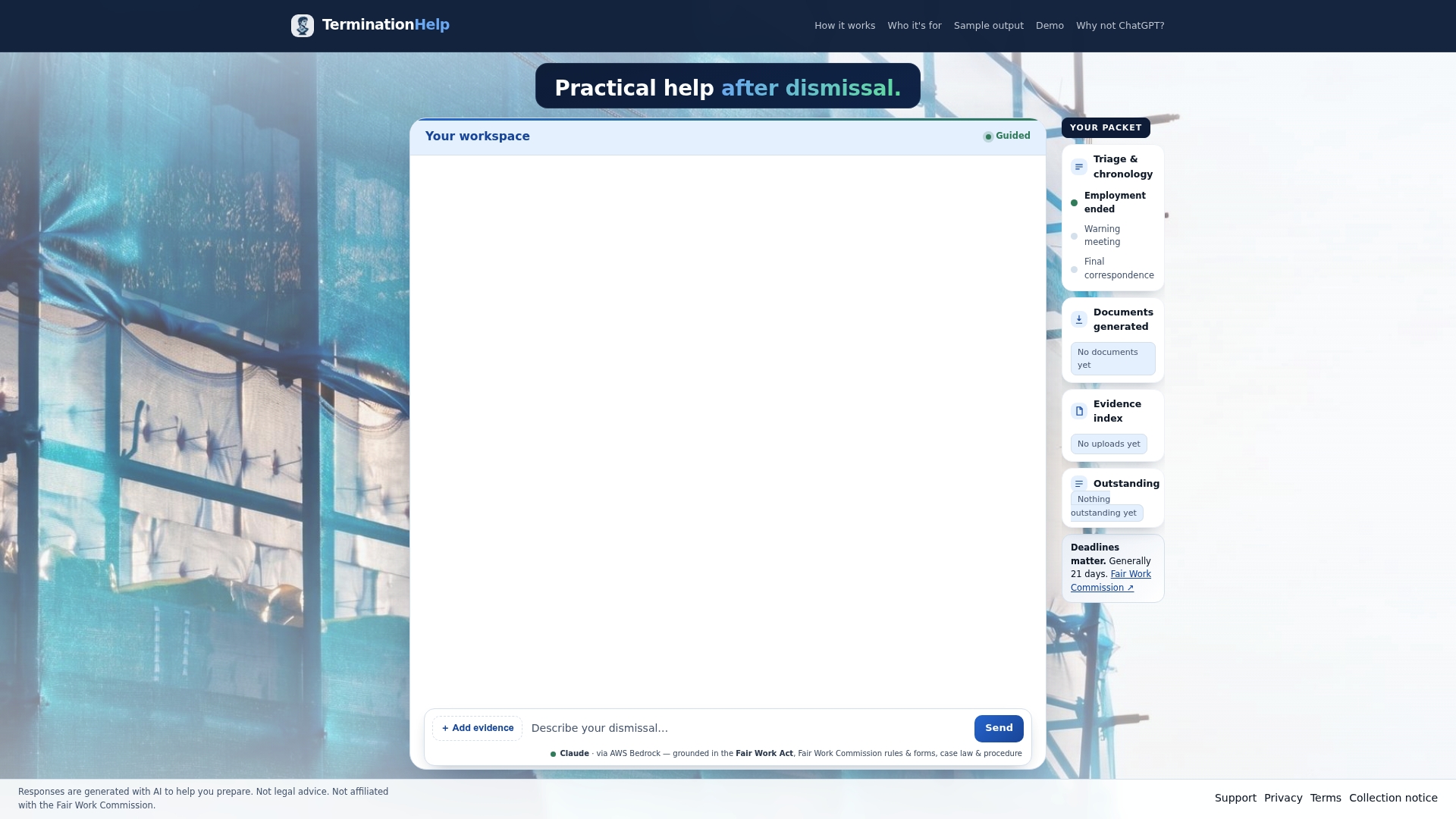
Lawyers, unions and businesses can also use it to prepare client, member or employer-side matters.
Our perspective
Most people come to us asking which claim is "better". We think that is the wrong first question. The right first question is what actually happened, in order, with documents behind each step.
The two claims reward different preparation. Unfair dismissal rewards a clear account of process and reasons. General protections rewards a precise link between a protected right and the employer's action. If your timeline is not built before you choose, you are guessing.
That is why we built Terminationhelp around Australian law only: eligibility first, evidence organised against the elements of the claim, and forms generated for each stage so nothing is missed. With the 21-day window running, structure beats speed, and a good packet is something you can file yourself or hand straight to a lawyer, union or community legal centre.
Nicolas
FAQ
Can I make a general protections claim and an unfair dismissal claim for the same dismissal?
No. Legal Aid NSW says you cannot make both about the same dismissal. Unpaid wages and entitlements can still be claimed separately. Decide which claim fits your facts before you lodge.
Can I claim general protections if I do not meet the unfair dismissal minimum period?
Possibly, if you were dismissed for a prohibited reason such as exercising a workplace right. The FWC says general protections is not a substitute for failing unfair dismissal eligibility: you need an alleged prohibited reason and a legal basis for it.
Is the deadline the same for both claims?
For dismissals, both generally have a 21-day limit counted from the day after the dismissal takes effect. The FWC's Form F8 sets this out for general protections dismissals. Late applications are allowed only in limited circumstances, so lodge early.
Who decides a general protections dismissal claim?
The FWC runs a conference to try to resolve it but does not decide the merits. If it does not settle, the matter usually proceeds to the Federal Circuit and Family Court, or to the FWC if both sides consent to arbitration.
Can contractors use either claim?
Only employees can bring an ordinary unfair dismissal claim. Some independent contractors may bring a general protections dismissal claim. Your real working arrangement matters more than whether you have an ABN.
Sources
- Unfair dismissal, Fair Work Commission
- General protections and harmful (adverse) action, Fair Work Commission
- Protections at work, Fair Work Ombudsman
- Unfair dismissal: can you apply?, Fair Work Commission
- How do I choose?, Legal Aid NSW
- Jobs and employment types, ATO
- Form F8, Fair Work Commission
- Increase to the application fee for 2026–27, Fair Work Commission
- FWC Bulletin Volume 9/25, 4 September 2025
- Fair Work Commission procedural rules 2026
- Types of workplace disputes, Fair Work Commission
Recommended
- Unfair dismissal particulars: what to set out in your claim
- Procedural Fairness in Dismissal: What Australian Law Requires
- Australia FWC Checklist: General Protections Claim, Forms & Causation
- Check Unfair Dismissal Eligibility in Australia: 21 days to lodge
Article produced using AI. This is not legal advice.