

Whether you can record a conversation in Australia depends on where you are, who agrees to it and why you are recording. There is no single national rule. Each State and Territory has its own legislation, and a recording that is lawful in Victoria can be an offence in New South Wales. At work there is a second problem on top of the criminal law: even a lawful secret recording can cost you your job or your credibility in the Fair Work Commission.
This guide explains the state-by-state picture, what the Commission has done with secret recordings, and how to keep a reliable record of a workplace meeting without putting your claim at risk.
TL;DR
- Recording a private conversation without everyone's consent is an offence in NSW, the ACT, Tasmania, WA and SA, subject to narrow exceptions. Queensland, Victoria and the Northern Territory allow a participant to record, but restrict sharing the recording.
- Secret recordings at work can be treated as a valid reason for dismissal, and the Commission may refuse to admit them as evidence.
- Where you can take notes, ask a support person to take notes, or write up the meeting straight afterwards, do that first.
- If you have already made a recording, do not publish it or send it around. Keep it safe and get advice from a lawyer, union or community legal centre.
- Deadlines still run while you work this out, so do not let a recording question delay a dismissal claim.
Table of Contents
- Why the answer changes from state to state
- Can I record my boss without telling them?
- How the Fair Work Commission treats secret recordings
- Notes first, recordings last
- If you have already recorded something
- For employers and small business owners
- Perspective
- Get your evidence file in order
- FAQ
- Sources
Why the answer changes from state to state
Australian surveillance device laws were written state by state. The Australian Law Reform Commission noted in its 2014 report that Queensland, Victoria and the Northern Territory contain participant monitoring exceptions, while the other jurisdictions do not. Participant monitoring means you are in the conversation and you record it yourself.
Here is the broad picture for private conversations.
| Jurisdiction | Can a participant record without telling the others? | Main exceptions or limits |
|---|---|---|
| NSW, ACT, Tasmania | Generally no | Offence unless all parties consent or the recording is reasonably necessary to protect your lawful interests |
| Western Australia | Generally no | Same lawful interests exception, plus a public interest provision |
| South Australia | Generally no | Allowed where reasonably necessary to protect lawful interests |
| Queensland, Victoria, Northern Territory | Yes, if you are an active participant | Communicating or publishing the recording is restricted |
Two things in that table matter more than people expect. First, the NSW, ACT and Tasmanian position is that recording is an offence unless all parties consent or it is reasonably necessary to protect the recorder's lawful interests. Second, in Queensland, Victoria and the Northern Territory the freedom to record is not a freedom to share. In Victoria, for example, it is against the law to communicate or publish a record of a private conversation obtained with a listening device unless all people involved agree, with exceptions for public interest, protection of lawful interests and legal or disciplinary proceedings.
Some general summaries lump the Northern Territory in with the stricter group. The ALRC's description of the Territory's participant exception is the safer guide, but if you are in the NT, check the current legislation or ask a legal service before you press record.
What the penalties look like
The penalties are real. In NSW, recording a private virtual company meeting without all participants' consent carries a maximum penalty of $11,000 or 5 years imprisonment, or both, for an individual, and $55,000 for a corporation. In Western Australia the maximum is a $15,000 fine or 3 years imprisonment, and courts there have read the legislation as still prohibiting recording without consent even where someone wants an advantage in civil proceedings.

Virtual meetings count. Recording a Teams or Zoom call is a recording of a private conversation, and so is an AI note taker running in the background. If you use one, tell the other participants first.
Can I record my boss without telling them?
If you are in Queensland, Victoria or the Northern Territory and you are an active participant in the conversation, the recording itself is generally lawful. Hamilton Locke makes the same point and adds the workplace catch: employers may prohibit secret recordings, and the Fair Work Commission has treated them as a possible valid reason for dismissal.
In the other jurisdictions, the starting point is that you should not. The exception for protecting your lawful interests exists, but it is narrow and decided after the fact by a court or tribunal. You cannot know in the moment how it will be read.
The Victorian position is a good example of how participation works. Section 6(1) of the Surveillance Devices Act 1999 (Vic) prohibits recording a private conversation to which you are not a party. An employee recording their own meeting is a party, so that offence does not reach it. That does not make it wise, as the next section shows.
Also note a limit that applies to employers in Victoria. Section 9B of the same Act bans an employer from knowingly using a camera or listening device to monitor workers in a workplace toilet, washroom, change room or lactation room, with no consent or notice exception.

How the Fair Work Commission treats secret recordings
The criminal law is only half the issue. The other half is what a recording does to your case.
Evidence: the Commission is flexible, not careless
Under section 591 of the Fair Work Act 2009 the Commission is not bound by the rules of evidence. But its findings still need an evidentiary basis with rational probative force, and procedural fairness applies. In Altham-Wooding v PKDK Adventures, the Commission declined to admit a secret recording and separately found the recording itself was a valid reason for dismissal.
Legal Aid NSW gives the plain version: it is against the law to secretly record a private conversation, and if the other people did not give permission you might not be able to use your recording in a tribunal like the Fair Work Commission.
Cases that went against the employee
In Schwenke v Silcar, a Trade Assistant secretly recorded a disciplinary meeting. The Commission upheld the dismissal, calling the employee's excuse self-serving and finding the recording undermined mutual trust and confidence. That case is the usual warning: the meeting where you feel most at risk is the meeting where a secret recording can do the most damage.
Cases that went the employee's way
It is not one-way. In Thomas v Newland Food Company, an employee had secretly recorded conversations with management to protect himself against threats. The Commission found no valid reason for dismissal and no procedural fairness, and the dismissal was unfair. In a 2026 decision, Davies v Safety Xpress Unit Trust, the employer's reasons included use of recording devices against express instructions, but the Commission found no valid reason and awarded $10,849.61 because procedural fairness was not observed.
The lesson is not that recordings always lose. It is that the outcome turns on the facts: why you recorded, what the employer had told you, and whether the dismissal process was fair. Our guide to procedural fairness in dismissal covers the second half of that.
Notes first, recordings last
The Commission has said that secret recording is unlikely to be reasonably necessary when other ways to keep a record are easy to use. In Harry Holt v TEEG Australia, those alternatives were taking notes during a meeting, having a support person take notes, or making contemporaneous notes afterward.
So the practical order is:
- Ask for the meeting in writing. An email or letter that names the topic, the time and who will attend is itself a record.
- Bring a support person. They can take notes and be a witness to what was said.
- Take notes as you go. Write down the date, time, who was present and the key statements, in your own words and as close to verbatim as you can.
- Write up the meeting within hours. Note the date and time you wrote it. Notes made close to the event carry more weight.
- Confirm by email. Send a short message saying what you understood was said or decided. Silence in reply is useful too.
- Ask openly. You can ask whether everyone agrees to the meeting being recorded. A yes on the record solves the legal problem. A no is information too.
There are rare situations where the balance tips. The High Court's 2026 decision in Potter v The King held unanimously that a secret recording could be used in evidence against a perpetrator of violence because it was necessary to protect the victim-survivor's fundamental right of bodily integrity and autonomy. The court also observed that an audio recording of such stark admissions was far more powerful than a handwritten note. That was a case about serious violence, not an ordinary workplace dispute, and it does not make workplace recording safe. If you are being threatened or harassed at work, speak to a lawyer, union or community legal centre about your own situation before you rely on a recording.
If you have already recorded something
Do not panic and do not delete it. Equally, do not post it online, forward it to colleagues or play it to your manager as leverage. Sharing is where Queensland, Victoria and the Northern Territory draw their line, and it is where a stricter state's offence can compound.
Then:
- Store it securely with the date, time, place and who was present.
- Write your own notes of the conversation from memory, separate from the recording, so you are not relying on the file alone.
- Get advice before using it. A lawyer, your union or a community legal centre can tell you whether it was lawful where you are and whether to put it forward.
- Keep the dismissal clock in mind. An unfair dismissal application generally has to be lodged within 21 days of the dismissal taking effect. Our article on what evidence a casual employee needs inside those 21 days shows how to build a file quickly, and the guide on probation dismissals covers another common starting point.
A recording is one piece of evidence. Emails, texts, pay records, rosters, warning letters, performance reviews and witness details usually do more of the work, and none of them raises a criminal law question.
For employers and small business owners
If you are on the other side of a claim, the same rules protect you. Do not record meetings with staff without clear agreement, and consider a written policy that says how recordings and AI note takers are handled. Being sued in the Commission is stressful enough without a surveillance device complaint attached.
If you are preparing a response, your own contemporaneous records matter. A fair process, with the employee told the reason, given a chance to respond and allowed a support person, is what the Commission looks at. See our guides on employer obligations when dismissing an employee and the evidence file for the Small Business Fair Dismissal Code.
Nothing here is legal advice for your circumstances. Recording laws turn on facts and on the state you are in, so check current legislation or speak with a lawyer or your union.
Perspective
Most people who ask us about recording are not trying to trap anyone. They are frightened, they are about to walk into a meeting that could end their job, and they want proof of what is said.
We understand that. But in our view the strongest case is rarely built on a covert recording. It is built on an organised file: a clear timeline, the letters and messages you already have, written notes made at the time, and a claim lodged inside the deadline on the right forms.
That is what we designed our preparation support around. It is built for Australian Fair Work law and Commission procedure, and it helps you sort your evidence, check eligibility, understand the timeline and generate the forms for each stage. You can file the packet yourself or take it to a lawyer, union or community legal centre.
If you are unsure whether something you hold is usable, put it in the file and ask a legal professional about it. Do not let the question hold up the rest of your preparation.
Nicolas
Get your evidence file in order
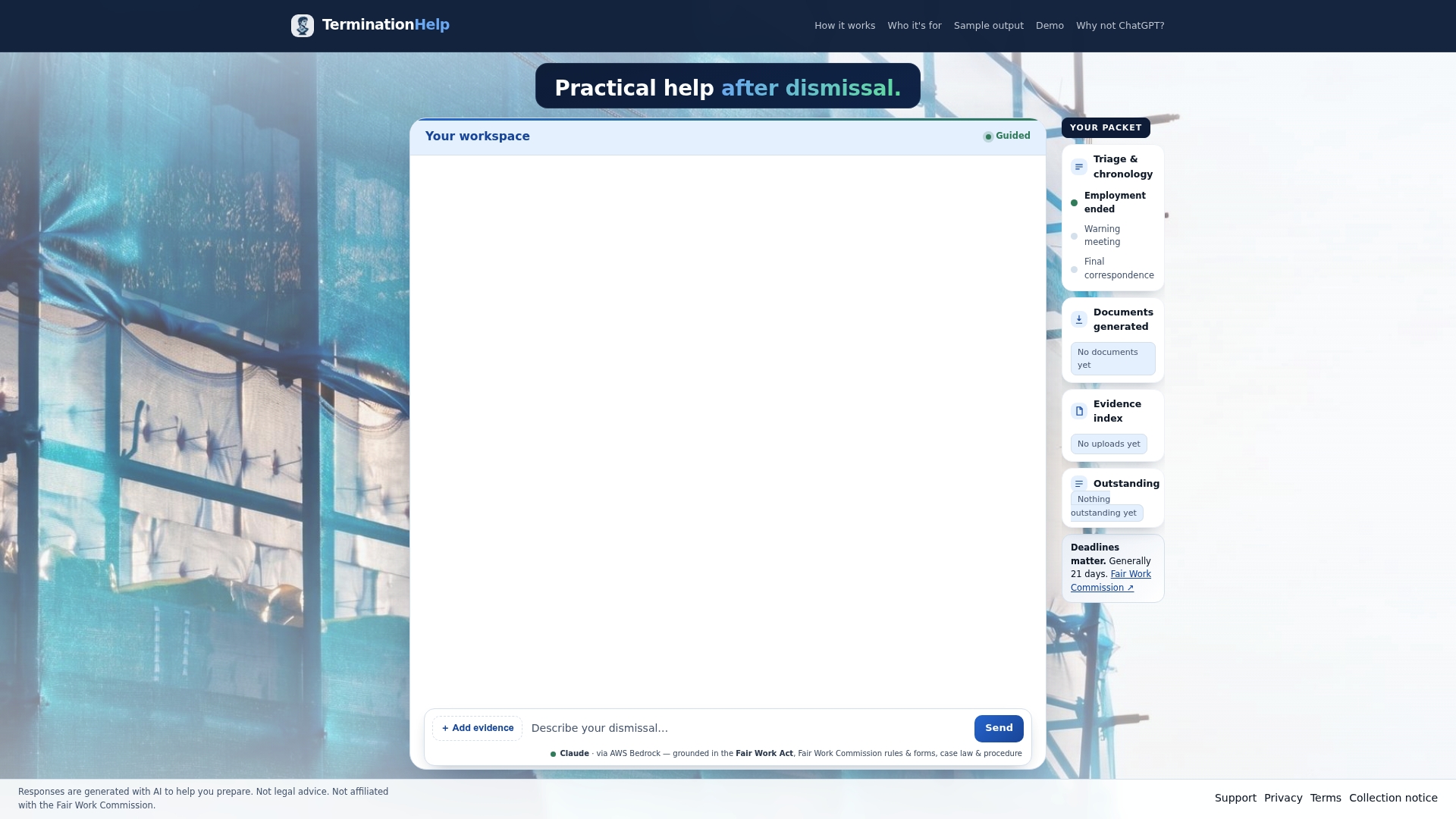
If you have been dismissed, or you are about to attend a meeting that worries you, the most useful thing to do this week is organise what you already have. Our preparation support walks you through eligibility checks, evidence organisation, document upload and the Fair Work forms, with a structured packet at the end that you can file yourself or hand to a lawyer, union or community legal centre.
It does not replace legal advice, and it does not predict outcomes. It gives you a clear, Australia-specific process so that the deadline and the paperwork are handled while you focus on the rest.
FAQ
Is it legal to record a conversation I am part of in Australia?
It depends on the State or Territory. In Queensland, Victoria and the Northern Territory a participant can generally record, but sharing the recording is restricted. In NSW, the ACT, Tasmania, WA and SA it is generally an offence without everyone's consent, unless a narrow exception such as protecting your lawful interests applies.
Can I record a meeting with my employer or HR?
Only safely if everyone agrees, or if you are in a participant-friendly jurisdiction and accept the employment risk. The Commission has upheld dismissals where an employee secretly recorded a disciplinary meeting. Ask for notes, a support person and a written summary instead, or ask openly for consent to record.
Can a secret recording be used in an unfair dismissal case?
Sometimes, but not reliably. The Commission is not bound by the rules of evidence, yet it has declined to admit secret recordings and has treated the recording itself as a valid reason for dismissal. Other decisions went the employee's way where the dismissal was otherwise unfair, so get advice on your specific facts.
Do AI note takers and meeting transcription tools count as recording?
Yes. Recording a Teams or Zoom call, with or without transcription, is recording a private conversation. Tell every participant before you start and get their agreement, particularly in states where all-party consent is the rule.
What should I do if I think my employer is recording me unlawfully?
Keep your own notes of when and how you found out, and raise it in writing if you feel safe doing so. Then contact your union, a community legal centre or your state's legal aid service. Employers are also restricted in places like toilets, change rooms and lactation rooms in Victoria.
Sources
- Recording private conversations: the law in Australia (Hamilton Locke)
- Participant monitoring (ALRC)
- Secret Recordings in the Workplace (Hall Payne Lawyers)
- Recording private conversations (LawHub)
- Take care before hitting record during a virtual meeting (Walter Baden)
- Surveillance and Recording Devices (Rudall and Rudall)
- Workplace Recording and Surveillance in Victoria (Recording Law)
- Secret recordings as evidence in Australia (Recording Law)
- I am being investigated at work (Legal Aid NSW)
- Thomas v Newland Food Company Pty Ltd [2013] FWC 8220 (AustLII)
- Termination of employment: key lessons from recent Fair Work Commission decisions (Mondaq)
- Potter v The King (HopgoodGanim)
- High Court dismisses man's appeal over rape admission (Sydney Morning Herald)
Recommended
- Remote work refusal rights: what Australian employees can do
- Australia: $95,050 payout cap and unfair dismissal remedies
- 21 Days to Respond to Serious Misconduct Under Reg 1.07 in Australia
- Check Unfair Dismissal Eligibility in Australia: 21 days to lodge
Article produced using AI. This is not legal advice.