

An Australian employer can dismiss you for medical incapacity, but only in limited circumstances. They cannot dismiss you because you are temporarily away with a documented illness or injury, and if they rely on your inability to do the job, the reason has to be valid and the process fair. If you have been dismissed and think the reason was your health, the clock is short: an unfair dismissal application must be lodged within 21 days. This guide explains where the line sits, what the Fair Work Commission (FWC) looks at, and how to get your claim ready in time.
TL;DR
- An employer must not dismiss you because you are temporarily absent with an illness or injury, if you can provide evidence of it. That protection has limits tied to a three-month period and to paid sick leave.
- Inability to perform the inherent requirements of your actual role can be a valid reason for dismissal, but it is not automatic. The FWC still looks at medical evidence, your chance of returning and whether you were given a chance to respond.
- You generally have 21 days from the dismissal taking effect to lodge an unfair dismissal application. Different claims (general protections, discrimination) have their own routes.
- Eligibility depends on how long you worked there and, for higher earners, on whether an award or enterprise agreement covers you.
Table of Contents
- What "medical incapacity dismissal" actually means
- The temporary absence protection
- When incapacity can be a valid reason
- Your options if you were dismissed over your health
- Can you claim unfair dismissal? Eligibility
- The 21-day deadline when you are unwell
- What compensation is possible
- How to prepare your claim
- Where we fit in
- Our perspective
- FAQ
- Sources
What "medical incapacity dismissal" actually means
Medical incapacity dismissal is a termination where the employer says your health stops you from doing your job. It might follow a long absence, a workplace injury, a mental health condition or a chronic illness. The employer's explanation might be "we cannot keep the role open" or "you can no longer do the work".
Two separate legal questions sit inside that situation, and people often mix them up:
- Was the dismissal because of a temporary absence? The Fair Work Act 2009 protects you here, in a limited way.
- Was there a valid reason related to your capacity to do the job, and was the process fair? This is the heart of an unfair dismissal claim.
A dismissal can fail on either question, and sometimes both.
The temporary absence protection
Section 352 of the Fair Work Act says an employer must not dismiss an employee because they are temporarily absent from work due to illness or injury of a kind prescribed by the regulations, as the Fair Work Commission explains on its temporary absence page. You need to be able to provide evidence of the illness or injury, typically a medical certificate.
The protection has a time limit. According to the same FWC page, it does not apply where your absence goes beyond three months, or your total absences in a 12-month period exceed three months (whether for one illness or several), and you are not on paid personal/carer's leave for the whole absence.
The Fair Work Ombudsman puts the practical result in simple terms: you are protected if you are away for less than three consecutive months, or less than three months in total over the last 12 months, or still using paid sick leave. If you use paid sick leave for the whole absence, you cannot be dismissed because of that absence, however long you are away.

A worked example
Say you have been off for five weeks after surgery with medical certificates covering every day, and you return. Two months later you need another three weeks off for a related complication. Your total absence in the 12 months is eight weeks, well under three months. A dismissal because of those absences would breach section 352.
Now say you have been off for four months, your paid sick leave ran out in month two, and you are on unpaid leave. The temporary absence protection no longer applies in the same way. That does not mean the employer can dismiss you freely, as the next sections show.
Dismissal on paid sick leave is not always unlawful
Being on sick leave does not make you immune. The Fair Work Ombudsman's library gives the example of an employee on paid sick leave who was lawfully terminated because the business was closing down. The test is the reason for the dismissal. If the reason is genuinely unrelated to your absence, such as a real redundancy, the sick leave alone does not block it.
When incapacity can be a valid reason
Once an absence runs long, or when a condition permanently affects what you can do, the question becomes whether you can still do your job. The FWC's capacity page explains that under section 387(a) of the Fair Work Act, being unable to perform the inherent requirements of your position may be a valid reason for dismissal, and that medical evidence can bear on whether that reason is sound.
Two points from that page matter most:
- Inherent requirements are the essential tasks of the role, not every detail of how it is currently done.
- The FWC looks at your substantive position, following the decision in J Boag & Son Brewing Pty Ltd v Button. It does not have to be a modified, restricted or temporary alternative role your employer might have offered.
A related rule sits in disability discrimination law. From 5 August 2009, section 21A(1) of the Disability Discrimination Act gives an employer a defence where, because of a disability, you cannot carry out the inherent requirements of the work even if reasonable adjustments were made. The Australian Human Rights Commission explains that this defence applies to dismissal, not to promotion, transfer or training.
What the FWC looks at when the absence is long
In a 2026 decision, Dhamija v MH Management (Qld) Pty Ltd ([2026] FWC 634, 26 February 2026), the Commission dealt with a housekeeping manager dismissed on 4 September 2025 after being incapacitated since June 2024 by a non-work-related illness. The Commission found incapacity was a valid reason, that he had been notified by a show cause letter dated 29 August 2025 and given a chance to respond, and that the dismissal was not unfair despite his personal circumstances.
The decision also quotes a Full Bench approach worth knowing. The Act precludes dismissal for a temporary absence of up to three months. Beyond that, the question becomes whether you are likely to return to your duties in the short or medium term, and updated medical advice is usually important to whether the reason is adequate.
That gives you a practical picture of what matters:
| Question the FWC asks | What helps you | What hurts you |
|---|---|---|
| Was there a valid reason? | Current medical evidence showing you can return, or can do the inherent requirements | No recent medical evidence, or evidence clearly showing you cannot do the role |
| Were you told the reason and given a chance to respond? | A written warning or show cause letter you answered, or proof you were never given one | A documented opportunity you ignored |
| How long was the absence, and was it covered by leave? | Certificates for every day, paid leave used | Gaps in certificates, long unpaid absence with no return date |
| Is the role itself affected? | Duties you can still perform with adjustments | A condition that prevents the core tasks of the role |
Case outcomes turn on their facts. If you want to understand how to read a decision like this one, our guide to unfair dismissal case law walks through it.
Your options if you were dismissed over your health
There is more than one way to challenge a health-related dismissal. The Fair Work Ombudsman says that even after more than three months of absence with paid sick leave used up, you may still be protected under state and territory workers compensation and rehabilitation laws. You may also be able to challenge the termination through an unfair dismissal application, a general protections claim, an unlawful termination claim, or a state or federal anti-discrimination claim.
Here is how the main routes differ for a reader who has just been dismissed.
Unfair dismissal
This is the claim most people mean. You argue the dismissal was harsh, unjust or unreasonable, and in a medical case the argument usually centres on whether there was a valid reason related to capacity and whether the process was fair. Our page on what unfair dismissal remedies look like covers the outcomes.
General protections (temporary absence)
The FWC's temporary absence page states that the section 352 protection is identical to section 772(1)(a). If you are not eligible to make a general protections application about temporary absence, you may be able to bring an unlawful termination claim instead. If you were dismissed in the last few weeks and the reason looks like your absence or your condition, it is worth understanding this route alongside unfair dismissal. Our general protections claim guide explains the forms and the causation question.
Disability discrimination
If the dismissal was because of a disability, a claim under section 351 of the Fair Work Act is another route. A UNSW Law Journal article by Allen (2018) explains that a dismissed employee must lodge a section 351 claim at the Commission within 21 days of the dismissal taking effect, and that someone who misses that limit can instead apply to the Federal Court or Federal Circuit Court within 14 days. The same article records Victoria Legal Aid's concern that the 21-day limit can be hard for people who are too unwell to act quickly. Because the deadlines and forums are different and technical, anyone considering this route should get tailored legal advice from a lawyer or community legal centre quickly.

Can you claim unfair dismissal? Eligibility
The FWC's unfair dismissal page sets out the core tests:
- Minimum employment period: 6 months if your employer has 15 or more employees, or 1 year if it has fewer than 15.
- Time limit: lodge within 21 days of the dismissal taking effect.
- Earnings: if you earn above the high income threshold, you must be covered by an enterprise agreement or award. The FWC lists the threshold as $190,100 for 2026-27.
These figures change each 1 July, so check the FWC page for the figure that applies to your dismissal date. For a step-by-step check, see our unfair dismissal eligibility guide. If you are a casual, the casual employee guide covers the evidence you need, and the probation guide covers new starters.
The 21-day deadline when you are unwell
The deadline runs from the day the dismissal takes effect, not from the day you feel well enough to deal with it. That is the hardest part of a medical dismissal, because the person most affected is often least able to act quickly.
Late applications exist but are not routine. In Romeo v Services Australia ([2025] FWC 945, 3 April 2025), the applicant's application was filed 39 days after termination, 18 days past the limit, and she sought an extension. Whether an extension is granted depends on the reasons for delay and the other circumstances, so treat it as a last resort and not a plan. Our 21-day time limit explainer covers how it is counted.
What compensation is possible
The FWC states that for dismissals on or after 1 July 2026 the compensation cap is $95,050, and the application fee for 2026-27 is $92.70. The cap is a maximum, not a typical amount. Reinstatement is the primary remedy the Act contemplates, but in practice it is often not appropriate after a breakdown in the relationship, and compensation is common instead.
How to prepare your claim
A medical dismissal claim is won or lost on documents. Work through this list as soon as you can after dismissal:
- Write down the dismissal date and how you were told. The 21 days run from when it took effect. Keep the letter, email or text.
- Collect your medical evidence. Certificates, treating doctor letters, any fitness-for-work assessments and any note about your expected return.
- Save the employer's communications. Show cause letters, meeting invitations, requests for medical information and your replies.
- Record your leave history. Dates of absence, paid sick leave used, unpaid leave taken, and the 12-month total.
- Note what you could still do. Any adjustments offered or refused, alternative duties discussed and your actual duties.
- Check eligibility. Employment period, employer size, earnings and coverage by an award or agreement.
- Decide which claim fits. Unfair dismissal, general protections, discrimination or a workers compensation issue may all be in play.
- Lodge on time. The forms need to be accurate and complete.
Where we fit in
Most people in this position are unwell, stressed and short of time. Our platform is an AI preparation tool built for Australian Fair Work claims. It runs an eligibility check, helps you organise your evidence, lets you upload documents, produces a timeline and generates the Fair Work forms your claim needs. You get a structured packet that you can file yourself or take to a lawyer, union or community legal centre. Everything is grounded in Australian legislation, Fair Work Commission procedures and relevant case law.
If you want to see how the process works, start with our preparation support page.
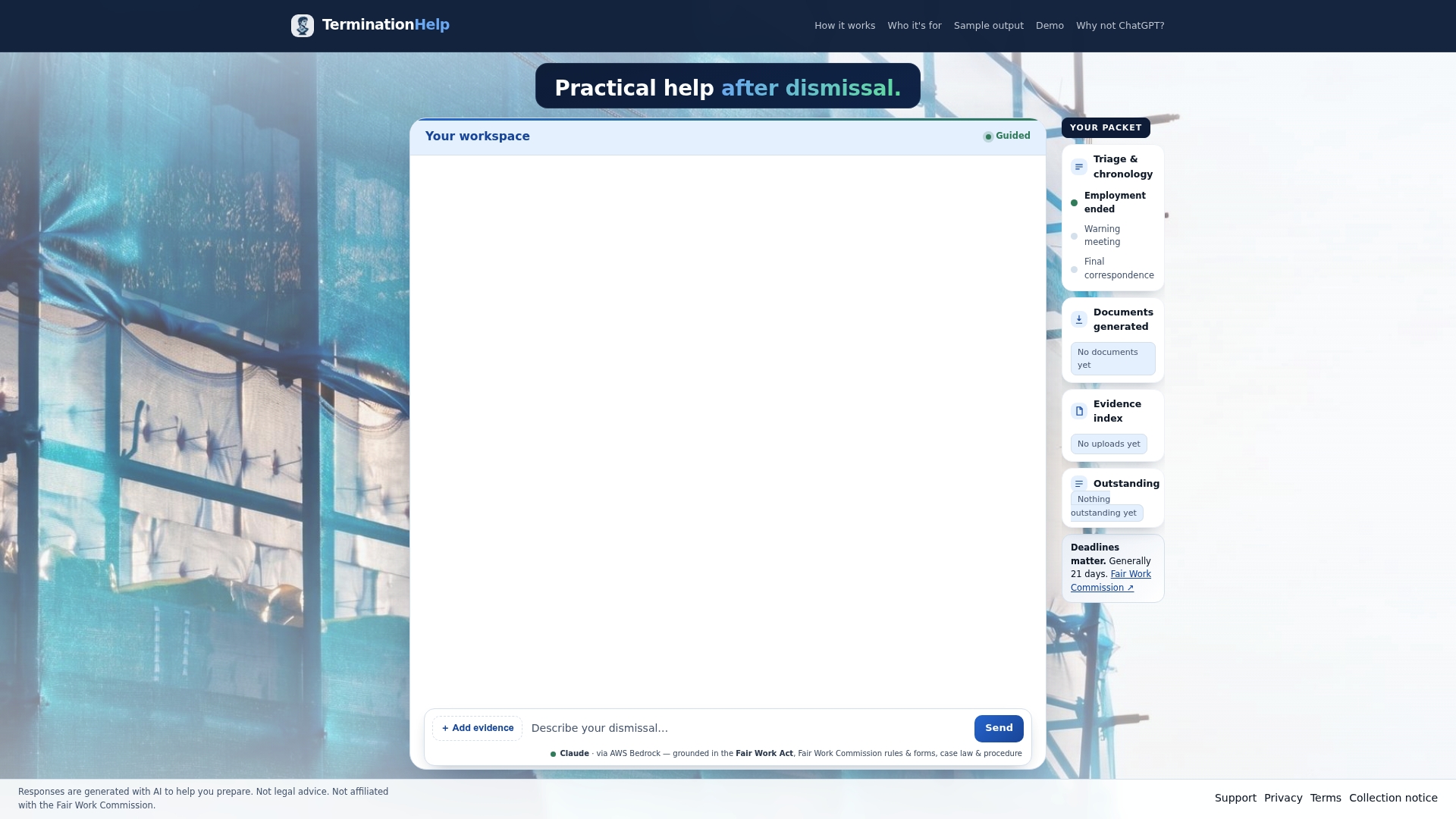
If you are a small business owner who has received a claim, or a lawyer or union representative looking to organise a matter, the same preparation workflow applies. For the filing steps themselves, see our guide to filing an unfair dismissal claim. Employers can also read about employer obligations when dismissing.
Our perspective
Health-related dismissals are the cases where the law is least intuitive and the calendar is least forgiving. The three-month rule, paid leave, inherent requirements and a 21-day limit all interact, and a person recovering from surgery or a mental health episode is rarely in a position to untangle them.
We built our tool because the problem is organisation as much as law. If your certificates, leave records, employer emails and timeline are in order, you can see which protection applies and which claim fits. Because we are limited to Australian employment law and Fair Work Commission procedure, the forms and guidance follow the rules that apply to your matter. Our approach is designed to keep your data onshore and never use it to train AI.
We do not replace a lawyer, a union or a community legal centre, and we do not predict outcomes. We get your matter prepared properly and early, so that whoever files it, the work has been done.
Nicolas
FAQ
Can my employer dismiss me while I am on sick leave?
Not because of the absence itself, if you can provide evidence of your illness or injury and the absence falls within the protected period. The employer may still dismiss you for a different, lawful reason, such as a genuine business closure. If you used paid sick leave for the whole absence, you cannot be dismissed because of that absence.
Is being unable to do my job a valid reason for dismissal?
It can be. The FWC says inability to perform the inherent requirements of your substantive position may be a valid reason, and medical evidence can affect whether it is adequate. The employer must also follow a fair process, including telling you the reason and giving you a chance to respond.
How long do I have to apply?
For unfair dismissal you generally have 21 days from the date the dismissal takes effect. A late application needs an accepted explanation for the delay, so lodge as early as you can.
Can I claim if I have only just started the job?
Unfair dismissal requires a minimum employment period of 6 months at an employer with 15 or more employees, or 1 year at a smaller employer. Other routes, such as general protections or discrimination claims, may still be open, and they have separate rules.
Sources
- Temporary absence – illness or injury, Fair Work Commission
- Long periods of sick leave, Fair Work Ombudsman
- Fair Work Ombudsman library, termination during sick leave
- Capacity, Fair Work Commission
- Improved rights protection for people with disability (2009), Australian Human Rights Commission
- Dhamija v MH Management (Qld) Pty Ltd [2026] FWC 634
- Unfair dismissal, Fair Work Commission
- Increase to the application fee for 2026-27, Fair Work Commission
- Romeo v Services Australia [2025] FWC 945
- Allen, Adverse Effects, UNSW Law Journal (2018)
Recommended
- Check Unfair Dismissal Eligibility in Australia: 21 days to lodge
- Employer obligations when dismissing an employee in Australia
- Australia: $95,050 payout cap and unfair dismissal remedies
- Unfair Dismissal Case Law in Australia: How to Read It
Article produced using AI. This is not legal advice.