

A direction from your employer is lawful and reasonable when it falls within your employment contract and involves nothing illegal, and when it is also reasonable in the circumstances. If it meets both tests, refusing it can give your employer a valid reason to discipline or dismiss you. If it fails either test, you may be on much safer ground. Even a proven refusal does not decide an unfair dismissal claim on its own, because the Fair Work Commission still looks at how you were dismissed. If you have been dismissed after refusing a direction, we built our preparation tool for exactly that situation.
TL;DR
- A direction is lawful if it sits within the scope of your employment and is not illegal. It is reasonable if it makes sense in all the circumstances, including the nature of the job, workplace practice and any award or agreement.
- Refusing a direction that passes both tests may be misconduct, and in some cases serious misconduct.
- A valid reason is only one part of the test. The Commission also weighs notice, your chance to respond and whether dismissal was a proportionate outcome.
- Health and safety concerns and other legitimate reasons can justify a refusal in some circumstances.
- The deadline to lodge an unfair dismissal application is short, so work out your position quickly.
Table of Contents
- What the two tests actually mean
- When contract wording decides the outcome
- When refusing can be justified
- What happens if you refuse a valid direction
- Refusing a direction and an unfair dismissal claim
- Check your eligibility and the deadline
- Small business owners and employers
- How we approach it
- Get your matter prepared
- FAQ
- Sources
What the two tests actually mean
Australian law has no single statute that defines a "lawful and reasonable direction". The idea comes from the common law, which means law developed by courts through decisions, and from the High Court's long-standing approach in the Darling Island Stevedoring case. The Fair Work Commission applied that approach in a 2021 decision. The Commission said a command must be within the subject matter of the employment and involve no illegality, and it must also be reasonable to bind the employee.
That gives you two separate questions.
Is it lawful? A direction is lawful when it falls within the scope of your employment contract and involves no illegality. Your contract, award or enterprise agreement sets that scope. An instruction to do something outside your role, or to break a law or safety rule, fails here.
Is it reasonable? The Commission assesses reasonableness in all the circumstances. It considers the nature of the employment, established usages and practices, and any applicable industrial instruments (awards and enterprise agreements). The same instruction can be reasonable in one workplace and unreasonable in another.

A quick way to test a direction
Ask yourself:
- Is the task within my job, as described in my contract, award or agreement?
- Would it involve anything illegal or unsafe?
- Is this how this type of workplace normally operates?
- Did my employer explain the direction and consult where they should have?
- Is there a genuine personal or health reason that makes compliance difficult?
Answers that point to "no" on the first three, or a clear "yes" on the last, are the starting point for a refusal that can be defended.
When contract wording decides the outcome
Contract terms often settle the lawfulness question. In Moers v Williamson Family Trust, the Commission found a direction to facilitate the provision of fitness-for-work medical information was lawful and reasonable. The employment agreement contemplated it and the employee had already consented to the relevant disclosure. The refusal was treated as serious misconduct, and the dismissal was found consistent with the Small Business Fair Dismissal Code.
The lesson is practical. Before you refuse anything, read what you signed. A direction that your contract already anticipates is much harder to resist than one that asks for something new.
When refusing can be justified
A direction does not have to be illegal to be refused. The Fair Work Ombudsman says that, in some circumstances, workers may refuse a direction to attend the workplace because of a reasonable health and safety concern or another legitimate reason. Employers, for their part, must meet their work health and safety obligations.
The 2021 Full Bench decision in Mt Arthur Coal shows how fact-heavy this is. It concerned a site-access vaccination requirement and considered consultation, privacy, bodily integrity and other factors. The Full Bench concluded that the particular requirement was not a lawful and reasonable direction, in part because of shortcomings in consultation. The decision does not mean every workplace requirement fails. It shows that the Commission looks at the whole picture, including how the employer went about it.
If your refusal rests on a reason like this, write it down at the time. Say what you were asked to do, why you could not, and what alternative you offered. That record matters later. Our guide to remote work refusal rights covers one common version of this situation.
What happens if you refuse a valid direction
Refusal of a lawful and reasonable direction may amount to misconduct. It can give an employer a valid reason for discipline, a formal warning or, in some cases, dismissal. The Fair Work Ombudsman also notes that non-compliance may lead to discipline and potentially termination, subject to statutory protections.
Misconduct sits on a scale. A single refusal of a minor instruction is not the same as a repeated, deliberate refusal of a safety-critical one. Whether conduct is serious misconduct depends on the facts. That matters because serious misconduct is treated differently from ordinary misconduct, including for the small business code mentioned above.
Refusing a direction and an unfair dismissal claim
If you were dismissed over a refusal, the question for the Commission is not just whether you refused. Under s 385 of the Fair Work Act 2009, a dismissal is unfair when it is harsh, unjust or unreasonable, and other statutory conditions are met. The Commission's Unfair Dismissals Benchbook explains that a proven refusal of a lawful and reasonable direction can support a valid reason. The Commission must still assess all the s 387 factors, including notice, your opportunity to respond and procedural fairness.
Two decisions show the range.
A valid reason that still ended unfairly. In Pham v Sommerville Retail Services, the Commission found the refusal and later conduct together supplied a valid reason. It still found the dismissal harsh because of procedural flaws, the employee's long service and a good record.
An allegation that was not proven. In Artisan Pools v Mutton, the Full Bench refused permission to appeal. The first-instance decision had found no valid reason because the alleged sabotage was unproven. Refusing to attend a meeting alone did not establish that allegation. The same decision records that a reduction in compensation for misconduct applies only where the misconduct contributed to the dismissal.
Together, they show that an employer must prove what it alleges and then still deal with you fairly. For more on what fairness requires, see our explainer on procedural fairness in dismissal and on employer obligations when dismissing an employee.

The evidence that tends to matter
In a dispute over a direction, the facts usually come down to documents. Gather:
- Your contract, any award or enterprise agreement, and position description.
- The direction itself, ideally in writing, or your notes of when and how it was given.
- Your response, including any reasons you gave and alternatives you offered.
- Any warnings, show-cause letters or meeting invitations, and how much notice they gave you.
- Your employment history, including any past warnings and your length of service.
Check your eligibility and the deadline
Not everyone can make an unfair dismissal claim, and the time limit is tight: you generally have 21 days from the day your dismissal took effect. Eligibility depends on factors such as how long you have worked there and whether you are covered by an award or earn under the high income threshold. Our guide to unfair dismissal eligibility and the 21-day limit sets out the checks. If you are casual, see the casual employee evidence guide, and if you were still on probation, the probation checklist.
If you were dismissed for a reason that might involve a workplace right, such as a health-related absence or a complaint, a general protections claim may also be relevant. General protections versus unfair dismissal explains which claim fits which facts.
Small business owners and employers
If you are an employer who has received a claim, the same tests apply to you. You need to show the direction was within the employee's role, reasonable, and clearly communicated. You also need to show that you followed a fair process. Where the Small Business Fair Dismissal Code applies, the Commission looks at whether you followed it, as it did in Moers. Keep your contract wording, the direction as given, and any records of warnings and meetings.
How we approach it
Most people who contact us after refusing a direction are focused on one question: was I right to refuse? That matters, but the Commission asks more. It asks whether the direction was within the contract, whether it was reasonable, whether the employer can prove what it alleges, and whether the process was fair.
That is why we built our tool around Australian legislation, Fair Work Commission procedure and relevant case law, rather than a generic chatbot. It checks eligibility, helps you organise your evidence against the s 387 factors, and prepares the forms and timeline. Nobody should have to work out the 21-day deadline while they are still reeling from a dismissal.
What you end up with is a structured packet. You can file it yourself or take it to a lawyer, union or community legal centre, so the person helping you starts with your facts in order.
Nicolas
Get your matter prepared
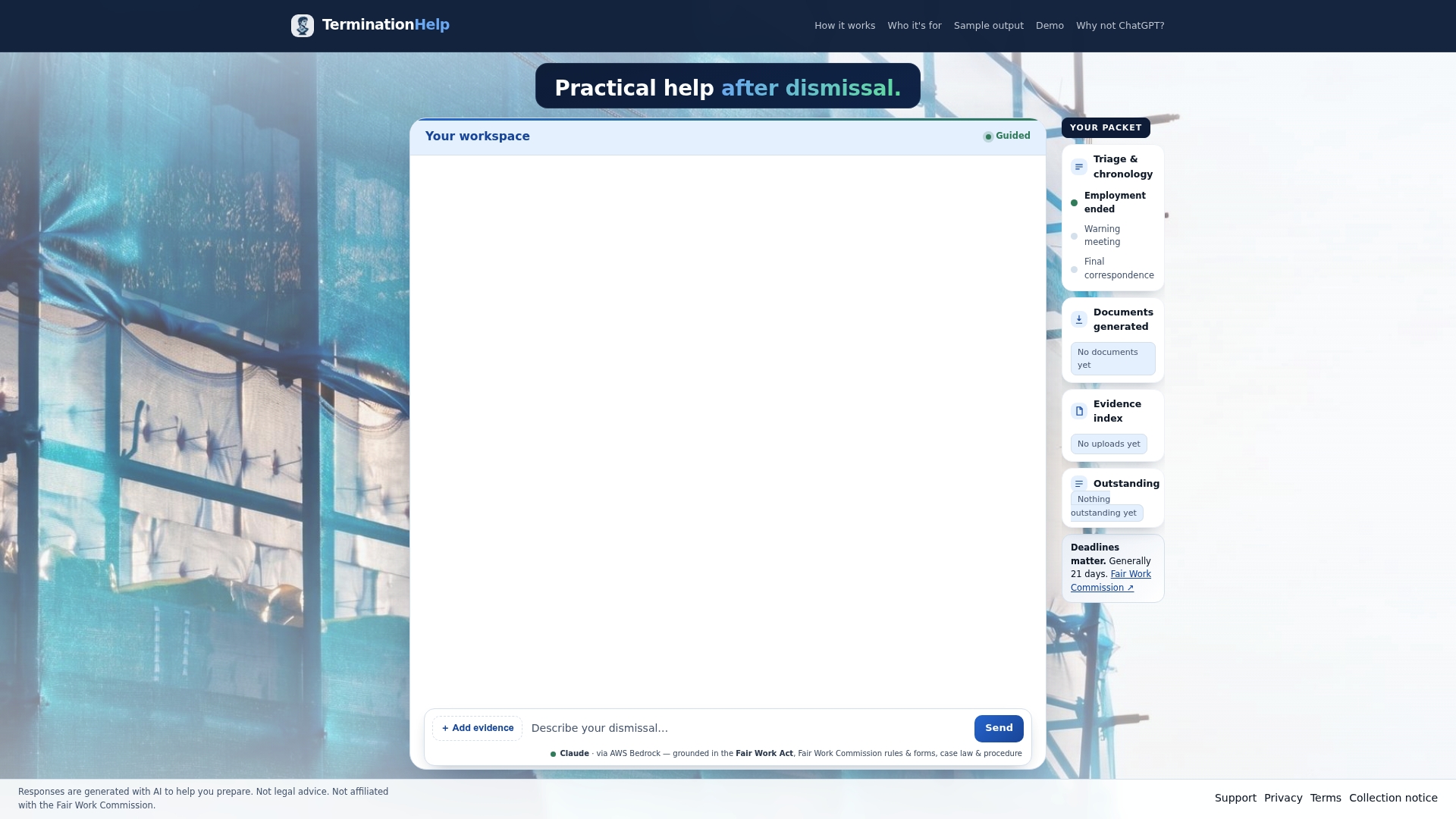
If you have been dismissed after refusing a direction, or you are an employer responding to a claim, our preparation support takes you through eligibility checks, evidence organisation, document upload and the generation of the Fair Work forms your matter needs. Everything is grounded in Australian legislation and Fair Work Commission rules, and you can file the finished packet yourself or bring it to a lawyer, union or community legal centre.
If you are weighing a settlement or what the Commission can order, unfair dismissal remedies explains the options, and how to read unfair dismissal case law helps you make sense of decisions like those above.
FAQ
Can my employer direct me to do work outside my job description?
Only if the task falls within the scope of your employment. Your contract, award or enterprise agreement sets that scope, and the Commission has said a lawful direction must be within it. A task closely related to your role is more likely to be within scope than a completely different one.
Can I be dismissed for refusing a direction?
Yes, if the direction was lawful and reasonable and the refusal is proven, it can be a valid reason for dismissal. The Commission must still weigh the other s 387 factors, including notice, your opportunity to respond and how harsh the outcome was.
Can I refuse a direction because of a health or safety concern?
In some circumstances, yes. The Fair Work Ombudsman says a reasonable health and safety concern or another legitimate reason can justify refusing a direction to attend the workplace. Raise the concern with your employer in writing as early as you can.
What if my employer says I refused but I did not?
The employer has to prove its allegation. In Artisan Pools, the Full Bench recorded that the alleged sabotage was unproven and the dismissal had no valid reason. Keep your messages and notes of what was actually said.
How long do I have to make a claim after being dismissed?
Generally 21 days from the day the dismissal took effect. Check your eligibility and the date as soon as possible.
Sources
- Fair Work Commission decision [2021] FWC 5677
- Moers v Williamson Family Trust [2025] FWC 1344
- Fair Work Ombudsman: Directing employees to the workplace and COVID-19
- CFMMEU v Mt Arthur Coal Pty Ltd [2021] FWCFB 6059
- Fair Work Commission Unfair Dismissals Benchbook
- Pham v Sommerville Retail Services Pty Ltd [2016] FWC 2267
- Artisan Pools Pty Ltd v Mutton [2025] FWCFB 246
Recommended
- Remote work refusal rights: what Australian employees can do
- Employer obligations when dismissing an employee in Australia
- Recording Conversations at Work in Australia: What the Law Allows
- Procedural Fairness in Dismissal: What Australian Law Requires
Article produced using AI. This is not legal advice.