

The Fair Work Commission can order two things if it finds your dismissal was harsh, unjust or unreasonable: reinstatement to your job, or compensation for lost pay. Compensation is awarded far more often than reinstatement, and median awards typically sit around 5 to 7 weeks' pay. The maximum payout is capped, and for dismissals from 1 July 2026 that cap is $95,050.
TL;DR:
- Reinstatement is rarely ordered because most relationships do not survive dismissal disputes, and the employer's ability to absorb the employee back is often limited.
- Compensation is typically awarded in weeks' pay, with median awards around 5 to 7 weeks, and the cap for dismissals from July 2026 set at $95,050.
- Eligible claimants must have at least six months of service (twelve for small businesses) and lodge within 21 days of dismissal, with extensions granted only in rare cases.
- The Fair Work Commission prioritizes whether the dismissal was harsh, unjust, or unreasonable, considering factors like valid reasons, communication, warnings, and employer size.
- Preparing evidence and understanding procedural requirements are crucial, and tools like TerminationHelp can streamline application preparation to improve chances of success.
Table of Contents
- What reinstatement means and when it is ordered
- How compensation is calculated and the statutory cap
- Eligibility and the 21-day lodgment deadline
- How the Fair Work Commission decides which remedy to order
- Conciliation, hearings and likely outcomes: what happens next
- When remedies are refused: genuine redundancy and employee conduct
- Unfair dismissal or general protections: which claim fits your case
- How a specialist Australian preparation tool helps you get ready for conciliation and lodgment
- What this guide gets right that most advice doesn't
- Start preparing: TerminationHelp gets your case conciliation ready
- Sources
- FAQ
What reinstatement means and when it is ordered
Reinstatement puts you back in your old job, with continuity of service and pay as if the dismissal never happened. It sounds like the obvious fix, but the Commission only orders it in a small share of cases.
Members lean towards reinstatement when the working relationship is still salvageable and the employer can realistically absorb you back without major disruption.
- The employer-employee relationship isn't beyond repair
- Reinstatement is practical given the size and structure of the business
- There's no finding of serious misconduct that would make trust impossible
Reinstatement is uncommon mostly because relationships rarely survive a dismissal dispute intact. If the role has been filled, the business has restructured, or the split was acrimonious, the Commission usually finds compensation is the more workable outcome.
Pro Tip: If reinstatement genuinely matters to you, say so clearly and early in your application. The Commission won't offer it as a default. You need to ask for it and explain why it's workable.
How compensation is calculated and the statutory cap

Compensation covers lost remuneration only. It does not cover distress, embarrassment, or the emotional toll of losing your job, no matter how unfair the dismissal felt. The Fair Work Commission's own guidance is explicit that awards focus strictly on financial loss, which is why even a clearly unjust dismissal can produce a modest payout.
The law caps compensation at whichever is lower: half the high income threshold, or 26 weeks of your pay. For dismissals taking effect on or after 1 July 2026, that cap sits at $95,050, based on half of the $190,100 high income threshold.
In practice, most awards are nowhere near that ceiling. Median compensation runs around 5 to 7 weeks' pay. Reaching the cap requires an unusually long remaining period of likely employment and a genuinely high salary, which makes it the exception rather than the rule.
- Compensation is reduced if you'd have been dismissed anyway for a valid reason within a reasonable timeframe
- Any income you've earned since dismissal gets deducted
- You need payslips and bank records to prove the loss, or the Commission may reduce or refuse the award
Eligibility and the 21-day lodgment deadline
Before you get near remedies, you need to clear the eligibility bar and lodge on time.
- Minimum employment period. You need 6 months of service generally, or 12 months if your employer is a small business (fewer than 15 employees).
- Income threshold. You must earn under the high income threshold, unless a modern award or enterprise agreement covers you, in which case the threshold doesn't apply.
- Casual employees. You're eligible only if your work was regular and systematic, and you had a reasonable expectation the employer would keep offering shifts, per Fair Work Commission eligibility rules.
- The 21-day deadline. Your application must be lodged within 21 days of the dismissal taking effect, not 21 days from when you found out about it or processed the news.
- Extensions. These are granted rarely, and only where fairness genuinely demands it.
If you're on probation, none of this changes automatically. Probation isn't a legal concept under the Fair Work Act. What matters is whether you've hit the minimum employment period, not whether your employer has labelled you "probationary."
How the Fair Work Commission decides which remedy to order
The Commission applies one core test: was the dismissal harsh, unjust or unreasonable? To answer that, members must weigh specific factors set out in the Fair Work Act 2009, not just whether the employer had some reason to act.
- Whether there was a valid reason connected to your capacity or conduct
- Whether you were told the reason and given a chance to respond before being sacked
- Whether warnings were given for performance issues
- The size of the employer and whether it had dedicated HR expertise
- Any other matters the Commission considers relevant
Genuine redundancy and the Small Business Fair Dismissal Code can block a remedy entirely, even where the process felt unfair to you. The Commission also expects solid documentation. Warnings, meeting records, and payroll data carry real weight in these hearings.
Conciliation, hearings and likely outcomes: what happens next
Most claims go to conciliation first, usually a phone conference with a Commission staff member acting as an independent go-between.
- Conciliation. Around two thirds of matters settle here, often for payment, a statement of service, an apology, or occasionally reinstatement.
- No settlement. If conciliation fails, the matter proceeds to a formal hearing or the Commission issues a certificate allowing court action in limited circumstances.
- Preparation. Walk into conciliation knowing your preferred remedy, your evidence checklist, and a realistic timeline for how long you were likely to keep working.
When remedies are refused: genuine redundancy and employee conduct
Genuine redundancy is a complete bar to unfair dismissal relief. If your role genuinely no longer exists and consultation obligations were met, the Commission can't order a remedy, even if you disagree with the business decision.
- Serious misconduct discovered during the case can strip away any remedy, even after a finding of unfairness
- Giving misleading evidence damages your credibility and can sink an otherwise strong claim
- Failing to produce payslips or bank statements to prove lost earnings often means no compensation is ordered, regardless of how unfair the dismissal was
- Small businesses that followed the Small Business Fair Dismissal Code have a specific procedural defence, even where the outcome feels harsh
Unfair dismissal or general protections: which claim fits your case
These are different legal pathways, and you can't run both for the same dismissal.
- Unfair dismissal turns on whether the sacking was harsh, unjust or unreasonable
- General protections claims require proving you were dismissed for a prohibited reason, such as making a complaint or exercising a workplace right
- General protections has no minimum employment period and no compensation cap, but the burden of proof works differently
- If you were forced to resign after raising a complaint, or dismissed while on sick leave, get advice quickly. That fact pattern often points towards general protections rather than straightforward unfair dismissal
How a specialist Australian preparation tool helps you get ready for conciliation and lodgment
Most people don't lose their case on the merits. They lose it on preparation: missing the 21 day window, showing up to conciliation without payslips, or not knowing which remedy to actually ask for.
TerminationHelp is an AI tool designed to assist users in preparing Fair Work matters by generating relevant forms to help with their application process.
- Runs an eligibility check against minimum employment periods and the income threshold before you spend time on an application
- Organises your evidence, including warnings, emails, and payroll records, into a structured packet
- Auto generates the Fair Work forms you need at each stage, with the relevant timelines attached
- Complements a lawyer, union, or community legal centre rather than replacing them if your matter is complex
What this guide gets right that most advice doesn't
Most articles on this topic lead with sympathy and procedural history, then bury the actual numbers three sections down. That ordering does readers a disservice. If you've been sacked, you need to know within the first minute that reinstatement is rare, compensation is capped, and the median payout is measured in weeks, not months.
The conventional advice also oversells reinstatement as some kind of vindication remedy. It isn't. The Commission treats it as a practical question: can this relationship actually work again? Most of the time, the honest answer is no, and compensation becomes the only realistic outcome.
Where I'd push back hardest is on preparation. Too many applicants treat conciliation as a formality and turn up without pay records or a clear number in mind. The Fair Work Commission is explicit that a failure to prove lost earnings can sink an otherwise strong claim. If there's one thing to prioritise before anything else, it's getting your evidence in order well before the 21 day deadline closes.
— Nicolas
Start preparing: TerminationHelp gets your case conciliation ready
TerminationHelp is the alternative to guessing your way through Fair Work paperwork alone. Instead of piecing together which forms apply to your situation and hoping you've read the eligibility rules correctly, the platform runs an eligibility check, organises your evidence into a clear packet, and generates the actual Fair Work forms you need at each stage.
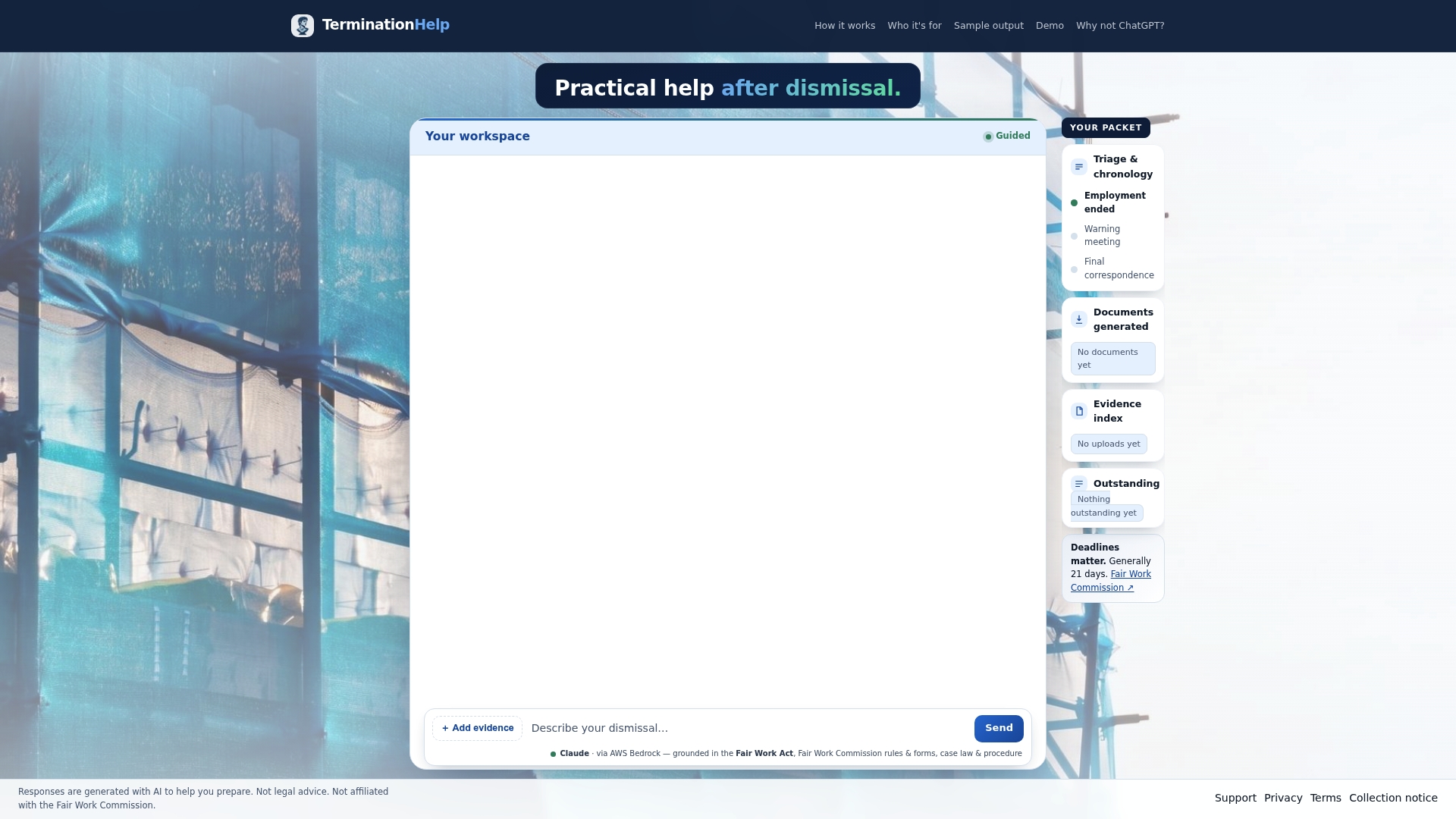
If you're inside the 21 day window and unsure where to start, the practical order is: run the eligibility check, pull together your payslips and any written warnings or performance records, then build your preparation packet before conciliation. You can bring that packet independently or hand it to a lawyer, union, or community legal centre for review. Start with the preparation support service to see exactly what's generated for your matter.
FAQ
What is the most common remedy for unfair dismissal?
Compensation is awarded far more often than reinstatement. Median awards typically sit around 5 to 7 weeks' pay, reflecting the fact that compensation only covers proven lost earnings, not distress or inconvenience.
What remedies are available for unfair dismissal?
The Fair Work Commission can order reinstatement, compensation, or in some cases both, though reinstatement remains uncommon. Compensation is capped at the lower of half the high income threshold or 26 weeks' pay, which is $95,050 for dismissals from 1 July 2026.
What are fair reasons for dismissal?
A dismissal is generally fair when there's a valid reason tied to your conduct or capacity, you were told the reason, and you were given a chance to respond before being sacked. The Commission also looks at whether warnings were given for performance issues and whether the process was proportionate to the employer's size.
What are the steps to address unfair dismissal?
Check your eligibility against the minimum employment period and income threshold, then lodge your application within 21 days of the dismissal taking effect. Most matters go to conciliation first, and if that fails, proceed to a formal Commission hearing. Using a preparation tool like TerminationHelp can help you organise evidence and generate the required forms before those deadlines close.
Can I claim unfair dismissal while on probation?
Probation isn't a defined legal status under the Fair Work Act. What matters is whether you've completed the minimum employment period, which is 6 months generally or 12 months for a small business employer.
Can a casual employee claim unfair dismissal?
Yes, if your work was regular and systematic and you had a reasonable expectation of continuing employment. Irregular or genuinely occasional casual work usually won't meet this test.
Recommended
Article produced using AI. This is not legal advice.