

You can likely apply for unfair dismissal if you have worked at least 6 months full-time or part-time for a larger employer, or 12 months for a small business, earn under the high-income threshold, and lodge within 21 days of your dismissal taking effect. Casuals, redundancies and forced resignations each carry their own rules, covered below, along with what happens if you miss these marks.
TL;DR:
- Eligibility requires at least 6 months of continuous service with larger employers or 12 months with small businesses, including associated entities and regular casuals.
- The high-income threshold is now $190,100 annually from July 2026, and earnings above this with no award or enterprise agreement exclude you from applying.
- You must lodge your application within 21 days of dismissal, with gathering detailed evidence and understanding the actual termination date crucial to meet deadlines.
- Redundancies and fixed-term contract expirations generally do not qualify as dismissals unless procedural rules were not followed or the arrangement was a sham.
- Compensation is capped at the lesser of 26 weeks' pay or half the high-income threshold, with reinstatement as the primary remedy, depending on the circumstances.
Table of Contents
- Minimum employment period and small business rules
- Coverage and the high-income and award exceptions
- Time limits, fees and urgent practical steps
- What counts as a dismissal: resignation, redundancy and being forced out
- Misconduct, poor performance and what fair process looks like
- Remedies: reinstatement and compensation, and how the cap works
- Preparing an application: evidence, paperwork and common pitfalls
- What to expect at Fair Work Commission conciliation and hearings
- Unfair dismissal versus general protections: when to consider both
- Why eligibility usually comes down to paperwork and timing
- How TerminationHelp helps you prepare your application
- FAQ
- Sources
Minimum employment period and small business rules
Your length of service decides whether you clear the first hurdle. Employees of businesses with 15 or more staff need 6 months of continuous service; if your employer is a small business with fewer than 15 employees, you need 12 months.
Counting "15 employees" is not always obvious. When working out small business status, you include every full-time and part-time worker, plus casuals engaged regularly and systematically, and staff employed by associated entities connected to your employer. Businesses sometimes miscount this and wrongly assume they qualify as small when they do not.
A few situations affect how your service is counted:
- Casual employees count only when their work is regular and systematic with a reasonable expectation of continuing employment, not for one-off or irregular shifts.
- Service with a previous employer can carry over where there has been a transfer of business and the new employer takes on the same role.
- Associated entities of your employer are included when calculating whether the business counts as small.
- Time spent on approved leave generally still counts towards your minimum employment period.
If you are unsure whether you have cleared the threshold, the date your contract ends, not your last physical day in the office, is usually what matters.
Coverage and the high-income and award exceptions
Clearing the service test is not enough on its own. If your annual earnings exceed the high-income threshold and you are not covered by a modern award or enterprise agreement, you are not eligible to apply.
For dismissals from 1 July 2026, the high-income threshold is $190,100 per annum, up from $183,100 the year before, reflecting the annual indexing that occurs every 1 July. Earning above this figure only rules you out if you are also award-free and have no enterprise agreement in place. Check your payslip or contract for an award reference, or ask your employer directly, before assuming you are excluded.
Time limits, fees and urgent practical steps
The strictest rule in the whole system is the deadline: you have 21 days from the date your dismissal takes effect to lodge, not 21 days from your last day worked. If your employer pays out your notice, the dismissal usually takes effect immediately rather than at the end of a notice period.
As of 1 July 2026, the application fee is $92.70, payable on lodgement, with a waiver available if you can document serious financial hardship.
Before you lodge, gather:
- The exact date and method of your dismissal, including any letter or email.
- Your employer's correct legal name and contact details.
- Any reasons given for the dismissal, written or verbal.
- Your desired outcome, whether reinstatement or compensation.
Pro Tip: Start your application even if you do not have every document ready. You can add evidence later, but you cannot add back a missed deadline.
What counts as a dismissal: resignation, redundancy and being forced out
Not every end of employment is a "dismissal" in the legal sense. If you resign voluntarily, you generally cannot claim unfair dismissal, but if you were forced to resign because of your employer's conduct, that can amount to constructive dismissal and may still qualify.
Fixed-term contracts that simply expire are usually not dismissals, unless the arrangement looks like a sham designed to avoid giving you ongoing rights.
- A genuine redundancy, where your role is no longer needed and your employer has met consultation obligations under the relevant award or agreement, generally excludes an unfair dismissal claim.
- A redundancy that skips required consultation, or where the role is reassigned rather than genuinely eliminated, may not count as genuine and can still support a claim.
- Being dismissed while on sick leave is not automatically unlawful, but if the real reason relates to your illness rather than a legitimate business reason, it may be challengeable.
The label your employer uses ("resignation", "redundancy", "restructure") does not settle the question. What matters is what actually happened.
Misconduct, poor performance and what fair process looks like
Serious misconduct, such as theft, violence or a serious breach of workplace safety, can justify dismissal without notice. Even then, the Commission must be satisfied the dismissal was not harsh, unjust or unreasonable, which means process still matters.
For poor performance, employers are generally expected to give a valid reason, warn you, and give you a genuine opportunity to respond before dismissing you.
- A valid reason connected to your conduct or performance is the starting point for any lawful dismissal.
- You should normally be told the reason and given a chance to respond before the decision is final.
- Small businesses assessed against the Small Business Fair Dismissal Code face a different, generally less formal, standard than larger employers.
- Skipping warnings or process entirely, especially for performance issues, is one of the more common reasons a dismissal is found unfair.
Remedies: reinstatement and compensation, and how the cap works
Reinstatement is treated as the primary remedy the Commission must consider first, ahead of compensation. It is often considered inappropriate where trust has broken down, the role no longer exists, or you are incapable of returning to the position.
Where compensation is ordered instead, it is capped at the lesser of your remuneration over the 26 weeks before dismissal, or half the high-income threshold at the time.
Your actual award, if any, depends heavily on your prior earnings and how long you were likely to have remained employed, so these figures mark the outer limit rather than a typical outcome.
Preparing an application: evidence, paperwork and common pitfalls
A strong application rests on paperwork, not just your account of events. Gather your employment contract, payslips, performance reviews, any written warnings, and the termination notice or email itself.
- Record the exact date and wording of your dismissal, since this anchors your 21-day deadline.
- Collect evidence of inconsistent or shifting reasons given for your dismissal, which can undermine your employer's case.
- Avoid relying on hearsay. Favour emails, texts and documents over secondhand accounts of what someone said.
- Note down your desired outcome early, whether that is reinstatement or a specific compensation figure.
Pro Tip: Missing the 21-day deadline and weak evidence for constructive dismissal claims are two of the most common reasons otherwise valid applications fail.
Preparing all of this from scratch under time pressure is where many people lose days they cannot spare. TerminationHelp's preparation support organises your evidence, checks your eligibility against the rules above, and generates the required Fair Work forms, so you spend less time working out paperwork and more time building your case.
What to expect at Fair Work Commission conciliation and hearings
Conciliation comes first for almost every application. It is an informal, facilitated discussion between you and your employer, run by a Commission member or staff conciliator, aimed at reaching a settlement without a formal hearing.
- Bring your key dates, documents and a clear idea of the outcome you want before conciliation.
- Many applicants represent themselves successfully at this stage, though you can bring a support person or representative.
- If conciliation does not resolve the matter, it proceeds to a formal hearing with evidence given under oath.
- Community legal centres and unions can help you prepare if you are unsure how to present your case.
Unfair dismissal versus general protections: when to consider both
Unfair dismissal asks whether your termination was harsh, unjust or unreasonable. General protections ask whether you were dismissed for an unlawful reason, such as raising a workplace complaint or taking personal leave, and carries no statutory compensation cap.
If your situation involves both harsh treatment and a suspicious underlying reason, it is often worth checking eligibility for both pathways, since they test different legal questions and can lead to different outcomes.

Why eligibility usually comes down to paperwork and timing
Most unfair dismissal cases I come across do not fail because the dismissal was fair. They fail because someone missed the 21-day window, could not find the termination letter, or waited too long to write down what was actually said to them.
If you take one thing from this, make it urgency: gather your dates and documents today, not next week. The Commission, your union, a community legal centre, or a structured tool like TerminationHelp can all help you organise what you have, but none of them can extend a deadline that has already passed.
— Nicolas
How TerminationHelp helps you prepare your application
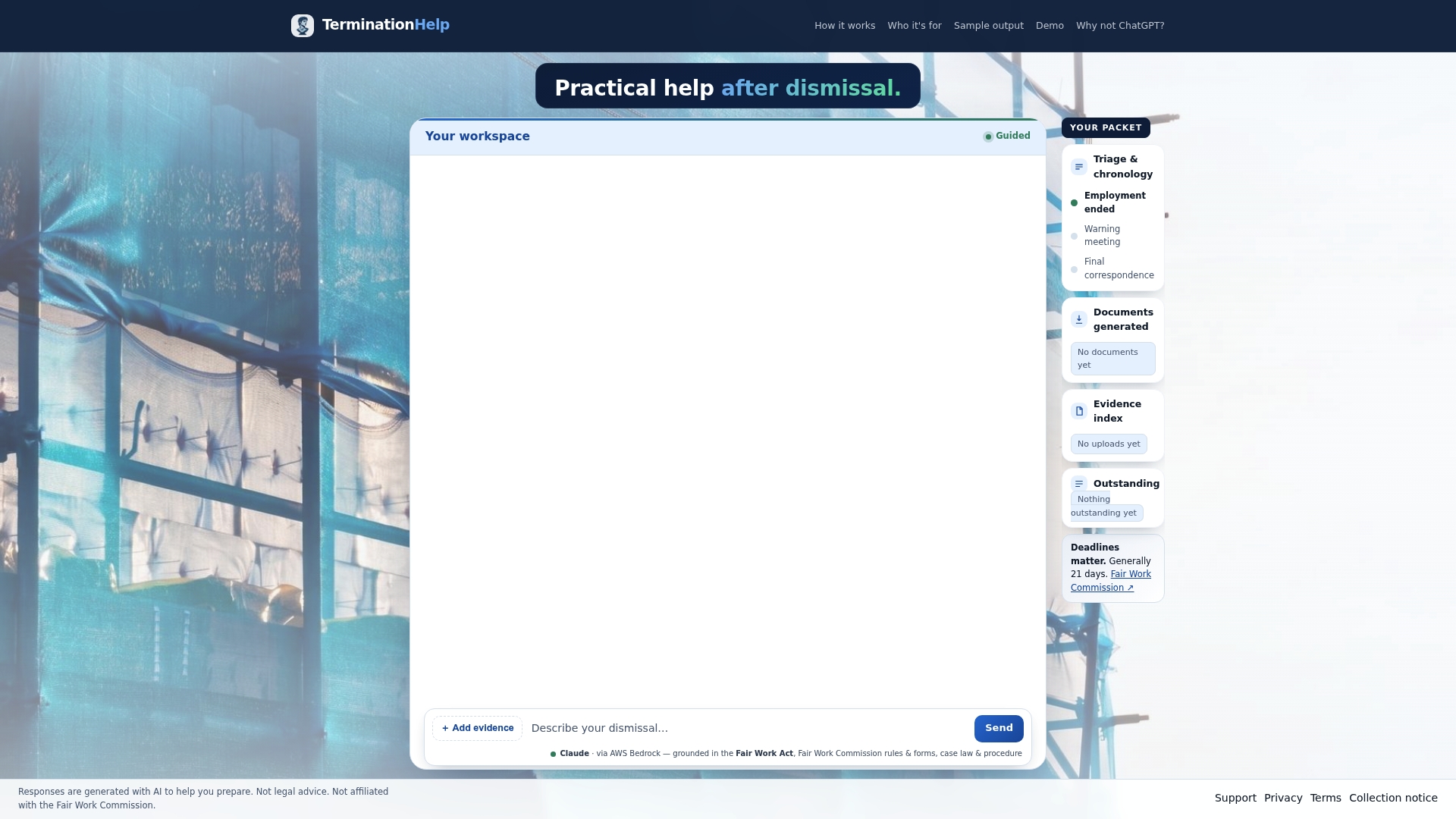
We built our preparation support specifically for Australian Fair Work matters, so every form, timeline and eligibility check reflects current Commission rules rather than generic legal templates. We organise your evidence, check your eligibility against the tests above, and generate the forms your application needs.
This suits you if you are preparing an unfair dismissal or Fair Work matter and want structured, step-by-step support rather than a blank page. Check your eligibility against the Commission's own guidance first, then start your preparation support with us when you are ready to move.
This article is general information, not a substitute for advice from a qualified lawyer. Consult a qualified legal professional about your own circumstances before acting on anything here.
FAQ
Who is eligible to apply for unfair dismissal?
You are generally eligible if you have completed the minimum employment period, 6 months for larger employers or 12 months for small businesses, earn under the high-income threshold or are covered by an award or agreement, and lodge within 21 days of dismissal.
Who is entitled to unfair dismissal remedies?
Employees found to have been dismissed harshly, unjustly or unreasonably may be entitled to reinstatement or compensation, with reinstatement considered the primary remedy before compensation is assessed.
What is the qualifying period for unfair dismissal?
The qualifying period is 6 months of continuous service for employees of larger employers, or 12 months if your employer is a small business with fewer than 15 employees.
How much compensation can I get for unfair dismissal in Australia?
Compensation is capped at the lesser of your remuneration over the 26 weeks before dismissal or half the high-income threshold, which puts the cap at $95,050 for dismissals from 1 July 2026. Actual awards are usually well below this limit and depend on your individual circumstances.
Article produced using AI. This is not legal advice.