

Yes, the Small Business Fair Dismissal Code can make a dismissal fair, but only if you're eligible and you follow one of two lawful routes: summary dismissal for serious misconduct, or a warned, staged process for conduct or capacity issues. Eligibility hinges on your headcount (fewer than fifteen) and the employee's service meeting a minimum period requirement. Whichever route applies, contemporaneous records are what actually protect you if a claim lands.
TL;DR:
- Properly counting only individual employees, not full-time equivalents or associated entities, is critical for small business eligibility under the dismissal code.
- Summary dismissals require a genuine, reasonable belief of serious misconduct like theft, violence, or safety breaches, supported by contemporaneous investigation notes.
- Most lawful dismissals follow a staged process involving clear warnings, responses, support opportunities, and documented steps to avoid procedural pitfalls.
- Employers must prepare a detailed, date-stamped evidence file including warnings, investigation records, and witness statements to defend against unfair dismissal claims.
- Small businesses retain obligations for final pay and entitlements, and must file any unfair dismissal claims within 21 days, emphasizing the importance of compliant early documentation.
Table of Contents
- Who the small business fair dismissal code applies to
- Summary dismissal: when you can act immediately
- Other dismissal: the warning and response process
- Building an evidence file the Commission will accept
- What happens after the dismissal
- Where small businesses trip up
- Balancing small business practicality with recorded fairness
- Getting your dismissal paperwork right before it matters
- Sources
- FAQ
Who the small business fair dismissal code applies to
The Code applies only to genuine small business employers, and the headcount test trips up more owners than you'd expect. You're counted as a small business if you employ fewer than fifteen people, but that figure includes regular and systematic casuals and anyone employed by an associated entity. A café with 12 staff that shares ownership with a sister business employing 6 more no longer qualifies, even though each site looks small on its own.
Two other checks matter before you rely on the Code:
- Confirm you're a national system employer. Most private sector businesses across Australia are covered, but the Fair Work Commission's small business guidance sets out the specifics for your structure.
- Check the employee has been with you for at least 12 months. Small business employees need this minimum period to bring an unfair dismissal claim at all, a longer threshold than the 6 months that applies to bigger employers.
- Count individuals, not full-time equivalents. Two part-time staff still count as two people, not one.
Get the headcount wrong and the Code offers no protection at all, regardless of how well you handled the dismissal itself.
Summary dismissal: when you can act immediately
Summary dismissal means ending employment on the spot, without notice or a warning period. The legal test isn't whether the employee actually did something wrong. It's whether you held a genuine, reasonable belief that they did, that the conduct was serious, and that it justified immediate termination. The Code's original text frames it this way deliberately: the Fair Work Commission examines your belief and how you formed it, not whether guilt is proven beyond doubt.
Conduct that typically clears this bar includes:
- Theft or fraud involving the business, its stock, or its money
- Violence or serious threats of violence in the workplace
- Sexual harassment of another employee, contractor, or customer
- Serious breaches of workplace health and safety that put people at risk
- Conduct serious enough to warrant a police report, where that step is relevant
None of these justify skipping an inquiry. Ask the employee for their version of events, note who you spoke to, and write down what you found before you act. A dismissal driven by a snap judgement, with no paper trail showing how you reached it, is exactly the scenario that unravels in front of the Commission.
Pro Tip: Write your investigation notes the same day, even if it's just a few dot points with a timestamp. A one-page record made hours after the incident carries far more weight than a tidy summary written from memory a month later.
Other dismissal: the warning and response process
Most dismissals in a small business aren't summary. They're built on ongoing performance problems or conduct that doesn't warrant instant termination. This is where the Code sets out a staged process, and skipping a stage is the single fastest way to lose an unfair dismissal case.
- Identify a valid reason. It has to relate to the employee's conduct or their capacity to do the job. Reasons unrelated to either won't hold up.
- Warn the employee, preferably in writing. Tell them plainly that their job is at risk and specify what needs to change. Vague warnings that don't name the actual problem undermine compliance even when everything else is done correctly.
- Let them respond. Give the employee a genuine chance to explain themselves or challenge the warning before any final decision is made.
- Allow a support person. They can bring a colleague, friend, or family member to meetings, though not a lawyer acting in a professional capacity.
- Set a reasonable improvement window. There's no fixed number of days here. A junior staff member struggling with a new system might reasonably need weeks of coaching, while a senior employee ignoring a clear instruction might need only a short window.
- Document every step, including why you chose the timeframe you did and any training or support offered.
Rigid, one size fits all timelines are a trap. A 2012 Fair Work Commission decision makes clear that what counts as a reasonable opportunity depends entirely on the specific issue and what support was realistically available.
Building an evidence file the Commission will accept
If a claim is lodged, the Commission looks at what you actually did under the Code, not just what you believed. That makes your paperwork the centrepiece of your defence.
A solid evidence file includes:
- The completed Small Business Fair Dismissal Code checklist
- Written warnings, dated and specific to the issue raised
- Investigation notes and records of who was interviewed
- Copies of meeting invitations sent to the employee
- The employee's written or recorded response
- The final statement of termination
- Witness statements, signed and dated
- Payroll records confirming final pay and entitlements
Structure it simply: a cover sheet, a chronology of events, a folder of key documents, and signed witness statements at the back. This isn't paperwork for its own sake. The Fair Work Commission's own guidance is explicit that employers need to be able to show what they did at each stage, and dated, contemporaneous notes carry far more weight than a reconstruction written after a claim lands on your desk.
What happens after the dismissal
Summary dismissal removes your obligation to give notice. It doesn't remove anything else. You still owe the employee their final pay and any accrued entitlements, and small business status doesn't automatically wipe out redundancy obligations either.
- Calculate final pay including unused annual leave and any other accrued entitlements owed under the National Employment Standards.
- Check the relevant award or enterprise agreement. Small businesses generally don't owe redundancy pay, but certain awards, agreements, or insolvency situations override that general position.
- Remember the employee has 21 days from the dismissal date to lodge an unfair dismissal application with the Commission, a timeframe set out in section 388 of the Fair Work Act 2009. Extensions are only granted in exceptional circumstances, so don't assume a late claim will simply be waved through.
Where small businesses trip up
The same handful of mistakes show up again and again in Fair Work Commission decisions, and most of them are avoidable with a bit of forward planning.
The most common error is failing to count associated entities and regular casuals correctly, which knocks a business out of small business status without the owner realising it. The second is dismissing someone for a reason they were never actually warned about, relying instead on a contract clause or a general sense that "they knew this was coming." A 2016 Commission decision shows how easily this sinks an otherwise defensible case: procedural gaps and undisclosed reasons are treated as decisive, regardless of how the underlying conduct looked.
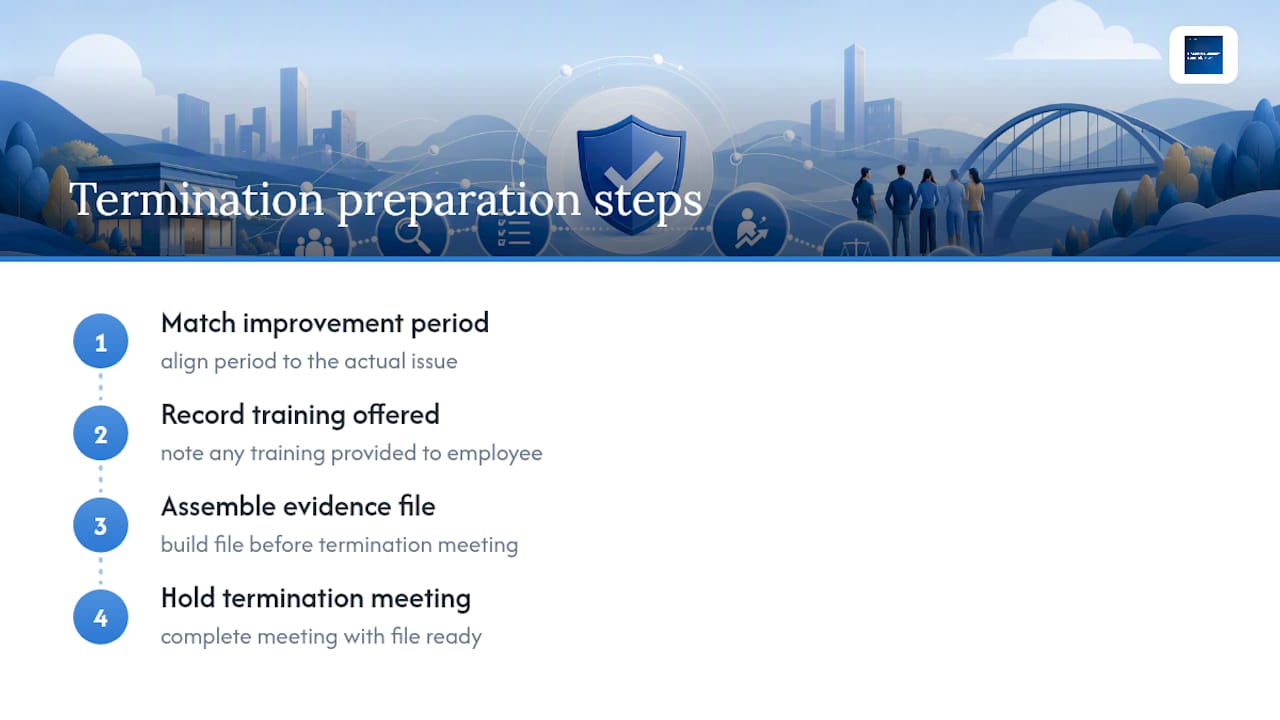
Pro Tip: Match your improvement period to the actual issue, note any training you offered, and build your evidence file before the termination meeting happens, not after the fact when memories have already started to blur.
Balancing small business practicality with recorded fairness
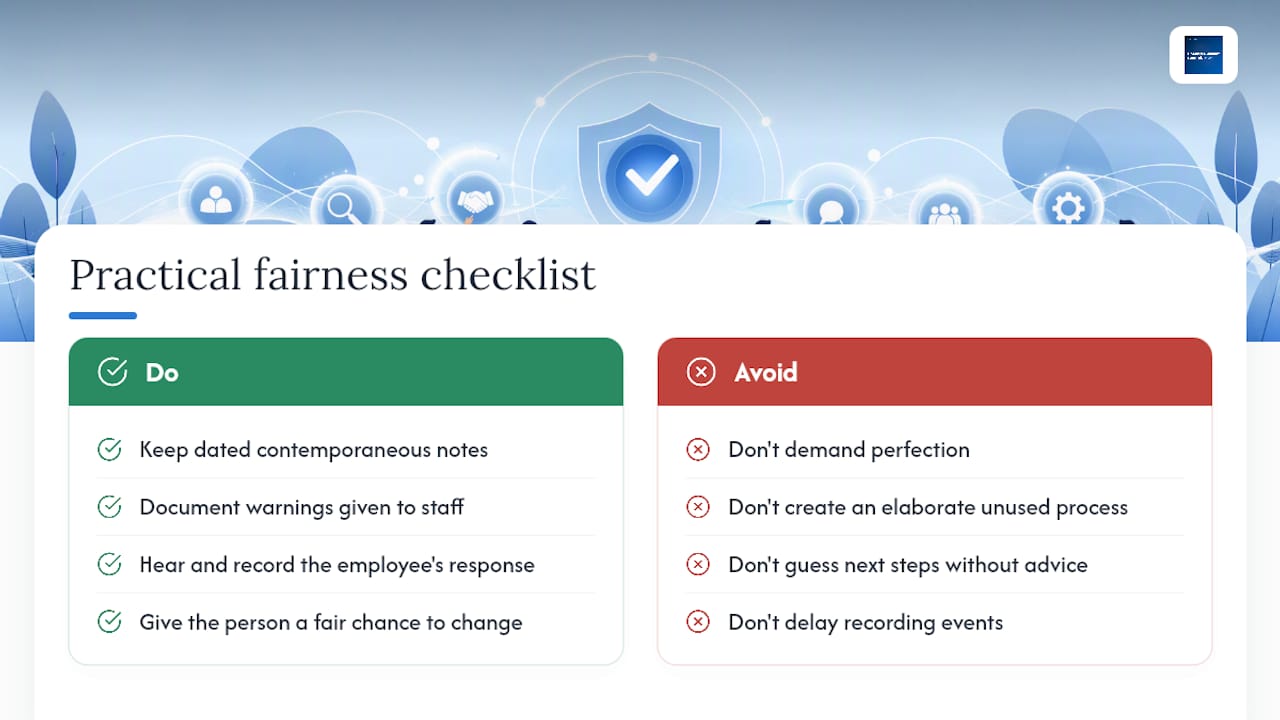
Running a small business rarely leaves room for a dedicated HR function, and the Code was written with that in mind. It doesn't demand perfection. It demands a genuine attempt, backed by dated notes, to warn people, hear them out, and give change a fair chance.
A short, contemporaneous file beats an elaborate process you never actually followed. If a matter escalates toward the Commission or looks genuinely contested, that's the point to bring in paid preparation support or legal advice rather than guessing at the next step.
— Nicolas
Getting your dismissal paperwork right before it matters
Most small business owners don't get this wrong because they're careless. They get it wrong because they're running a business, not a compliance department, and the Code's requirements only become urgent once a dismissal is already underway. There are AI-assisted tools available that are designed around Australian Fair Work rules, generating checklists, forms, and evidence structures that compliant dismissals need, rather than generic legal templates that ignore jurisdiction entirely.
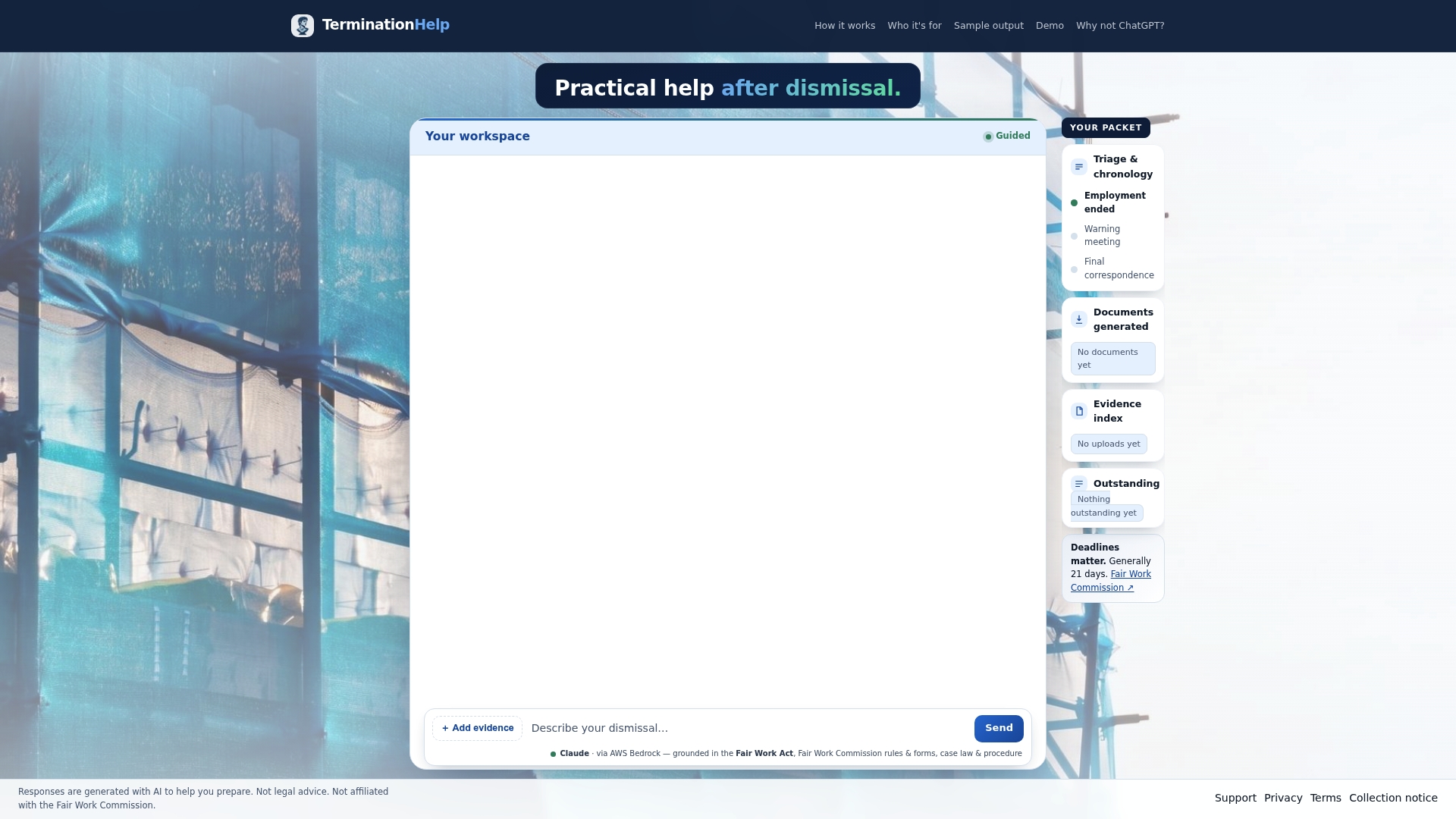
The preparation support service walks you through eligibility checks, organises your evidence into the structure the Commission expects, and produces the required Fair Work forms whether you're preparing to defend a claim or making sure your own dismissal process holds up before you act. It's built for employers who want a clean, supplier-neutral file they can hand to a lawyer, a union, or the Commission itself, without paying agency rates to get there. Head to Terminationhelp to start building your file today.
This article is general information, not a substitute for advice from a qualified lawyer. Consult a qualified legal professional about your own circumstances before acting on anything here.
Sources
- Dismissal rules for small business owners | Fair Work Commission
- FAIR WORK ACT 2009 - SECT 388 The Small Business Fair Dismissal Code
- Legislation
- Ending employment: dismissal | Fair Work Ombudsman
FAQ
Are small businesses exempt from unfair dismissal claims?
No. Small businesses aren't exempt, but employees need at least 12 months of continuous service before they can lodge an unfair dismissal claim, compared with 6 months for larger employers. If you comply with the Small Business Fair Dismissal Code, the Commission treats the dismissal as fair.
How do I terminate an employee in a small business?
Confirm your headcount and the employee's eligibility, then choose the right route: summary dismissal for serious misconduct, or a warned process with a chance to respond and improve for conduct or capacity issues. Document every step as you go, since that record is what the Commission actually assesses.
What are the three types of dismissal?
The three broad categories are summary dismissal (immediate, for serious misconduct), dismissal with notice for conduct or capacity reasons, and redundancy. Small businesses generally don't owe redundancy pay, though awards, agreements, or insolvency can change that.
What are five fair reasons for dismissal?
Common fair reasons include serious misconduct such as theft or violence, ongoing poor performance despite warnings, an inability to perform the inherent requirements of the role, serious breaches of workplace health and safety, and repeated breaches of a lawful and reasonable direction. Each still needs to go through the appropriate process under the Code, whether that's summary or staged dismissal.
Recommended
Made with BabyLoveGrowth to get cited by AI
Article produced using AI. This is not legal advice.