

Serious misconduct under Australian law is wilful or deliberate conduct that is inconsistent with continuing your employment, or conduct that creates a serious and imminent risk to health, safety or the business, and it can justify summary dismissal without notice. That does not end the matter: an employer still has to follow a fair process and hold real evidence. The sections below cover the legal test, concrete examples, procedure and what to do next.
TL;DR:
- Small acts of dishonesty or reckless behavior are less likely to be considered serious misconduct unless they involve a breach of trust or safety risks.
- The reasonableness of the employer's belief in misconduct, especially for small businesses, can justify instant dismissal even if not all legal criteria are fully met.
- Employers must follow a fair process, including clear allegations, evidence collection, and giving employees a chance to respond, to justify dismissal for misconduct.
- Evidence such as photographs, transactional records, and contemporaneous notes carry significant weight in proving serious misconduct.
- Past dismissals for misconduct can affect future employment references, making a fair process and solid evidence crucial for avoiding reputation damage.
Table of Contents
- What the law says: the statutory test for serious misconduct
- Real-world examples and why context decides the outcome
- Summary dismissal, your entitlements and unfair dismissal risk
- How investigations should run and why evidence quality matters
- Small businesses and the reasonable belief test
- What to do next if you have been accused or dismissed
- How a serious misconduct finding can follow you afterwards
- Why union representation matters during an investigation
- Where the line sits: borderline cases and how they are judged
- Penalties short of dismissal: warnings, demotion and other options
- When misconduct crosses into criminal territory
- What experience with these cases teaches you
- Getting your case organised with TerminationHelp
- Key legislation and decisions worth reading directly
- Sources
- FAQ
What the law says: the statutory test for serious misconduct
The starting point is Regulation 1.07 of the Fair Work Regulations 2009. It defines serious misconduct in two limbs. The first covers conduct that is wilful or deliberate and inconsistent with the continuation of the employment contract: in plain terms, behaviour so far outside what an employer could reasonably accept that it effectively breaks the working relationship. The second covers conduct that causes serious and imminent risk to the health or safety of a person, or to the reputation, viability or profitability of the employer's business.
Regulation 1.07 also gives examples, including theft, fraud, assault and refusal to carry out a lawful and reasonable instruction, and it defines intoxication as being so affected by alcohol or drugs that you cannot perform your duties safely or properly. Legal commentary on the provision notes that these examples are illustrative rather than exhaustive, and that courts apply an objective test asking whether, in the circumstances, the conduct made continued employment during the notice period untenable.
A few related points matter when working out whether the test applies to your situation:
- The "ordinary meaning" of serious misconduct still governs: a one-off lapse in judgement is treated very differently to a calculated act of dishonesty.
- Context changes everything, including your role, the industry, any relevant policy you were told about, and whether safety was genuinely at risk.
- Coverage extends to employees under the national workplace relations system, and some protections reach employee-like workers depending on their arrangement.
- Intoxication is assessed by impairment, not by a fixed reading, so the focus is whether you were fit to do your job safely.
Real-world examples and why context decides the outcome
Certain categories of conduct come up again and again in Fair Work Commission matters, and each one plays out differently depending on the facts.
- Theft or fraud, even of a small amount, is frequently treated as serious misconduct because it strikes at trust, though the Commission will still look at intent and whether the taking was genuinely dishonest.
- Physical assault at work, including a single serious incident, is usually treated as conduct inconsistent with continued employment because of the safety risk it creates for others.
- Sexual harassment is squarely within the definition where it is established, and employers are expected to act on credible complaints rather than dismiss them.
- Intoxication at work turns on whether you were actually impaired and unfit for your duties, not simply on whether you had a drink beforehand.
- Refusal to follow a lawful and reasonable instruction can amount to serious misconduct, but only if the instruction was genuinely lawful, reasonable and clearly communicated.
What separates a dismissible event from a manageable one is often not the category of conduct but its surrounding facts. A single angry outburst is treated differently to a pattern of aggression. Conduct that was reckless but not intended to cause harm sits differently to a calculated breach of trust. Whether anyone was actually endangered, and whether the employer's reputation or operations were genuinely affected, both weigh heavily.
Reported decisions illustrate how closely the Commission examines the evidence behind these categories. In one 2025 matter, the Commission accepted photographic and transactional records as reasonable grounds supporting a dismissal for dishonesty, showing that documentary evidence, not just witness accounts, can carry real weight in these cases.
Pro Tip: Write down what happened as soon as possible after any incident, including times, people present and what was said, because contemporaneous notes carry far more weight than a recollection reconstructed months later.
Summary dismissal, your entitlements and unfair dismissal risk
Summary dismissal means your employer ends your employment immediately, without working notice. It does not mean you lose everything you are owed: accrued annual leave and other outstanding entitlements are generally still payable, and Fair Work Ombudsman guidance confirms employers are expected to settle these amounts even where dismissal is instant.
Having a valid reason for dismissal is not the end of the story under the Fair Work Act. A dismissal can still be found harsh, unjust or unreasonable, and therefore unfair, if the process was flawed, for example if you were never given a genuine chance to respond to the allegations before the decision was made.
Key points to hold on to:
- Summary dismissal usually removes the notice period but rarely removes entitlements already accrued.
- Unfair dismissal claims can succeed even where misconduct is proven, if the process around the dismissal was unreasonable.
- A disproportionate response, such as dismissing someone for a minor, isolated lapse with no safety or trust implications, is a common ground for challenge.
In Commission decisions, the employer's investigation records, witness notes and whether you were given a chance to respond are often the deciding factors, outweighing the substantive conduct itself. This is why two dismissals for similar conduct can land very differently once the process is scrutinised.
How investigations should run and why evidence quality matters
Before dismissing someone for serious misconduct, an employer is expected to follow a reasonable process. That typically looks like this:
- Gather the available evidence, including documents, messages, CCTV footage and any physical records relevant to the allegation.
- Interview relevant witnesses and record their accounts close to the time of the incident, while memories are still reliable.
- Put the allegations to the employee in writing, clearly and specifically, rather than in vague or general terms.
- Give the employee a genuine, timely opportunity to respond before any final decision is made.
- Weigh the response against the evidence and reach a considered decision, rather than one made in haste.
The standard of proof in these matters remains the balance of probabilities, but the Commission applies the Briginshaw principle: the more serious the allegation and the graver its consequences, the stronger and more persuasive the evidence needs to be before it can be accepted. A vague recollection is rarely enough to justify a finding of theft or assault; contemporaneous records, consistent accounts and objective documents carry far more weight.
A few things commonly undermine an employer's position, and equally, an employee's ability to defend themselves:
- Delay: waiting weeks or months to act on known conduct can suggest condonation, weakening the case for summary dismissal later.
- Flawed investigations: skipping witness interviews or failing to put allegations clearly to the employee leaves the process open to challenge.
- Over-reliance on hearsay: secondhand accounts carry less weight than direct evidence, particularly for serious allegations.
Pro Tip: If you are under investigation, ask for the specific allegations in writing before responding, so you know exactly what you need to address rather than guessing at what is being alleged.
Small businesses and the reasonable belief test
Employers with fewer than 15 employees are assessed differently. The Small Business Fair Dismissal Code allows a small employer to dismiss an employee instantly for serious misconduct where the employer genuinely and reasonably believed the conduct was serious enough to justify it, even if every strict element of Regulation 1.07 is not separately proven.
This shifts the focus from forensic proof of the conduct itself to whether the employer's belief was reasonable and based on some genuine inquiry. A few practical points follow:
- Small employers are expected to make some inquiry into the facts, not simply act on suspicion or rumour.
- Keeping basic written records of that inquiry, even brief ones, is what allows a small employer to rely on the Code successfully.
- If you have been dismissed by a small business, it is still worth testing whether the employer's belief was actually reasonable, or whether it was based on an assumption, a biased account or no real inquiry at all.
Being employed by a small business does not remove your right to challenge a dismissal: it changes what the employer has to show, not whether you can apply.
What to do next if you have been accused or dismissed
If you are facing an allegation of serious misconduct, or you have already been summarily dismissed, a few steps in the first days matter more than almost anything else.
- Ask for written reasons for the dismissal if you were not given them, since vague verbal explanations are hard to challenge or respond to later.
- Preserve everything: save relevant emails, text messages, rosters, payslips and any CCTV footage you can access before it is deleted or overwritten.
- Record dates and details of key events, including conversations, while your memory is fresh.
- Check the clock: an unfair dismissal application generally needs to be lodged within 21 days of the dismissal taking effect, though the Fair Work Commission can allow a late application in limited circumstances.
- Consider your options beyond unfair dismissal, including a general protections claim, or in extreme cases a report to police, depending on what actually occurred.
- Get advice early, whether from a union, a community legal centre or a lawyer, because the strength of your case often depends on evidence gathered in the first week or two.
This is where organising your material properly starts to matter. An AI-powered preparation support tool helps you pull together the documents, timelines and evidence that go into a Fair Work application, and generates the forms the Commission requires at each stage, without replacing the advice of a lawyer or union where your matter needs it.
Pro Tip: Do not wait until the 21-day window is nearly closed to start gathering your evidence; building your file early gives you far more room to seek advice before you lodge.
How a serious misconduct finding can follow you afterwards
A finding or allegation of serious misconduct can affect more than the job you have just lost. Future employers sometimes ask directly about the circumstances of a past dismissal, and a vague or inconsistent explanation can raise more concern than an honest, specific one. References are a particular pressure point: a past employer is not generally required to give a reference at all, and one who does is expected to be accurate rather than generous, so a dismissal for serious misconduct may simply mean no reference is offered rather than a negative one being given.
This is one reason a fair process matters so much at the time. If a dismissal was based on weak evidence or a rushed investigation, successfully challenging it, whether through conciliation or a Commission decision, can make a meaningful difference to how you explain the gap or the ending in future job applications. It also means the written reasons an employer provides at the time are worth keeping, since they may become the only clear record of what was actually alleged, as opposed to what gets repeated informally later.
Why union representation matters during an investigation
Most employees have the right to bring a support person to meetings connected to a serious misconduct investigation, and where you are a union member, that support person is often a union representative with direct experience of these processes. A union representative can help you understand what is actually being alleged, ask for allegations to be put in writing, request more time to respond where it is genuinely needed, and make sure the employer is following its own policies and a fair process.
Representation does not change the substantive facts of what happened, but it often changes how clearly those facts are presented and tested. Employers are generally expected to allow a support person into relevant meetings, and refusing to do so can itself become a factor in whether the overall process was fair. If you are not in a union, a lawyer or an advocate from a community legal service can often play a similar role, even if their formal standing differs.
Where the line sits: borderline cases and how they are judged
Not every matter is a clear theft, assault or clean refusal of an instruction. Borderline cases often involve a single lapse in an otherwise long, clean employment history, conduct outside work hours that only loosely connects to the job, or a dispute over whether an instruction was genuinely lawful and reasonable in the first place. In these cases, the Commission tends to weigh the whole picture rather than any one fact in isolation.
Relevant factors typically include the employee's length of service and disciplinary history, whether the conduct was a genuine one-off or part of a pattern, whether there was any warning or policy the employee had clearly been made aware of, and how directly the conduct affected safety, trust or the business. A single sharp comment made under pressure, for instance, is treated very differently to repeated, deliberate rule-breaking, even if both are described using the same general language in a termination letter. Proportionality sits at the centre of these assessments: whether dismissal, as opposed to a lesser response, was a reasonable reaction to what actually occurred.

Penalties short of dismissal: warnings, demotion and other options
Dismissal is not the only response available to an employer, and for conduct that falls short of serious misconduct, it is often not the appropriate one. Common alternatives include a formal written warning, a final warning making clear that any repeat will lead to dismissal, a period of closer supervision, a temporary demotion, or in some workplaces a transfer to a different role or site.
These lesser responses are relevant to an unfair dismissal case in two directions. If an employer jumped straight to dismissal for conduct that would ordinarily attract a warning, that disproportion can support a finding that the dismissal was harsh. On the other hand, where an employee had already received clear warnings about similar conduct, a subsequent dismissal is harder to challenge, because the escalation looks more measured. Keeping a copy of any warning you receive, and your own notes on the circumstances around it, is worth doing regardless of how minor it seems at the time.
When misconduct crosses into criminal territory
Some conduct that amounts to serious misconduct at work also engages criminal law directly, most obviously theft, fraud, assault and certain forms of harassment. An employer's internal finding of serious misconduct is a workplace decision made on the balance of probabilities, and it is entirely separate from any criminal investigation, charge or conviction, which operates under a different process and a higher standard of proof.
In some sectors, specific roles carry mandatory reporting obligations, for example around conduct affecting children or vulnerable people, and an employer may be legally required to notify a regulator or authority regardless of what happens internally. Being dismissed for alleged serious misconduct does not mean you have been convicted of anything, and the reverse is also true: a decision not to pursue criminal charges does not automatically undo a workplace finding. If your situation involves a possible criminal element, it is worth getting advice on both tracks separately, since what helps your position in one does not always help in the other.
What experience with these cases teaches you
The biggest mistakes are rarely about the law itself. People wait too long to write anything down, assume a text message will still exist in three months, or believe an employer has to prove their case to a criminal standard when the real test is the balance of probabilities, weighted by Briginshaw for serious allegations. Evidence preserved in the first week is worth more than anything reconstructed later from memory. Get advice early, even informally, before details blur.
— Nicolas
Getting your case organised with TerminationHelp
Once you know where you stand on serious misconduct, the practical challenge becomes turning scattered messages, dates and documents into a case a lawyer, union or the Fair Work Commission can actually work with. TerminationHelp's preparation support is built specifically around Australian Fair Work claims, using the relevant legislation, forms and case law to structure your material into a lodgement-ready packet.
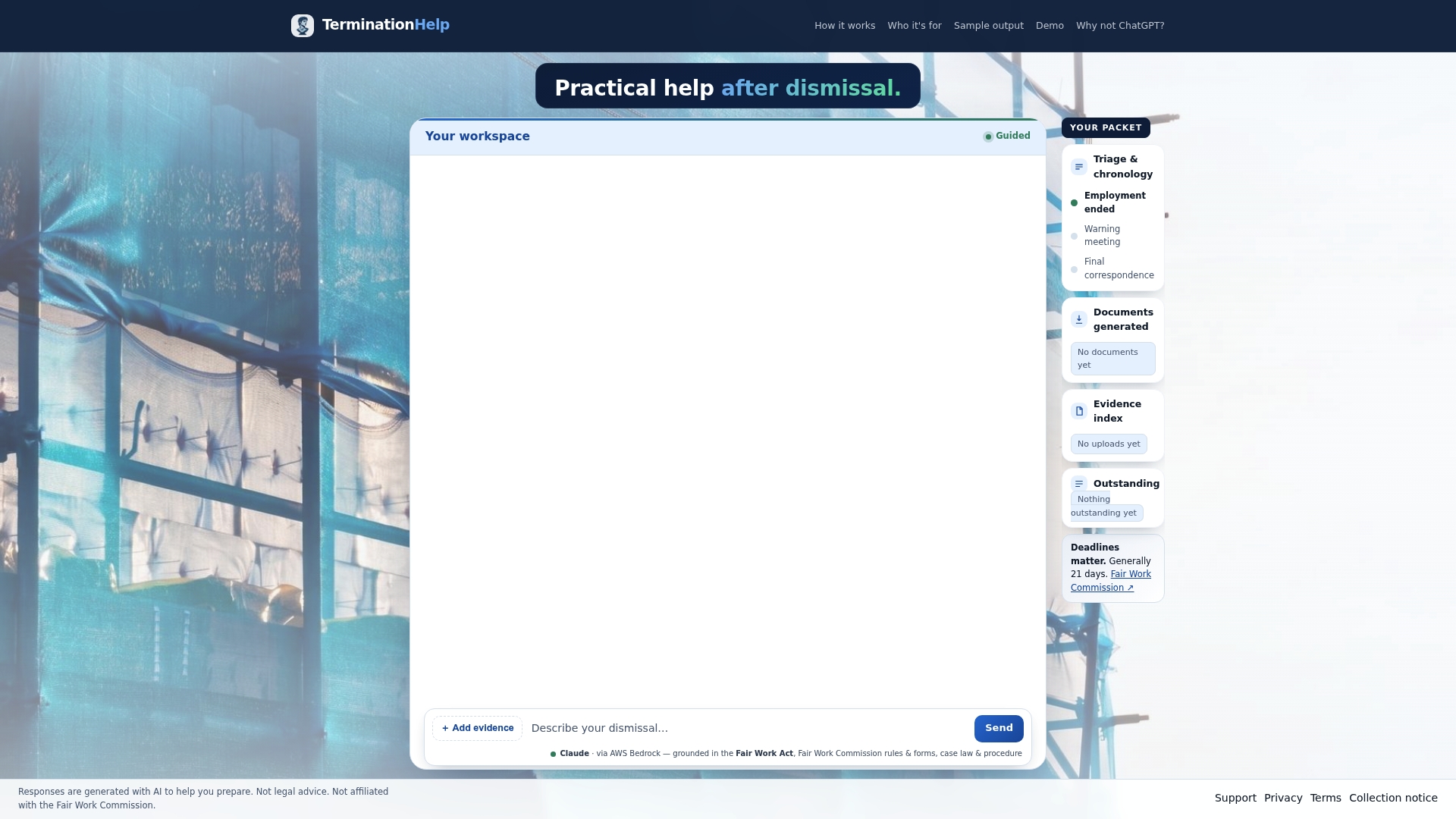
- It organises your evidence, including dates, documents and communications, into a structured timeline.
- It generates the Fair Work forms needed at each stage, rather than leaving you to work out which ones apply.
- It keeps your information within Australia and does not use your data to train other systems.
This does not replace advice from a lawyer, union or community legal centre where your matter calls for it, but it gives you a clear, organised starting point either way. If you are weighing up your options after a dismissal, TerminationHelp is a practical place to begin preparing your case.
Key legislation and decisions worth reading directly
- Regulation 1.07 sets out the statutory definition and the intoxication test.
- The Fair Work Commission's guidance on conduct explains how the test is applied in practice.
- The Small Business Fair Dismissal Code page covers the reasonable belief test for small employers.
- For readers assessing their broader work rights, this overview of work rights for international students covers eligibility questions that can affect dismissal protections.
This article is general information, not a substitute for advice from a qualified lawyer. Consult a qualified legal professional about your own circumstances before acting on anything here.
Sources
- Conduct | Fair Work Commission
- Fair Work Regulations 2009 - reg 1.07 (AustLII)
- What is the Small Business Fair Dismissal Code? | Fair Work Commission
- Mitchell Fuller v Madison Branson Lawyers Pty Ltd 2025 FWC 784
FAQ
What are five examples of serious misconduct?
Theft, fraud, assault, sexual harassment and being intoxicated at work are among the clearest examples recognised under Fair Work Commission guidance and Regulation 1.07. Refusing to follow a lawful and reasonable instruction can also qualify. Whether any of these actually meets the legal threshold still depends on the specific facts and context.
Is being singled out at work a form of harassment?
Being treated unfairly or targeted at work can amount to harassment or bullying depending on the conduct involved, but it is assessed separately from the legal test for serious misconduct. If the targeting involves discrimination, sexual harassment or a pattern of unreasonable behaviour that creates a health and safety risk, it can raise its own legal issues under workplace laws. The right response depends heavily on the specific conduct and context, so getting tailored advice is worthwhile.
What are the grounds for a finding of serious misconduct?
The legal grounds are wilful or deliberate conduct inconsistent with continuing the employment relationship, or conduct causing serious and imminent risk to health, safety, reputation or the business, as set out in Regulation 1.07. Context, intent and the surrounding facts all affect whether conduct meets that threshold in a given case.
What is considered serious misconduct under Australian law?
Serious misconduct is conduct serious enough that it breaks the basis for continuing employment, whether through deliberate wrongdoing like theft or fraud, or through creating a genuine safety risk, as defined under Fair Work Commission guidance. It is distinct from ordinary misconduct or poor performance, which generally call for a warning rather than instant dismissal.
Recommended
Article produced using AI. This is not legal advice.