

Yes, you can dispute a redundancy and the redundancy pay that comes with it, but only on specific grounds. The Fair Work Commission tests every genuine redundancy claim against a two-part check: whether your job genuinely stopped being needed, and whether your employer met its consultation obligations. The Fair Work Commission and Fair Work Ombudsman both oversee these rules, and various tools can help you prepare a case either way.
TL;DR:
- Redundancies must be genuine, involving both a true cessation of the role and proper consultation, with late or token consultation risking dispute.
- Eligibility for redundancy pay requires at least 12 months of continuous service, coverage by the national system, and employment with a non-small business.
- Redundancy pay is scaled to service length, with a reduction from 16 to 12 weeks after 10 years of service, based on specific employment conditions.
- Employers should document business reasons, start consultation early, and keep records of redeployment efforts to defend the redundancy process.
- Disputes often arise from late or superficial consultation, role re-advertising, or token redeployment offers, making thorough evidence collection crucial.
Table of Contents
- What makes a redundancy genuine under the Fair Work Act?
- Who gets redundancy pay and how much is it worth?
- What employers must do during a redundancy to avoid a dispute
- Signs a redundancy might not be genuine and how to prove it
- How the Fair Work Commission resolves redundancy disputes
- Small businesses, insolvency and transfers of business
- A practical checklist for employees and employers
- How TerminationHelp supports a redundancy dispute preparation
- A fair process beats a fight every time
- Get your redundancy dispute preparation sorted with TerminationHelp
- FAQ
- Sources
What makes a redundancy genuine under the Fair Work Act?
A redundancy is not automatically fair just because an employer calls it one. Under section 389 of the Fair Work Act, a dismissal counts as a genuine redundancy only when the employer no longer requires the person's job to be performed by anyone because of changes in operational requirements, and the employer has complied with any consultation obligations set out in an applicable award or enterprise agreement, according to the Fair Work Commission.
That second limb carries enormous weight. Many redundancies fail not because the business case was weak, but because consultation happened too late or not at all. The award or agreement will usually specify what consultation must look like, and skipping it undermines the whole process.
A redundancy also stops being genuine when redeployment was reasonably available within the employer's business or an associated entity and the employer did not properly explore it. Labelling a termination "redundancy" does not protect an employer from scrutiny. The Fair Work Commission looks at the substance of what happened, not the paperwork used to describe it.

Who gets redundancy pay and how much is it worth?
Eligibility under the National Employment Standards hinges on three things: at least 12 months of continuous service, coverage by the national workplace relations system, and employment with a business that is not a small business employer, which the Fair Work Ombudsman defines as fewer than 15 employees.
If you meet those conditions, your entitlement scales with service length under the standard NES table:
- There is a reduction in redundancy pay from 16 weeks to 12 weeks for employees with at least 10 years continuous service. This is consistent with the 2004 Redundancy Case decision made by the Australian Industrial Relations Commission.
These figures come straight from the Fair Work Ombudsman's redundancy pay table, and the drop at the ten-year mark is not an error. It reflects how the standard was originally set.
Redundancy pay is calculated using your base rate for ordinary hours, excluding bonuses, incentive payments and penalty rates. Awards and enterprise agreements can set different or more generous terms, so always check what applies to you before assuming the NES table is the final word.
What employers must do during a redundancy to avoid a dispute
A redundancy that ends up contested almost always has a gap in process, not just a disagreement about outcome. Meaningful consultation means telling affected employees about the proposed changes before a final decision is made, giving them a genuine opportunity to respond, and considering that feedback, says the Fair Work Commission. Consultation that happens after the decision has already been locked in is not consultation at all, and FWC commentary repeatedly treats this as a fatal flaw.
Employers also need to give the correct notice period or make a payment in lieu, and must genuinely test whether redeployment exists. The Fair Work Commission's redeployment guidance points to several factors: whether a suitable vacancy actually exists, whether the employee has the skills for it, location, remuneration and the availability of retraining. That enquiry extends to associated entities, not just the immediate employer.
Employers preparing for a defensible redundancy process should:
- Document the business case for the role becoming redundant before any announcement.
- Start consultation while decisions are still genuinely open to change.
- Check every associated entity for suitable vacancies, not just the current employer.
- Keep dated records of consultation meetings, redeployment searches and correspondence.
Pro Tip: Keep a simple timeline file from day one, dated emails, meeting notes and vacancy searches are the first thing the Commission asks for if a dispute arises.
Signs a redundancy might not be genuine and how to prove it
Some patterns show up again and again in disputed redundancies. A role gets re-advertised weeks later under a new title, a replacement is hired suspiciously quickly, or the employer runs a competitive recruitment process for what is effectively the same job. The Fair Work Commission treats forced competition for an employee's own role as evidence that redeployment was never genuinely considered.
Other red flags include consultation letters dated after the decision was already made, and redeployment offers that look token rather than serious, such as a role at a far lower salary with no attempt to adjust duties or location.
If you are building a case, gather:
- Job advertisements posted before or shortly after your dismissal.
- Emails or messages showing when the decision was actually made.
- Payroll or headcount records relevant to the 15-employee threshold.
- Meeting minutes or notes from any consultation sessions.
- Any redeployment assessment, or evidence none occurred.
Selection criteria and how casual staff are counted toward the 15-employee threshold are also commonly disputed, since the Fair Work Ombudsman notes that casuals engaged regularly and systematically often get missed from that count.
How the Fair Work Commission resolves redundancy disputes
Where the Commission finds a dismissal meets the genuine redundancy test, it has no jurisdiction to grant an unfair dismissal remedy, as confirmed by the Fair Work Commission. That makes the genuine redundancy question the first and often decisive battleground in any dispute.
The process generally runs through these steps:
- Lodge an unfair dismissal application within 21 days of the dismissal taking effect.
- The employer may raise a jurisdictional objection arguing the redundancy was genuine.
- The matter typically goes to conciliation, an informal conference aimed at settlement.
- If unresolved, it proceeds to a formal hearing where evidence is tested.
- Outcomes can include reinstatement, compensation orders or dismissal of the claim.
Separately, an employer can apply under section 120 to reduce the redundancy pay owed, either because it obtained "other acceptable employment" for the employee or because it genuinely cannot afford the full amount. The Commission applies an objective test, weighing pay, hours, location, seniority and job security of the alternative role, and the onus sits with the employer to prove the new job is truly acceptable, as seen in an FWC decision involving ASN Events Pty Ltd. A similar evidentiary standard applied in a decision concerning MacMahon Contractors Pty Ltd, where the Commission required proof, on the balance of probabilities, that redeployment had genuinely not been available.
Small businesses, insolvency and transfers of business
Small business employers, those with fewer than 15 employees, are generally exempt from paying NES redundancy pay. That exemption has a notable carve-out: the Closing Loopholes amendments limit it where downsizing happens in an insolvency context, closing a gap that previously let some employees miss out entirely, according to a DEWR factsheet on the small business redundancy exemption.
Where a business enters liquidation or administration, the Fair Entitlements Guarantee can cover certain unpaid entitlements, including some redundancy pay, when the employer cannot meet its obligations.
Transfer of business rules also matter here. When employment continues with a new employer following a business transfer, that continuity can affect whether a later redundancy is genuine and whether redeployment within the new structure was properly considered.
A practical checklist for employees and employers
If you are an employee considering a dispute:
- Collect every relevant document: contract, award, payslips and correspondence.
- Check which award or agreement applies and what it says about consultation.
- Write down a dated timeline of every conversation and decision you are aware of.
- Seek advice promptly, since the unfair dismissal time limit is only 21 days.
If you are an employer trying to avoid one:
- Build and document the operational case for the role becoming redundant.
- Begin consultation before any decision is finalised, not after.
- Search for redeployment options across associated entities and record the search.
- Keep contemporaneous notes of every step, not a summary written after the fact.
Pro Tip: Employers who document their redeployment search, even when no suitable role exists, are far better placed if a dispute reaches the Commission. For further support, the Fair Work Ombudsman, community legal centres, and unions can help you get organised.
How TerminationHelp supports a redundancy dispute preparation
Preparing a redundancy dispute means pulling together eligibility details, a clear timeline and the right Fair Work forms, often under time pressure. Preparation platforms can check your eligibility, help organise evidence such as consultation records and vacancy ads, and generate the forms the Fair Work Commission requires at each stage, structured around Australian Fair Work law rather than generic legal templates.
For someone facing a jurisdictional objection over genuine redundancy, or preparing for conciliation, that structure reduces the chance of a filing error and keeps evidence presented in the order the Commission expects to see it.
A fair process beats a fight every time
Most redundancy disputes trace back to one failure: consultation that happened too late to change anything. Employers who treat it as a genuine conversation, not a formality, rarely end up in front of the Commission.
— Nicolas
Get your redundancy dispute preparation sorted with TerminationHelp
Whether you are an employee weighing up a challenge or an employer trying to get the process right, having your documents, timeline and forms organised early changes how a dispute unfolds.
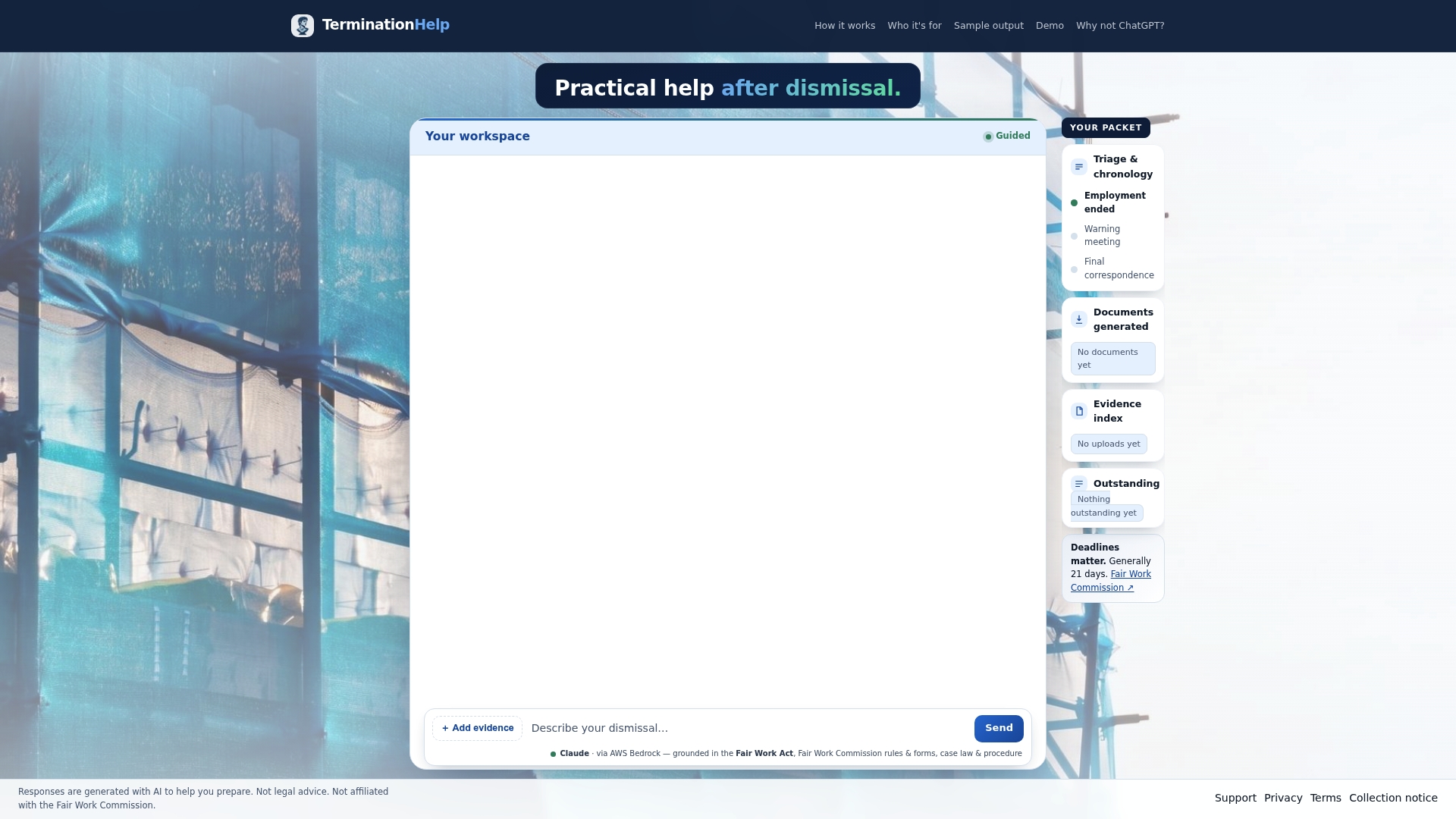
Our preparation support helps you:
- Check your eligibility against the genuine redundancy test before you lodge anything.
- Organise evidence, timelines and consultation records into a structured packet.
- Generate the Fair Work forms your matter actually needs, at each stage.
If a redundancy payout has you thinking about what comes next financially, it is also worth reading about retirement planning options for Australians before you decide how to use the money. Visit our TerminationHelp homepage to see the full preparation workflow, and check our collection notice for how your information is handled.
This article is general information, not a substitute for advice from a qualified lawyer. Consult a qualified legal professional about your own circumstances before acting on anything here.
FAQ
Can you dispute redundancy pay?
Yes, you can dispute both the redundancy itself and the pay calculation if you believe the genuine redundancy test was not met or the amount was calculated incorrectly. Disputes are typically raised through the Fair Work Commission, either as part of an unfair dismissal application or a separate underpayment claim.
How do you prove a redundancy is unfair?
You generally need evidence that your job still existed in substance, such as the role being re-advertised, or that consultation happened after the decision was already made. Vacancy ads, dated correspondence and meeting records are the documents the Fair Work Commission weighs most heavily when assessing redeployment and consultation.
What are some examples of unfair redundancy?
Common examples include an employer re-advertising the same role shortly after dismissing someone, offering only a token redeployment option far below the person's skills or pay, or holding consultation meetings purely as a formality after the outcome was already decided.
Can I sue for redundancy?
You cannot "sue" for redundancy in the civil litigation sense, but you can lodge an application with the Fair Work Commission within 21 days of your dismissal if you believe it was not a genuine redundancy. Where the Commission agrees, remedies can include reinstatement or compensation rather than damages through a court.
Sources
- What is a genuine redundancy? | Fair Work Commission
- Redundancy pay - Fair Work Ombudsman
- Redeployment | Fair Work Commission
- FWC decision — ASN Events Pty Ltd (2026) (example of s.120 considerations)
- Addressing anomalous consequences of the small business redundancy exemption (Closing Loopholes) — DEWR factsheet
Recommended
Article produced using AI. This is not legal advice.