

Under the National Employment Standards, notice periods for termination run from one to four weeks based on continuous service, with an extra week for employees over 45 with at least two years in the job, unless an award, agreement or contract sets a longer period. An employer can pay out the notice instead of having the employee work it. If you think your dismissal was unfair, you have 21 days from the day it takes effect to lodge with the Fair Work Commission.
TL;DR:
- Annual leave during notice requires employer approval, while weekends and public holidays count toward the period rather than extending it.
- Payment in lieu must cover usual earnings, regular allowances, and loadings through the notice period, and employers must pay it by the termination date.
- Unfair dismissal applicants generally need six months’ service, or 12 months at a small business with fewer than 15 employees.
- Casual employees, employees hired for a specified task or period after it ends, and those dismissed for serious misconduct generally receive no NES notice.
Table of Contents
- NES minimum notice periods and who they cover
- Resignation: employee notice and employer options when an employee gives notice
- Working during notice periods and interaction with leave and public holidays
- Payment in lieu of notice and final pay entitlements
- Exceptions and exclusions: who doesn't get NES notice and why
- Unfair dismissal and time limits you must know
- Practical checklist: what to do when notice is given or received
- How our preparation support helps with notice, final pay and Fair Work claims
- Common mistakes we see in notice and dismissal disputes
- Ready to prepare your Fair Work claim
- FAQ
- Sources
NES minimum notice periods and who they cover
The National Employment Standards set a floor, not a ceiling, for notice. Length of continuous service determines the minimum, and the figures below apply to full time and part time employees who aren't excluded under the NES.
| Continuous service | Minimum notice |
|---|---|
| 1 year or less | 1 week |
| Over 1 year, up to 3 years | 2 weeks |
| Over 3 years, up to 5 years | 3 weeks |
| Over 5 years | 4 weeks |
Employees over 45 years old with at least two years of continuous service get an extra week on top of whichever band applies, under the NES notice table.
Continuous service generally includes:
- Time spent on paid leave, including annual and personal leave.
- Periods of unpaid parental leave, which count toward service even though unpaid.
- Approved unpaid leave where the employment relationship continues without a break.
An award, enterprise agreement or employment contract can lawfully specify a longer notice period than the NES minimum, but it can never go shorter. When a contract is silent, the NES figure is what applies.
Resignation: employee notice and employer options when an employee gives notice
When you resign, check your award, enterprise agreement or employment contract first: many set a specific notice period for employees, often matching the NES bands above. If your contract is silent, a reasonable period, commonly aligned with the NES minimum, is expected. You're free to offer more notice than required if that suits your transition.
Employers receiving a resignation have several lawful options:
- Let you work out the full notice period as offered.
- Pay out the remaining notice instead of having you work it (payment in lieu).
- Agree with you to a shorter notice period than originally given.
- End the employment earlier than your last offered day and pay out the difference.
When an employer ends employment early and pays out the balance, that payment must reflect what you would have earned had you worked through to the end of the notice period, and any outstanding leave entitlements still need to be calculated into your final pay.
Working during notice periods and interaction with leave and public holidays
You can take annual leave during a notice period, but only if your employer agrees to it. An employer generally can't force you onto leave during notice unless an award or contract specifically allows that.
Public holidays and weekends that fall within the notice period still count toward it: the notice period doesn't pause or extend because of them, under Fair Work Ombudsman guidance. The notice period starts the day after notice is given and runs for the full number of weeks required, ending on the corresponding calendar day.
Notice obligations apply during probation too. Being on probation doesn't remove your entitlement to notice (or payment in lieu) unless you're otherwise excluded under the NES.
- Leave taken during notice requires employer agreement, not a unilateral decision by either party.
- Public holidays and weekends count as part of the notice period, not as extensions to it.
- Probationary employees still receive NES notice or payment in lieu when dismissed.
Pro Tip: Mark your notice start and end dates in writing as soon as notice is given, so there's no dispute later about when the period actually finished.
Payment in lieu of notice and final pay entitlements
Payment in lieu of notice must equal the full amount you would have earned had you worked through to the end of the notice period, calculated at your usual rate of pay, including any regular allowances or loadings you'd have received. Under the NES, this payment should be made on or before the day your employment ends, according to the notice of termination fact sheet.
Final pay should also include:
- Accrued but untaken annual leave.
- Any other termination entitlements set out in your award, agreement or contract, such as accrued long service leave where applicable.
- Outstanding wages for hours already worked.
Payment in lieu equals full pay for the notice period at your usual rate, a standard confirmed by the Fair Work Ombudsman, and it's a figure payroll teams need to get right the first time.
A common employer error is processing payment in lieu through a standard payroll cycle that lands after the termination date rather than on or before it, which risks breaching section 117 of the Fair Work Act and can expose the employer to a claim.

Exceptions and exclusions: who doesn't get NES notice and why
Not every worker is covered by the NES notice provisions. Some categories are excluded outright, and others sit in genuinely tricky territory.
- Casual employees generally aren't entitled to NES notice of termination, since the employment relationship is structured around irregular, as-needed work.
- Employees engaged for a specified task, season or time period are excluded once that task, season or period ends, because the employment was always set to conclude on that basis.
- Employees dismissed for serious misconduct can be dismissed without notice, since the conduct itself justifies immediate termination.
- Abandonment of employment isn't automatic: employers should make reasonable attempts to contact an employee who has stopped attending work before treating the absence as a resignation, under Fair Work library guidance.
- Industry-specific award clauses sometimes modify how notice applies to particular roles or sectors, so checking the relevant award remains worthwhile.
Unfair dismissal and time limits you must know
Before you can apply for unfair dismissal, you need a minimum period of employment: six months of continuous service for most employers, or 12 months where your employer is classified as a small business with fewer than 15 employees, according to the Fair Work Commission.
The lodgement clock is strict. The 21-day deadline starts the day after your dismissal takes effect, and weekends and public holidays count toward those 21 days, though if the final day itself falls on a weekend or public holiday, the deadline shifts to the next business day, per the Fair Work Commission's timeframe guidance.
- Reinstatement to your former role is the Commission's primary remedy where a dismissal is found unfair.
- Compensation is secondary, calculated on lost remuneration, and the compensation cap is set to update annually; from 1 July 2026, it is $95,050, as confirmed by the Fair Work Commission.
- A late application may still be accepted in exceptional circumstances, but extensions are discretionary and far from guaranteed.
A breakdown of unfair dismissal remedies and the compensation cap covers how reinstatement and compensation decisions actually play out.
Practical checklist: what to do when notice is given or received
Acting quickly and keeping records protects both sides once notice enters the picture.
- Employees: get your last day of employment confirmed in writing, not just verbally.
- Employees: check your award, enterprise agreement or contract for the notice period that actually applies to you.
- Employees: keep copies of pay slips and any termination correspondence, and note the 21 day lodgement deadline immediately.
- Employers: provide written notice stating the termination date and the applicable notice period.
- Employers: calculate payment in lieu correctly and process it on or before the termination date.
- Employers: document every communication about the dismissal, including dates and the method used to deliver notice.
Pro Tip: Save every termination related document, text message and email the day you receive or give notice: reconstructing a timeline weeks later is far harder than keeping it as you go.
Our guide on checking unfair dismissal eligibility within 21 days walks through exactly what to gather before that clock runs out.
How our preparation support helps with notice, final pay and Fair Work claims
We built our platform to help you organise a Fair Work matter from the day notice is given or received. Our tool runs an eligibility check against the minimum employment period and lodgement deadline, helps you organise evidence such as pay records and termination correspondence, and generates the forms a Fair Work claim requires.
- Running an eligibility check before you commit time to a claim.
- Organising evidence into a structured packet within the 21 day window.
- Generating the required Fair Work Commission forms, including Form F2.
If you're on probation and unsure whether notice rules still apply to your situation, our piece on probation and unfair dismissal checks sets out exactly what to confirm first.
Common mistakes we see in notice and dismissal disputes
The mistakes that cost people the most are timing errors: missing the 21 day lodgement deadline, employers paying out notice after the termination date instead of before it, and treating an unexplained absence as resignation without ever attempting contact. Write down every date the moment it happens, get an eligibility check early, and keep every notice related communication in writing.
— Nicolas
Ready to prepare your Fair Work claim
A straightforward path is available if your notice period or dismissal didn't line up with what the NES requires: preparation support tools can check eligibility, organise evidence and generate the Fair Work forms needed, with content built specifically around Australian employment law rather than generic legal templates.
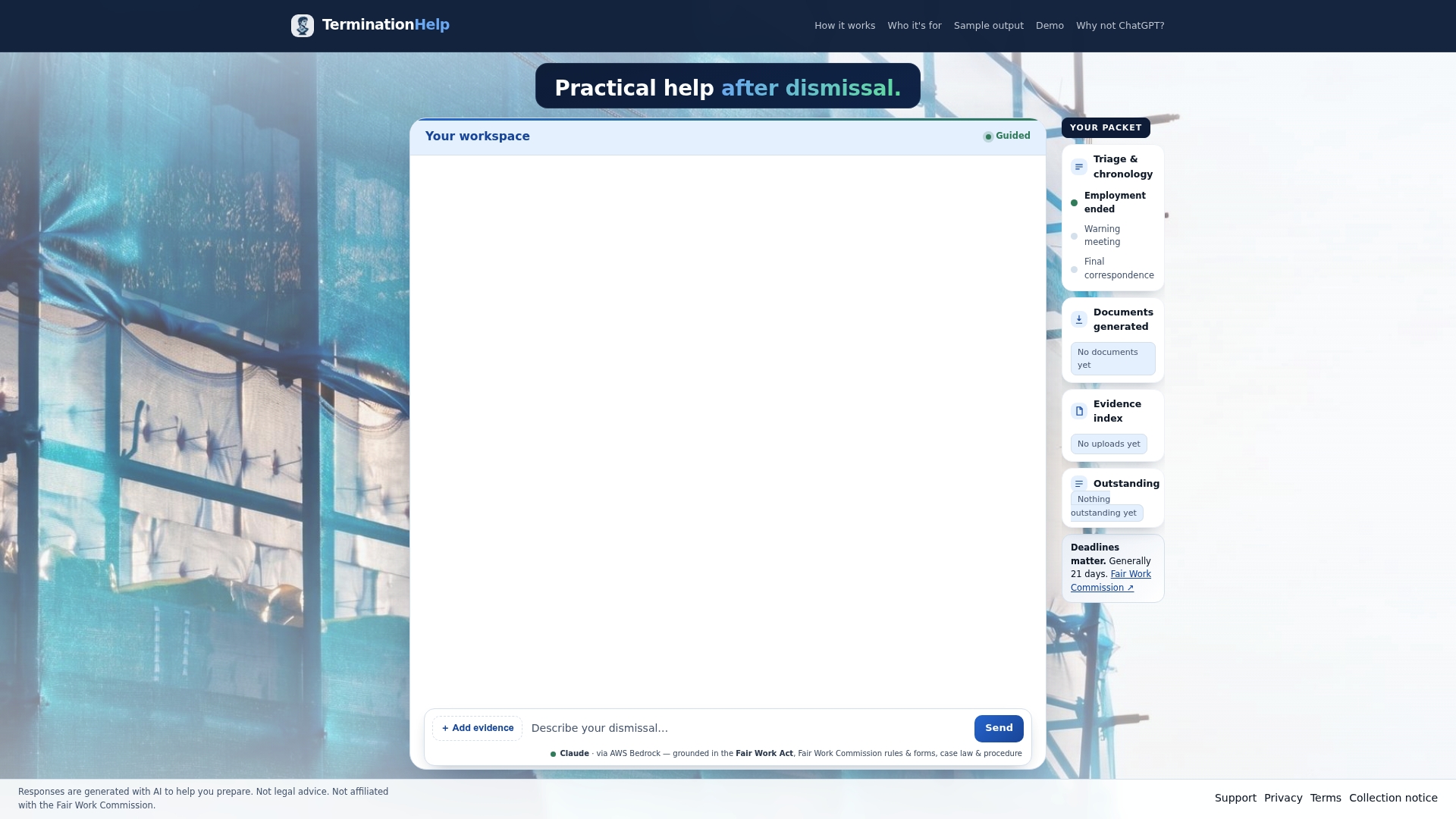
Start with our preparation support to see exactly what's involved, or head to Terminationhelp to begin organising your matter today.
This article is general information, not a substitute for advice from a qualified lawyer. Consult a qualified legal professional about your own circumstances before acting on anything here.
FAQ
What is termination for cause?
Termination for cause generally refers to dismissal based on serious misconduct or a significant breach of employment obligations, which can allow an employer to end employment without notice. Whether a specific situation meets that bar depends on the conduct itself and the terms of the relevant award or contract.
What is illegal dismissal?
There's no single legal term "illegal dismissal" in Australian law, but a dismissal can be unlawful if it's unfair, breaches general protections provisions, or fails to meet NES notice and final pay requirements. Each pathway, unfair dismissal or general protections, has its own eligibility rules and deadlines.
What is constructive dismissal?
Constructive dismissal describes a situation where you resign because your employer's conduct effectively forced you out, even though you technically handed in your resignation. If the circumstances show you had no real choice but to resign, this can still be treated as a dismissal for unfair dismissal purposes.
What is the minimum notice period for termination of employment?
The NES minimum notice period ranges from one week to four weeks based on continuous service, with an extra week added for employees over 45 with at least two years of service, as set out by the Fair Work Ombudsman. An award, agreement or contract can set a longer period, but never a shorter one.
How long do I have to lodge an unfair dismissal claim?
You have 21 days from the day after your dismissal takes effect to lodge an application with the Fair Work Commission, and weekends and public holidays count toward that period. If the final day lands on a weekend or public holiday, the deadline shifts to the next business day, according to the Fair Work Commission.
Sources
Recommended
- Check Unfair Dismissal Eligibility in Australia: 21 days to lodge
- Constructive dismissal in Australia: lodge within 21 days
- Lodge Form F2 in 21 Days: Unfair Dismissal Steps for Employees
- 21 Days to Respond to Serious Misconduct Under Reg 1.07 in Australia
Article produced using AI. This is not legal advice.