

A general protections claim alleges your employer took adverse action against you, such as dismissal or demotion, because you exercised a workplace right, engaged in industrial activity, or fall within a protected category like age or race. It covers Part 3‑1 of the Fair Work Act 2009. If you were dismissed, you have 21 days to lodge Form F8; if the adverse action didn't involve dismissal, Form F8C gives you a much longer window. Preserve every email, note the exact dates, and act quickly.
TL;DR:
- If dismissed, you must lodge Form F8 within 21 days, while non-dismissal claims can be filed up to six years after the adverse action occurred.
- Evidence should include the dismissal letter, employment contract, pay slips, relevant emails, and witness contact details to establish causation.
- Employers generally have around seven days to respond, and proper responses should admit or deny each allegation and include supporting documents.
- Courts can order compensation, reinstatement, or civil penalties based on the strength of the causal link between protected reasons and adverse actions.
- Using a specialized preparation service helps ensure correct form use, organized evidence, and adherence to current legislation before deadlines pass.
Table of Contents
- What counts as a general protections claim under the Fair Work Act
- Who can actually bring a claim
- Dismissal vs non-dismissal: picking the right form and pathway
- Time limits, forms and lodgment costs
- Building an evidence file that actually holds up
- Responding to a general protections claim as an employer
- What a claim can actually achieve
- How Terminationhelp helps you prepare a general protections application
- Common mistakes I keep seeing
- Get your forms and evidence sorted with Terminationhelp
- Primary sources for this guide
- Sources
- FAQ
What counts as a general protections claim under the Fair Work Act
The law protects specific reasons, and it protects you against specific employer actions taken because of those reasons. Get the distinction wrong and your application goes nowhere, even if what happened to you feels obviously unfair.
Protected reasons under Part 3‑1 of the Fair Work Act include:
- Exercising a workplace right (asking about pay, making a complaint, taking leave)
- Engaging in industrial activity, including union membership or refusal to join
- Discrimination on grounds like race, sex, age, disability, or pregnancy
- Taking a temporary absence due to illness or injury with proper notice
- Being the target of sham contracting arrangements
Adverse action covers dismissal, demotion, cutting your hours, refusing to hire someone, or threatening any of the above. The link between the two is what lawyers call the "because" test: your employer must have acted because of the protected reason. Under sections 360 and 361 of the Act, once you show the adverse action happened and the protected attribute existed, the reverse onus shifts to your employer to prove it wasn't the reason. That's a genuinely significant advantage over a standard unfair dismissal claim, where you carry the burden throughout.
Who can actually bring a claim
General protections coverage is wider than most people assume. It's not limited to employees on the payroll.
- Current employees, including casuals and part-timers
- Prospective employees who were refused a job for a prohibited reason
- Independent contractors, though their pathway usually runs through non‑dismissal provisions rather than the dismissal form
- Industrial associations and their officials acting on a member's behalf
Volunteers generally fall outside the scheme because there's no employment relationship to protect. Labour hire workers are covered, but figuring out which entity is legally responsible (the host business or the agency) takes some care before you name a respondent.
Dismissal vs non-dismissal: picking the right form and pathway
Your first decision point is simple to ask, harder to answer: were you actually dismissed, or did something else adverse happen while you were still employed?
- You were dismissed or forced to resign. Use Form F8 and lodge within 21 days of the dismissal taking effect. This is a hard deadline, not a guideline.
- You're still employed but suffered adverse action (demotion, reduced hours, a formal warning issued for a prohibited reason). Use Form F8C, which carries a far longer limitation period.
- You're unsure whether general protections or unfair dismissal fits better. If there's no protected attribute involved and you simply believe the dismissal was harsh or unjustified, an unfair dismissal application under a different part of the Act may be the more straightforward route.
Choosing the wrong pathway wastes your time limit. If in doubt, get the eligibility question answered before you touch a form.
Time limits, forms and lodgment costs
The 21-day clock for dismissal applications starts the day your dismissal takes effect, not the day you found out about it or the day you stopped being paid. The Fair Work Commission can extend this only in "exceptional circumstances," a genuinely narrow test that rarely favours applicants who simply ran out of time.
- Download Form F8 for dismissal matters or Form F8C for non-dismissal disputes directly from the Commission's forms page
- Non-dismissal applications can generally be lodged up to six years after the incident.
- Both forms can be lodged online, and the Commission will typically list your matter for a conference within a few weeks
Fee note: the F8C lodgment fee for the 2026–27 financial year is $92.70, with a waiver available for serious financial hardship using Form F80. Dismissal applications under Form F8 don't carry the same lodgment fee.
Building an evidence file that actually holds up
A general protections application starts formal legal action against a named respondent, so speculative or emotional claims tend to unravel fast at conference. What survives scrutiny is a chronology, not a complaint.
Gather these before you write a word of your application:
- The dismissal letter or termination notice, plus your employment contract
- Recent payslips showing your role, hours and pay rate
- Performance review notes, warnings, or any documented feedback
- Emails, texts or messages referencing the protected activity (a complaint, a leave request, a union query)
- Names and contact details of any witnesses to key conversations
Build your chronology around causation, not just what upset you. Note the date you exercised the workplace right, the date the adverse action followed, and who said what in between. A three-week gap between a complaint and a demotion is a far stronger story than a vague sense that things changed at some point.
Pro Tip: Name the respondent using their correct legal entity name and ABN, not just the trading name on the shopfront. Getting this wrong can delay your matter or force a costly amendment down the track.
Organising this evidence properly, and understanding what the Fair Work Act 2009 actually requires you to prove, is where most self-represented applicants lose ground before they even get to conference.

Responding to a general protections claim as an employer
If you've been served with an F8 or F8C, you generally have around seven days to file a response, though the Commission will confirm the exact date on your paperwork. A proper response sets out your own chronology, clearly admits or denies each allegation, and attaches the documents that support your version of events.
- Check jurisdictional objections early, such as whether the applicant was genuinely dismissed or whether the time limit was missed
- Don't ignore the conference invitation. Non-attendance rarely helps your position
- Expect settlement discussions to raise both money and non-monetary terms, like a statement of service or a confidentiality clause
- Litigating past conference stage is expensive for both sides, so weigh the evidence honestly before refusing to settle
What a claim can actually achieve
The Fair Work Commission's role at conference is to help the parties resolve the dispute, not to decide who's right. Outcomes at that stage often include an apology, a payment, reinstatement, or an agreed confidentiality term. If the matter doesn't resolve, the Commission issues a certificate, and either party can take the dispute to court or agree to arbitration.
- Courts can order compensation, reinstatement, or civil penalties against an employer for breaching Part 3‑1
- Reinstatement is considered where the working relationship hasn't broken down entirely
- Compensation is more likely, and often larger, where the causal link between the protected reason and the adverse action is well documented
How Terminationhelp helps you prepare a general protections application
A specialized preparation support service can guide you through an eligibility check first, so you know whether your facts fit the dismissal or non-dismissal pathway before you commit to a form. From there, it can organise your evidence, generate the correct Form F8 or F8C, and assemble a lodgment packet you can file yourself or hand to a lawyer, union, or community legal centre.
This type of service is particularly useful when the 21-day deadline is closing in, when the causation argument is genuinely complex (multiple possible reasons for a dismissal, for instance), or when you're representing yourself and need the paperwork to look like it was prepared by someone who's done this before. The workflows should be grounded in Australian Fair Work Commission procedure and current legislation, not generic legal templates.

Common mistakes I keep seeing
The biggest failure point isn't the paperwork, it's the causal link. Applicants assume a dismissal following poor performance feedback or a redundancy is automatically suspicious, when often it isn't. Don't file on a hunch. If your evidence of causation is thin, get advice from a union, a community legal centre, or a preparation service before the clock runs out.
— Nicolas
Get your forms and evidence sorted with Terminationhelp
Terminationhelp exists because most people preparing a general protections application are doing it once, under pressure, against a deadline they didn't choose. The preparation support service runs your eligibility check, organises your documents against a proper chronology, and generates Form F8 or Form F8C automatically once your facts are in.
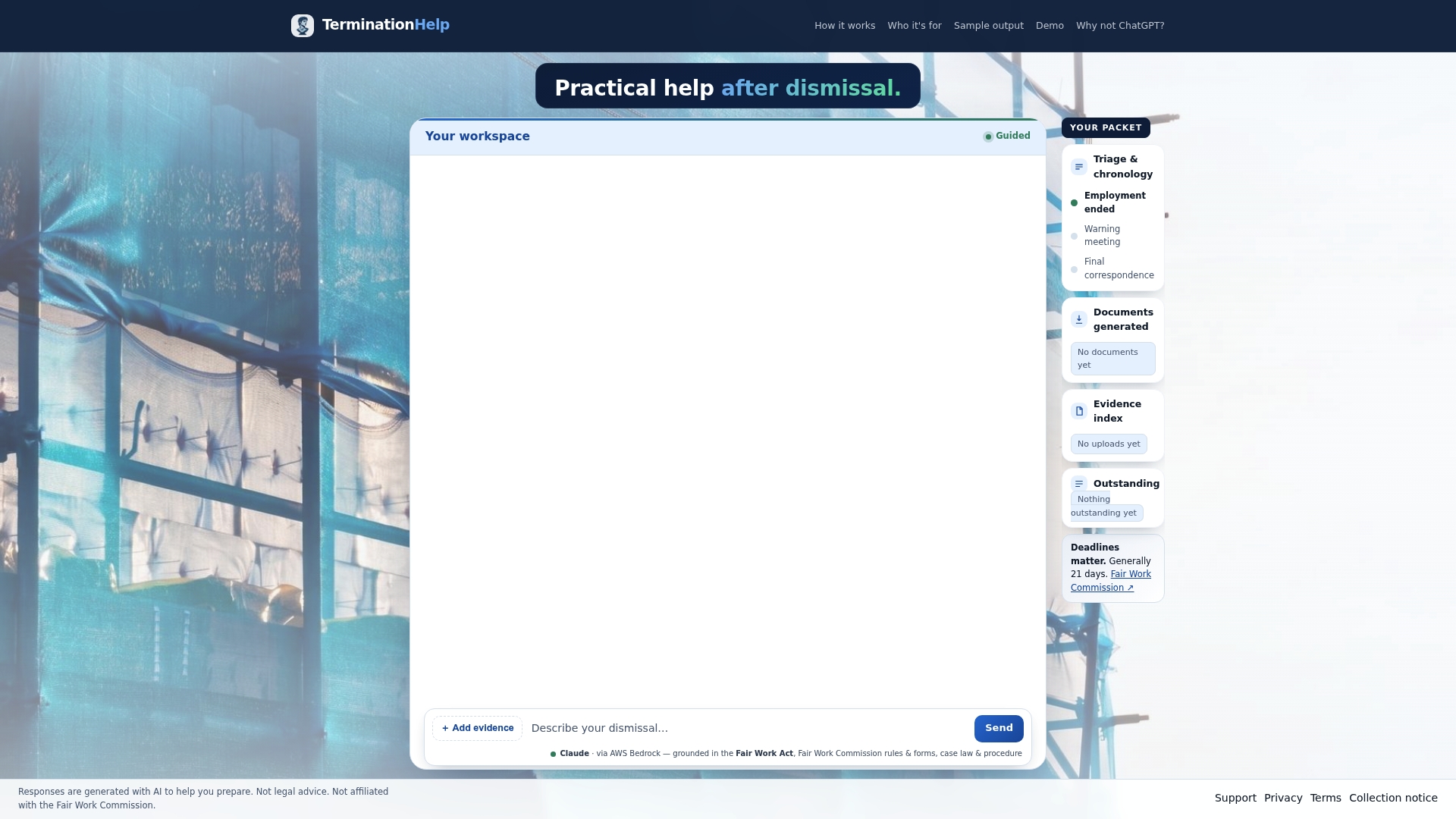
It's built specifically for Australian Fair Work Commission procedure and current legislation, not adapted from a generic legal template, so the output is something you can lodge yourself or take straight to a lawyer or union rep with confidence. If you're facing the 21-day dismissal deadline or trying to work out whether your situation fits the non-dismissal pathway, start by visiting the preparation support page and running your case through the eligibility check today.
Primary sources for this guide
Form F8 (dismissal) and Form F8C (non-dismissal) are available on the Fair Work Commission's forms pages, alongside its general protections guidance and the Fair Work Act 2009 itself. Justice Connect's step-by-step guide is a useful plain-English companion for self-represented applicants.
This article is general information, not a substitute for advice from a qualified lawyer. Consult a qualified legal professional about your own circumstances before acting on anything here.
Sources
- General protections and harmful (adverse) action | Fair Work Commission
- Apply — general protections (no dismissal) form F8C | Fair Work Commission
- Form F8 – General protections application (dismissal) | Fair Work Commission (PDF)
- Fair Work Act 2009 — authorised legislation text
- How to make a general protections claim | Justice Connect
FAQ
How much can I get for a general protections claim?
There's no fixed cap on compensation, unlike unfair dismissal claims. Courts assess the amount based on lost income, the strength of the causal link between the protected reason and the adverse action, and can also impose civil penalties on the employer separately from any payment to you.
What types of damages can be awarded in a general protections claim?
Courts can order compensation for lost wages and other financial loss, reinstatement to your former role, and civil penalties against the employer for breaching Part 3‑1 of the Fair Work Act. The Commission itself doesn't award damages at conference stage; it facilitates a resolution or issues a certificate for court action.
How long do I have to make a general protections claim?
For dismissal matters, you have 21 days from when the dismissal takes effect to lodge Form F8, with extensions granted only in exceptional circumstances. Non-dismissal applications using Form F8C can generally be lodged up to six years after the incident.
How do I respond to a general protections claim?
File your response within the timeframe stated on the Commission's notice, typically around seven days, setting out your own chronology and clearly admitting or denying each allegation. Attach supporting documents, raise any jurisdictional objections early, and prepare to discuss settlement at the conference rather than assuming the matter will be dismissed outright.
Recommended
Article produced using AI. This is not legal advice.