

Use Form F2 to apply for an unfair dismissal remedy through the Fair Work Commission. Download the official PDF, check the sample Form F2 for formatting, and lodge within 21 calendar days of your dismissal taking effect, even if you haven't gathered every piece of evidence yet. You can pay the fee or request a waiver with Form F80. Start your chronology and locate your dismissal letter today.
TL;DR:
- To apply using Form F2, you must meet specific eligibility criteria, including minimum employment duration, appropriate coverage, and employment status, or risk rejection.
- Lodging must occur within 21 days of dismissal, with late applications potentially rejected unless you provide clear evidence of reasonable delay and steps taken to resolve the matter.
- Responding to your employer’s reasons with detailed, date-specific evidence in properly numbered paragraphs improves your chances of a successful claim.
- Successful claimants typically receive compensation below the statutory cap of $95,050, with award amounts reduced by post-dismissal earnings and misconduct, if any.
Table of Contents
- What is Form F2 and when do you use it?
- Who can apply: eligibility checklist
- How to complete Form F2: what to include and drafting tips
- Fees, deadlines and how late applications are handled
- What happens after you lodge: timeline, conciliation and next steps
- Outcomes and remedies: reinstatement, compensation caps and realistic expectations
- How TerminationHelp supports Form F2 completion
- Common mistakes and what actually matters
- Get help preparing your Form F2 application
- FAQ
What is Form F2 and when do you use it?
Form F2 is the Commission's official application for an unfair dismissal remedy under Part 3‑2 of the Fair Work Act 2009, specifically section 394. It's the document that starts your unfair dismissal claim. Get it right and the Commission has what it needs to act on your case quickly.
Form F2 isn't always the right form, though. Before you start filling it in, check whether your situation actually fits:
- Regulated workers (some gig economy and contractor arrangements) may need a different unfair deactivation or termination pathway, not Form F2.
- General protections dismissals, where you believe you were sacked for a discriminatory or retaliatory reason, use a different application (Form F8).
- Genuine independent contractors generally fall outside unfair dismissal protections altogether, regardless of how the arrangement felt in practice.
If none of those exclusions apply and you were dismissed from employment, Form F2 is almost certainly your pathway. The Commission's eligibility tools on its website can confirm this before you lodge.
Who can apply: eligibility checklist
Four things determine whether you can actually use Form F2. Run through them in order:
- Minimum employment period. You need at least six months of continuous service, or 12 months if your employer is a small business (fewer than 15 employees, counted across all associated entities on the day of dismissal).
- System coverage. You must be covered by the national workplace relations system, and either be under a modern award or enterprise agreement, or earn below the high income threshold. For dismissals taking effect on or after 1 July 2026, that threshold sits at $190,100.
- Employment status. Casual employees can apply if their employment was regular and systematic with a reasonable expectation of continuing work. One‑off or genuinely irregular casual work usually won't qualify.
- No overlapping claims for the same dismissal. If you've already lodged a general protections or discrimination claim over the same sacking, you generally can't run an unfair dismissal claim in parallel. Pick the pathway that fits your facts best and stick with it.
Miss any of these and the Commission may dismiss your application before it even reaches conciliation, so it pays to check twice before you lodge.
How to complete Form F2: what to include and drafting tips
Form F2 asks for your employment details, the remedy you want (reinstatement or compensation), whether you've made another claim over the same dismissal, your employer's stated reasons, and why you believe the dismissal was harsh, unjust or unreasonable. The sample form shows the Commission expects answers in numbered paragraphs, not a wall of prose.
The smart approach is to mirror your employer's own reasons. List each reason they gave you for the dismissal, then respond point by point in matching numbered paragraphs, backing each response with dates, witness names, warning letters or performance records. This lets the Commission map your version directly against theirs.
For each allegation, include:
- The specific date and what actually happened, not your general impression of events.
- Names of anyone who witnessed the incident or conversation.
- Any prior warnings, performance reviews or lack of them.
- How the facts show the decision was disproportionate, procedurally unfair, or lacked a valid reason.
Before you attach anything, remember the Commission will forward your entire application, including attachments, to your former employer. Strip out anything irrelevant or unnecessarily personal. Order your attachments logically, label each one clearly (Attachment A, B, C), and lead with a short, dated chronology, ideally one page, because that's what mediators and employers tend to read first.
Before lodging, confirm the form is signed and dated, every attachment is labelled and referenced in the body text, and you've kept a copy for your own records as proof of lodgement.
Pro Tip: Write your chronology before you touch the rest of the form. Once you have the timeline straight, the numbered paragraphs practically write themselves.
Fees, deadlines and how late applications are handled
You have a strict 21-calendar-day deadline from the date your dismissal takes effect to lodge Form F2. That deadline is strict, and the Commission would rather you lodge on time with gaps than miss the window chasing perfect evidence. You can always supplement your application with more detail afterwards.
From 1 July 2026, the application fee is $92.70. If paying would cause serious financial hardship, you can apply for a waiver using Form F80.
A few practical points on payment and timing:
- The Commission stopped accepting cheque or money order payments from 1 February 2026, so plan for card or electronic payment.
- If you're lodging late, explain exactly what steps you took to dispute or resolve the dismissal in the meantime, and attach evidence of those steps, correspondence, medical certificates, anything contemporaneous.
- The Commission weighs the reasonableness of your delay when deciding whether to accept a late application, so a vague excuse rarely helps.
The 21-day window is the single most common trap. Applicants who spend two weeks organising documents before lodging often run out of time entirely.
What happens after you lodge: timeline, conciliation and next steps
Once you lodge Form F2, the Commission typically acts within five business days, sending your application to your former employer and organising the next step.
- Conciliation is usually scheduled first, commonly around five weeks after the Commission receives your application. It's an informal, confidential discussion with a Commission conciliator, aimed at reaching a settlement without a hearing.
- Resolution rate. Roughly three in four matters settle at conciliation, which makes it the stage where most cases are actually decided, not the final hearing.
- If conciliation fails, your matter moves to a conference or formal hearing, where a Commission member hears evidence and makes a binding decision.
Before conciliation, decide your bottom line. What outcome will you accept, what's your ceiling on compensation, and would you genuinely take reinstatement if offered? Walking in without that clarity puts you at a real disadvantage against an employer who's already thought it through.
Outcomes and remedies: reinstatement, compensation caps and realistic expectations
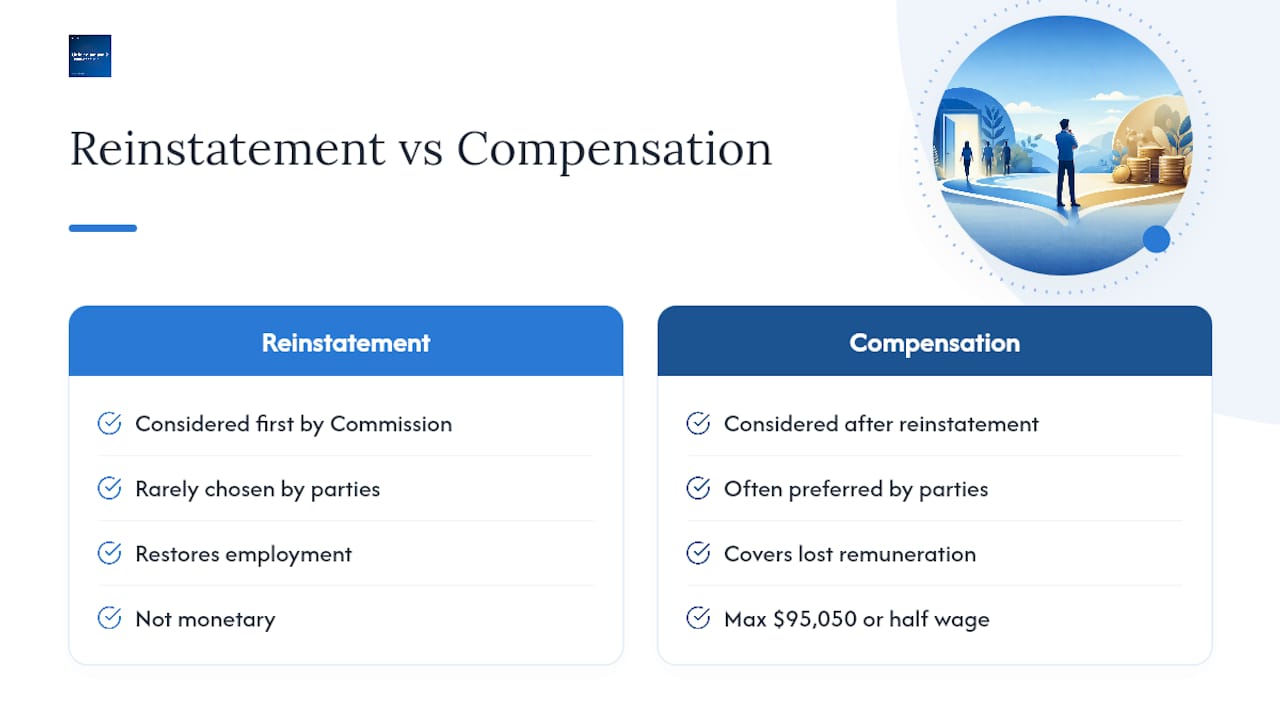
The Commission considers reinstatement first, before it even turns to compensation, though in practice many applicants and employers prefer a financial settlement given how relationships have usually broken down by that point.
Compensation is designed to cover lost remuneration you would have earned had the dismissal not occurred, not a punitive payout. For dismissals taking effect on or after 1 July 2026, the compensation cap sits at $95,050, with your payout limited to whichever is lower: half your annual wage or that cap figure.
Hitting the cap is rare in practice. Most successful applicants receive an amount closer to several weeks' pay, and any award gets reduced for money you earned (or reasonably could have earned) after the dismissal, plus any misconduct on your part that contributed to the outcome. The Commission's hearing outcome data shows a mix of monetary remedies and dismissed applications, but that data reflects only matters that reach a hearing, not the outcome for every applicant, since most resolve earlier at conciliation.
How TerminationHelp supports Form F2 completion
Filling out Form F2 well means translating a messy, emotional situation into a clear, evidence-backed legal document, and that's harder than it sounds when you're doing it for the first time under a 21 day clock.
There are AI-powered preparation tools available that assist with Australian Fair Work claims. They can help you:
- Draft numbered reasons that respond directly to your employer's stated grounds for dismissal.
- Order and label attachments the way the Commission's sample form recommends.
- Build a short chronology from the details you enter, rather than starting from a blank page.
- Generate a lodgement checklist so you don't miss a signature, a date or a required attachment.
Such platforms are often designed to be grounded in Australian legislation, Commission procedures and relevant case law, producing materials tailored to a Form F2 application rather than generic legal templates. It's worth being clear about what this is and isn't: These services provide preparation support, not legal representation. If your matter is complex or heads to a contested hearing, you may still want to bring your prepared documents to a lawyer, union, or community legal centre for the next stage.
Common mistakes and what actually matters
The biggest mistake I see is applicants delaying lodgement to perfect their evidence and running past the 21-day mark. Lodge on time, then supplement.
The second is attaching every personal document you have, forgetting the Commission sends all of it straight to your employer. Label, order, and cut anything irrelevant. Decide your conciliation position, remedy and ceiling, before you walk in.
— Nicolas
Get help preparing your Form F2 application
Terminationhelp is the alternative to figuring out Form F2 alone at your kitchen table at midnight. Instead of staring at a blank government PDF wondering how to phrase your numbered paragraphs, you answer structured questions about what happened, and the platform turns that into a properly organised application, chronology and attachment checklist ready for lodgement.
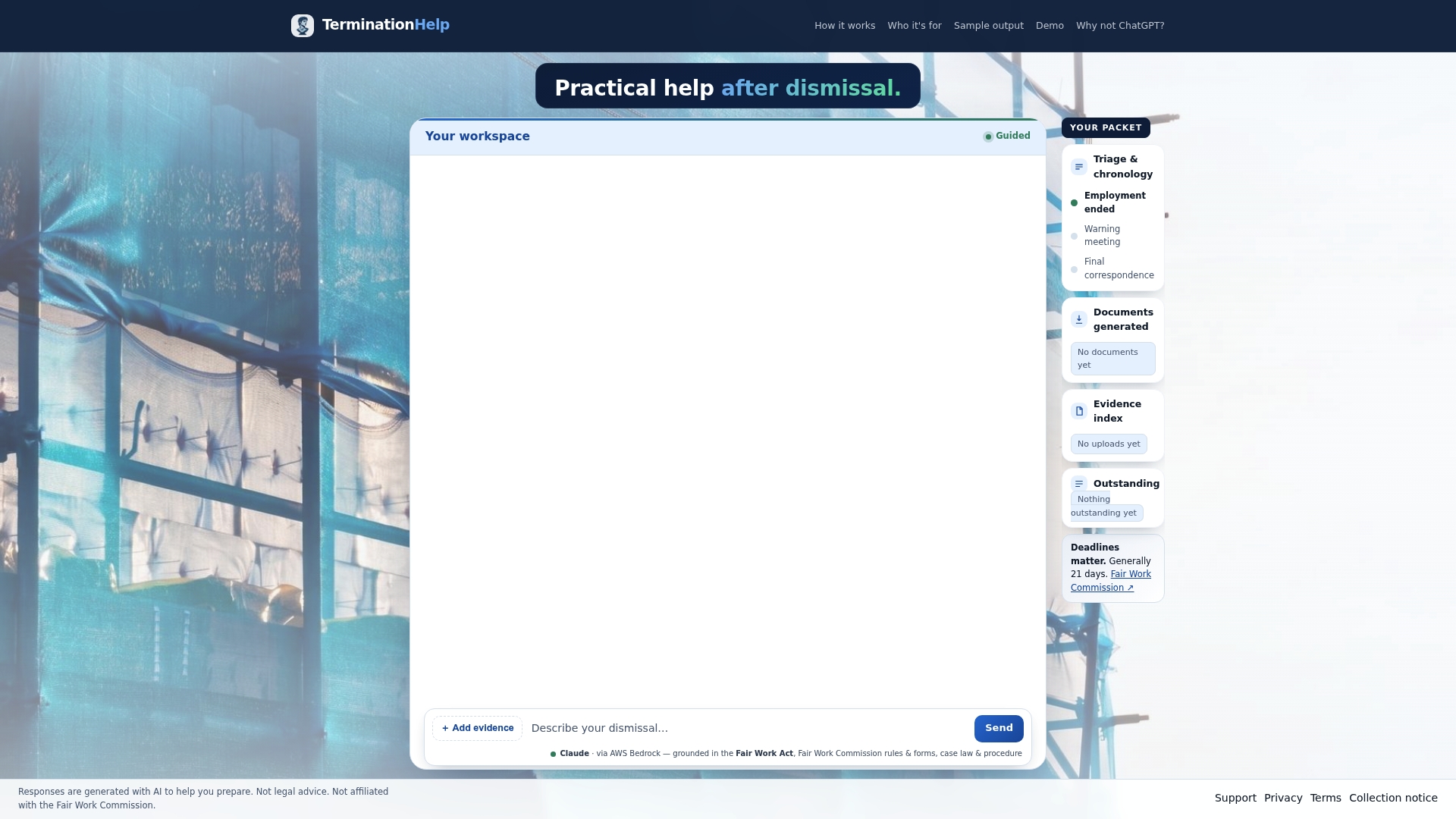
Such tools can suit individuals recently dismissed who need help structuring their reasons or want additional review before submitting to the Commission. The payment typically covers document generation and preparation of a full packet ready for lodgement or review by a lawyer, union, or community legal centre. See exactly how the preparation process works and get your Form F2 documents in order before your deadline runs out.
This article is general information, not a substitute for advice from a qualified lawyer. Consult a qualified legal professional about your own circumstances before acting on anything here.
FAQ
How much compensation will I get for unfair dismissal in Australia?
Compensation depends on your lost remuneration, capped at whichever is lower: half your annual wage or the statutory cap. For dismissals on or after 1 July 2026, that cap is $95,050. Most successful applicants receive far less than the cap, since it's reduced by any earnings after your dismissal.
What are the chances of winning an unfair dismissal case?
There's no single published success rate for unfair dismissal applicants, since most matters never reach a hearing at all. About three in four resolve at conciliation, and the Commission's hearing outcome figures only cover the smaller share of cases that go all the way to a formal decision.
What are five fair reasons for dismissal?
Common lawful grounds include poor performance after warnings, serious misconduct, genuine redundancy, breach of a lawful workplace policy, and incapacity to perform the role. Whether a specific dismissal was fair depends on the process followed and the evidence behind it, not just the stated reason.
How do I lodge Form F2 if English isn't my first language?
You can request an interpreter through the Fair Work Commission when you lodge or attend conciliation, and the Fair Work Ombudsman offers translated information and phone interpreting services. Community legal centres and unions can also help you complete Form F2 if you need support in another language.
What happens if my unfair dismissal application is rejected?
If the Commission dismisses your application, you generally have 21 days to lodge an appeal seeking permission to appeal the decision. Appeals focus on legal or factual errors in the original decision, so it's worth getting advice from a lawyer, union or community legal centre before proceeding.
Made with BabyLoveGrowth to create content that ranks
Article produced using AI. This is not legal advice.