

A fitness for work assessment determines whether a worker can safely and effectively perform the core duties of a specific role, and it ends in one of three outcomes: fit, fit with restrictions, or not fit for the role. In Australia, consent and privacy rules govern the entire process, which means an employer cannot compel participation or access medical details beyond what the job requires.
TL;DR:
- Fitness assessments are role-specific evaluations that determine if workers can perform their core duties safely, not general health checks.
- Assessments should be conducted only when relevant, consent is mandatory, and workers must be informed about the purpose and use of their medical information.
- A comprehensive assessment includes medical history, physical and mental tests, and functional simulations aligned with the actual job demands.
- Results are categorized as fit, fit with restrictions, or unfit, with restrictions tailored to allow workers to meet inherent job requirements through reasonable adjustments.
- Workers can challenge assessments by requesting reports, seeking second opinions, and consulting legal or union support if results lead to unfair dismissal or disputes.
Table of Contents
- What a fitness for work assessment is and who performs it
- When to use an assessment and what consent requires
- What the assessment typically covers
- How results are recorded and what employers must do with them
- How employers choose and brief a qualified assessor
- Running a fair, person-centred assessment
- If you disagree with the assessment
- Balancing safety with fairness in assessments
- An alternative when an assessment leads to a contested dismissal
- FAQ
- Sources
What a fitness for work assessment is and who performs it
Fitness for work means matching a person's physical and mental capability to the genuine demands of a job, not assessing general health. Safe Work Australia frames it as role-specific: the question is always whether someone can do this particular job safely, not whether they are healthy in a broad sense.
Three types of clinicians get involved, and each plays a different role:
- A treating doctor manages ongoing care and is usually too close to the case to give an independent opinion on work capacity.
- An independent medical examiner (IME) provides a one-off, impartial opinion, often for a workers' compensation insurer or an employer, and does not treat the patient.
- An occupational physician specialises in matching health conditions to workplace demands and is the preferred assessor for hazardous or safety-critical roles.
When to use an assessment and what consent requires
Assessments typically happen at four points: before hiring for safety-critical roles, when a worker returns after injury or illness, on a periodic basis in hazardous industries, and when someone moves into a role with different physical or cognitive demands. SafeWork NSW recommends assessments at each of these stages, including at the point employment ends due to ill health.
Consent is not optional. An employer should explain why the assessment is needed, what it will cover, and how the results will be used, before making a referral.
- Workers must agree to the assessment and to the release of specific findings to the employer.
- Employers cannot request information beyond what is relevant to the inherent requirements of the role.
- The Australian Human Rights Commission notes that irrelevant personal health questions are not permitted, and that reasonable adjustments must be considered before ruling someone unfit.
What the assessment typically covers
A standard fitness for work assessment moves through several stages, each building toward a job-specific conclusion rather than a general health check.
- A clinical interview covering relevant medical history and current symptoms related to the role's demands.
- A focused physical examination targeting the systems the job actually stresses, such as cardiovascular fitness for physically demanding work.
- Psychological screening or a referral to a specialist mental health assessment where the role involves high stress, isolation, or safety-critical decision-making.
- A functional capacity evaluation that simulates real job tasks, such as lifting, reaching, or sustained standing, rather than relying on a general fitness score.
- Specific tests where relevant, including spirometry for respiratory exposure, vision and hearing checks for safety-sensitive tasks, strength testing, and cognitive screens for roles with complex decision-making.
The RACP's guidelines for health assessment for work stress that every test should be justified by the job, not applied as a blanket checklist. A hearing test makes sense for a forklift operator; it adds nothing for a desk-based data analyst.
How results are recorded and what employers must do with them
A fitness for work report usually states any relevant diagnosis, specific functional limitations, suggested duties or restrictions, and a timeframe for review. It should not include unrelated medical history.
Reports land in one of three categories, and the distinction matters for what happens next:
- Fit: the worker can perform all duties without restriction.
- Fit with restrictions: the worker can perform the role with modified duties, reduced hours, or specific precautions, which may be temporary (recovering from surgery) or ongoing (a permanent condition).
- Unfit: the worker cannot currently perform the inherent requirements of the role, even with reasonable adjustments.
Reasonable adjustments might include modified shift patterns, mechanical lifting aids, or temporary redeployment to lighter duties. The test is always whether the adjustment allows the person to meet the inherent requirements of the job, not whether it is convenient for the employer.
Pro Tip: Keep the adjustment specific and time-bound where the condition is temporary, and review it against updated medical advice rather than leaving it open-ended.
How employers choose and brief a qualified assessor

The assessor's credentials matter as much as the test battery. An occupational physician with experience in the specific hazard profile of your industry, whether that is mining, aviation, or aged care, will produce a more defensible result than a generalist GP working from a vague job title.
Before the appointment, supply the assessor with the following:
- An up-to-date, task-specific job description rather than a generic position title.
- A list of workplace hazards, including noise, chemical exposure, manual handling loads, and shift patterns.
- The site's distance to emergency services, which matters for remote or hazardous locations.
- An invitation for the assessor to visit the workplace if the role is complex or physically demanding.
WorkSafe WA's Mines Safety Bulletin No. 167 lists incomplete role briefs and the use of clinicians unfamiliar with site-specific hazards as common causes of inadequate fitness determinations. An assessment built on a thin job description is only as reliable as the information behind it.
Running a fair, person-centred assessment
An adversarial process, one that feels like an interrogation rather than a clinical conversation, can cause harm that outlasts the assessment itself. Person-centred practice means understanding the individual's circumstances, building a working relationship rather than a transactional exchange, and supporting the worker's sense of control over the process.
- Explain each step before it happens, including why a question is being asked.
- Avoid making the worker repeat their history to multiple people without reason.
- Give the worker a clear sense of what happens to the information and who sees it.
A 2026 Safe Work Australia research report on psychological claims management found that trauma-informed, person-centred practice reduces secondary harm and supports recovery, while adversarial assessment processes can compound it. Balancing safety obligations with a timely return to work means treating the assessment as a tool for finding a path back to work, not a hurdle designed to catch someone out.
If you disagree with the assessment
A fitness for work determination is not necessarily final, and both workers and employers have avenues to challenge a result that seems wrong or incomplete.
- Request a copy of the full report and ask the assessor to clarify any finding that seems inconsistent with your treating doctor's advice.
- Gather supporting evidence, including treatment notes, a detailed job analysis, and any history of successfully performing the same duties.
- Seek a second opinion from another suitably qualified clinician, ideally one with experience in the same industry.
- Where the assessment sits inside a workers' compensation claim, understand that an independent medical examination informs the insurer's decision on liability, but it is not the only evidence that can be weighed.
- If the assessment leads to a dismissal or a dispute over reasonable adjustments, get advice from a union, a community legal centre, or consider whether the matter raises a Fair Work issue.
Balancing safety with fairness in assessments
Having looked closely at how these assessments play out, the sharpest failures come from treating workers as a liability to manage rather than a person to understand. A good assessment protects safety and the worker's standing at the same time. It does not have to be a trade-off between the two.
Workers should expect their results to be handled confidentially and shared only with people who genuinely need them. If the process feels rushed, opaque, or disconnected from the actual job, that is worth questioning rather than accepting.
— Nicolas
An alternative when an assessment leads to a contested dismissal
Sometimes a fitness for work outcome becomes the trigger for a dismissal that the worker believes was unfair or poorly handled. If that happens, an AI-guided preparation support service is available to help check eligibility, organise evidence, and generate forms needed to bring a Fair Work claim, whether you plan to file yourself or hand the packet to a lawyer, union, or community legal centre.
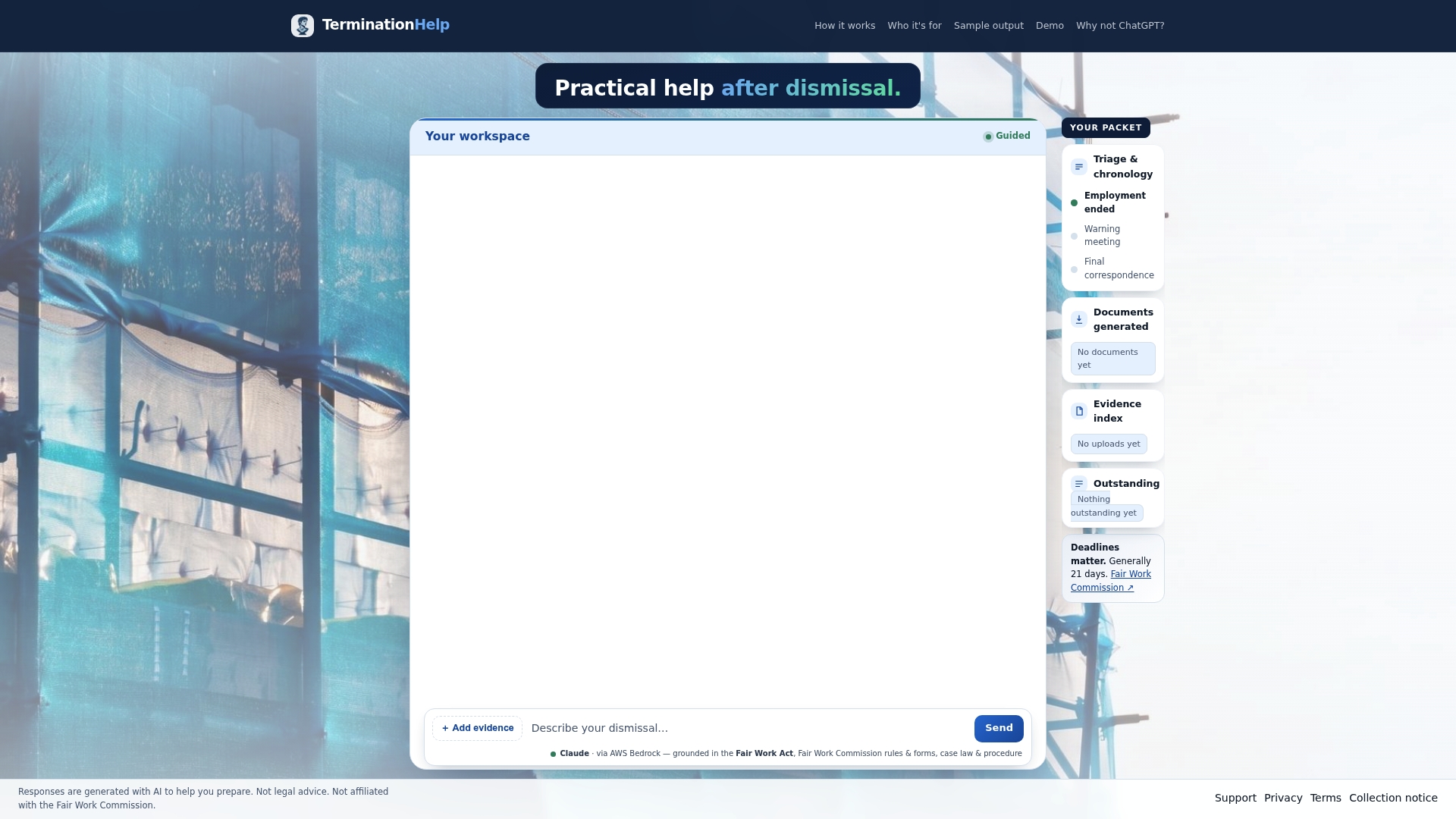
It is not a substitute for medical advice or the assessment itself. It is there for the next step, when a dismissal following an assessment needs to be documented and filed properly. You can see how the preparation support process works, or start directly from the main Terminationhelp page if you are ready to check your situation now.
FAQ
What is a fitness for work assessment?
A fitness for work assessment is a job-specific evaluation that checks whether a person can safely and effectively perform the core duties of a particular role. It typically results in one of three outcomes: fit, fit with restrictions, or not fit, based on matching capability to the actual demands of the job rather than general health.
What are some examples of fitness assessments?
Common examples include a clinical interview and physical examination, a functional capacity evaluation simulating real job tasks, and targeted tests such as spirometry, vision or hearing checks, and cognitive screens. Which tests apply depends entirely on the hazards and demands of the specific role being assessed.
What can make you fail a pre-employment medical?
A pre-employment medical outcome depends on whether your current capacity matches the inherent requirements of the role, so a condition that affects task-specific demands, such as lifting capacity for a manual role, can lead to a fit with restrictions or not fit result. Conditions unrelated to the job's actual duties should not affect the outcome under Australian discrimination law.
How do I challenge a fitness for work outcome I disagree with?
Start by requesting the full report and asking the assessor to clarify any findings that conflict with your treating doctor's advice, then consider a second opinion from another qualified clinician. If the outcome leads to a dismissal or dispute over adjustments, support from a union, community legal centre, or a service like Terminationhelp's preparation support can help you organise evidence and next steps.
Sources
For current rules and templates, go directly to the primary sources: Safe Work Australia for national guidance, your state WorkSafe regulator for jurisdiction-specific requirements, the RACP's health assessment guidelines for clinical standards, and the Australian Human Rights Commission for discrimination and reasonable adjustment obligations. Visa holders checking their broader work rights can also refer to Fewa Consultancy's guide on work rights for international students.
- Safe Work Australia
- Mines safety bulletin no. 167 — adequate assessment of fitness for work — WorkSafe WA
- Guidelines for health assessment for work — RACP
Recommended
Article produced using AI. This is not legal advice.