

Classification depends on the real nature of the working relationship, not the label in a contract. The focal question regulators ask is simple: is this person serving in your business as an employee, or running their own business as a contractor? Get it wrong and you risk PAYG shortfalls, unpaid superannuation, missed entitlements, and a sham contracting finding.
TL;DR:
- The distinction between contractor and employee depends on the actual nature of the relationship, not the written contract, with the totality of behavior over time being decisive.
- From August 26, 2024, most businesses must apply the whole of relationship test, which considers ongoing practical behavior, while sole traders and partnerships in WA generally continue to use the start of relationship test.
- Common factors for classification include control, delegation, tools, payment basis, financial risk, and ongoing work expectations, with no single factor being conclusive.
- Superannuation guarantee obligations apply mainly to labor-based contracts where more than 50% of the contract value is for work, even with an ABN.
- Misclassification as sham contracting can lead to severe penalties, so regular evidence collection, honest audits, and legal review are essential to mitigate risks.
Table of Contents
- Contractor or employee: why the difference matters so much
- Which legal test applies: whole of relationship or start of relationship?
- What factors decide contractor or employee status?
- When does super apply to contractors?
- Sham contracting and the penalties for getting it wrong
- How do you check a worker's status and gather evidence?
- How a Fair Work preparation tool helps when a dispute arises
- A practical view on getting classification right
- Get your Fair Work preparation sorted
- Sources
- FAQ
Contractor or employee: why the difference matters so much
An employee works inside your business. A contractor runs their own business and supplies services to yours. That distinction sounds simple until you're staring at a real contract, and the financial gap between the two categories is enormous.
Get the classification wrong and the consequences land squarely on the employer. You could owe backdated PAYG withholding, superannuation guarantee shortfalls plus interest, unpaid award entitlements like annual leave and personal leave, and potentially workers compensation and payroll tax exposure across several years.
The High Court settled how this gets decided. In Personnel Contracting v CFMMEU and ZG Operations v Jamsek, the Court confirmed that the totality of the contractual relationship decides status, not what the parties call each other on paper.
Practical stakes for employers include:
- Backdated PAYG withholding obligations if a contractor is reclassified as an employee
- Superannuation guarantee shortfalls, plus the SG charge and interest
- Unpaid award entitlements: leave, minimum rates, penalty rates
- Workers compensation and payroll tax liability across multiple years
- Reputational damage from a sham contracting finding
Which legal test applies: whole of relationship or start of relationship?
Two different tests now operate side by side, and knowing which one applies to your business changes how you assess every contract you sign.
From 26 August 2024, constitutionally covered businesses (most companies, trading corporations, and businesses in the Fair Work system) must apply the whole of relationship test. This test looks at the practical reality of how the parties actually behave over the life of the engagement, not just what the contract says on day one.
State-referred businesses (mostly unincorporated sole traders and partnerships in Western Australia) generally still use the start of relationship test, which focuses on the terms agreed at the outset.
A few things to check before you rely on either test:
- Was the work performed before 26 August 2024? The start of relationship test likely still applies to that period.
- Is your business constitutionally covered (a corporation) or state-referred (a sole trader or partnership in WA)?
- Is the worker a high-income contractor who has opted out of the whole of relationship test?
High-income contractors can notify their principal and opt out of the whole of relationship test, reverting to a contract-terms approach. That opt-out has to be made properly, and it materially changes which factors carry weight in a dispute.
What factors decide contractor or employee status?
No single factor is decisive. Courts and regulators weigh several indicators together, looking at how the relationship actually operates day to day.
- Control: Does the business direct how, when, and where the work is done, or does the worker decide their own methods?
- Delegation: Can the worker send someone else to do the job, or must they personally perform every task?
- Tools and equipment: Who supplies and maintains the equipment used for the work?
- Basis of payment: Is the worker paid for a result (a completed job) or for hours worked (like wages)?
- Financial risk: Does the worker bear the risk of loss on a job, or are they simply paid regardless of outcome?
- Expectation of ongoing work: Is there an understanding of continuing, indefinite engagement, or is each job a discrete commercial transaction?
Weigh these together rather than ticking boxes individually. A worker with an ABN who can't delegate, uses your equipment, works set hours, and has done so for three years looks like an employee no matter what the contract says.
Pro Tip: Run a "reality check" every 12 months on long-running contractor arrangements. Relationships drift, and a contractor engaged for a one-off project two years ago may now be indistinguishable from your staff.
When does super apply to contractors?
The Australian Taxation Office treats a contractor as an employee for superannuation guarantee purposes whenever the contract is mainly for their labour, meaning labour makes up more than 50% of the contract's dollar value.
A contract mainly for labour tips the SG obligation onto the engaging business, even where the worker holds an ABN and invoices like any other supplier. Paying by the hour, requiring personal performance, and denying any right to delegate are the clearest indicators that SG applies.
Where SG applies, you must offer the contractor a choice of super fund within 28 days of their start date and make contributions to that fund. Say you engage a solo tradesperson to install fittings, paid hourly, who can't send a substitute. That's a labour contract, and SG obligations follow even though they call themselves a contractor.
Sham contracting and the penalties for getting it wrong
Sham contracting happens when a business misrepresents an employment relationship as an independent contracting arrangement, often by insisting a worker get an ABN to keep doing the same job they did as an employee. It's illegal under the Fair Work Act, and penalties can be substantial for the business and, in some cases, individuals involved.

The defence standard has shifted. Employers used to escape liability if they weren't reckless; now they need to show they reasonably believed the arrangement was genuine contracting. That's a materially higher bar.
Practical steps to reduce exposure:
- Audit every contractor relationship honestly against the control, delegation, and risk factors above
- Keep records showing why each engagement was structured as contracting, not employment
- Have a lawyer or qualified adviser review any borderline arrangement before signing
- Fix mislabelled relationships proactively rather than waiting for a claim
How do you check a worker's status and gather evidence?
Start by pulling every document that describes the relationship, then compare it against what actually happens on the ground.
- Collect contracts, invoices, timesheets, rosters, and email or message threads about the work.
- Compare the written terms to real conduct: does the contract say "no set hours" while the roster shows fixed shifts every week?
- Check whether the worker can and does delegate tasks, or has ever supplied their own major equipment.
- Consult Fair Work Ombudsman guidance or ATO resources for a non-binding view on your specific facts.
- Get legal advice before making a final call on a borderline or high-value engagement.
Regulators investigating a dispute look past the contract to invoices, rosters, communications, and whether the worker had any genuine independence in running their own business.
Pro Tip: Keep a simple running file for every contractor, an evidence trail showing control, payment basis, and delegation rights as they actually operate, not just as drafted. It's the difference between a quick resolution and a drawn-out dispute.
How a Fair Work preparation tool helps when a dispute arises
Misclassification disputes often surface at the worst possible time, when a relationship ends and someone claims they were really an employee all along. Terminationhelp's preparation support service helps workers and small businesses organise the evidence that actually matters in these cases: contracts, invoices, communications, and timelines, structured into the forms Fair Work proceedings require.
It's built for people who need to move from "I think I was misclassified" to a properly organised claim or response, without guessing which documents matter. Workers preparing an unfair dismissal or general protections claim, and small businesses responding to one, both benefit from that structure.
A practical view on getting classification right
Write contracts that match reality, not the outcome you hope for. If a relationship is genuinely borderline, treat it conservatively and get advice before a dispute forces the question. Regulators and the Fair Work Commission look at what actually happened between the parties, never at the title on the front page.
— Nicolas
Get your Fair Work preparation sorted
Sorting out whether a dismissal followed a genuine contractor or employee relationship is exactly the kind of groundwork that decides whether a claim succeeds. The service is built specifically for Australian Fair Work matters, using eligibility checks, evidence organisation, and automatic generation of the forms the Fair Work Commission actually requires, all grounded in current Australian legislation and case law rather than generic legal templates.
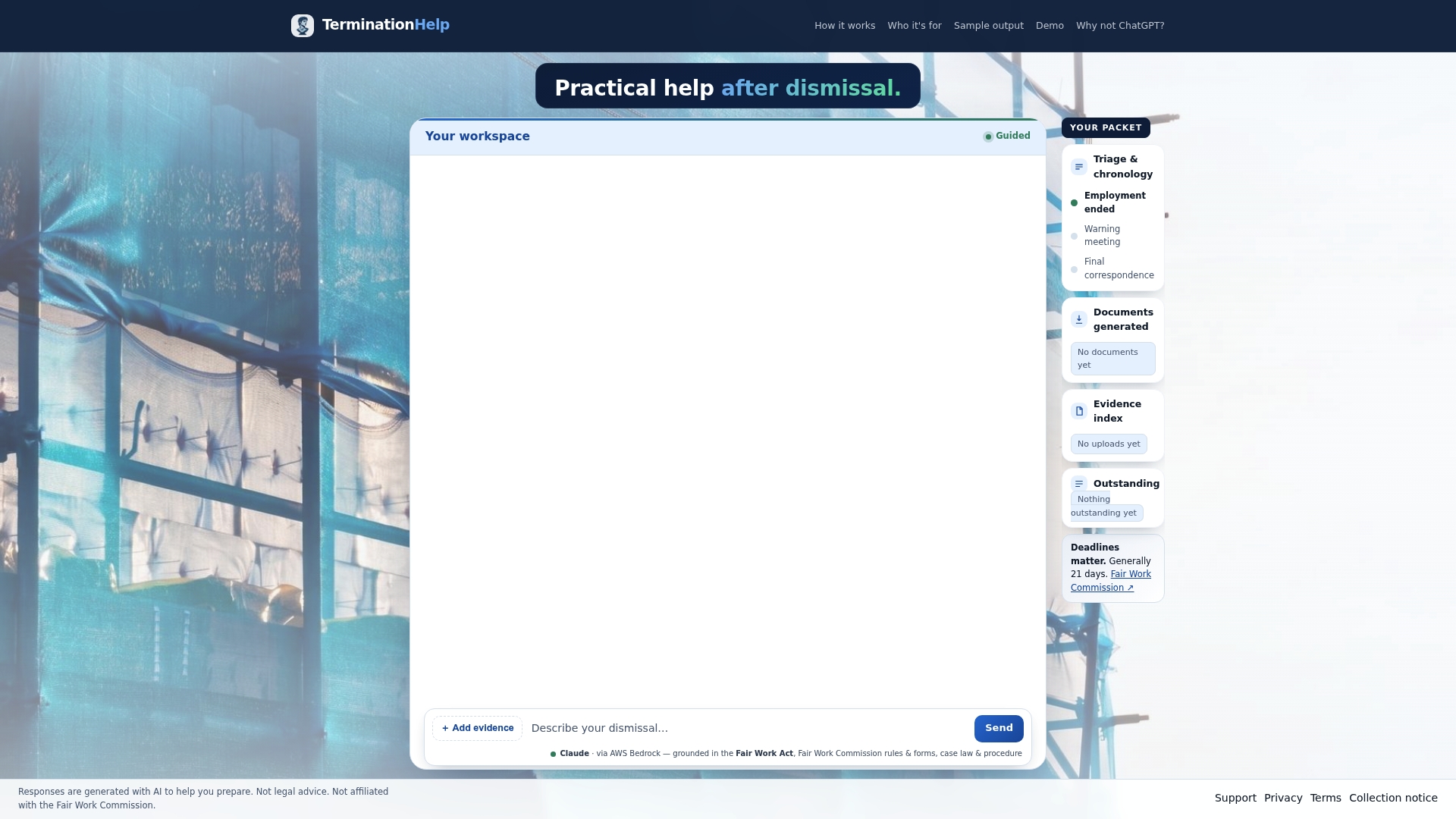
If you've been dismissed and believe your working arrangement was misclassified, or you're a small business trying to respond properly to a claim, preparation support organises your documents into a structured pack you can file yourself or hand to a lawyer, union, or community legal centre. Start by checking your eligibility on the Terminationhelp platform today.
Sources
- Difference between employees and independent contractors | ATO
- Whole of relationship test - Fair Work Ombudsman
This article is general information, not a substitute for advice from a qualified lawyer. Consult a qualified legal professional about your own circumstances before acting on anything here.
FAQ
What is the 80% rule for contractors?
There's no formal "80% rule" in Australian law, but people often use this shorthand to describe contractors who earn most of their income from one client, which regulators may treat as a red flag for disguised employment. The actual legal test still looks at control, delegation, and risk rather than a fixed income percentage.
Is an ABN considered a contractor or an employee?
Holding an ABN does not automatically make someone a contractor. The ATO is clear that administrative features like an ABN or GST invoicing are not decisive; the actual working relationship determines status.
Which is better, being an independent contractor or an employee?
It depends on what you value. Employees get award entitlements, superannuation, and unfair dismissal protections; contractors get more control and flexibility but carry their own tax, insurance, and super obligations. Neither is universally better, and misclassifying one as the other creates legal risk for the business either way.
How much tax do I pay as a contractor?
Contractors pay income tax on business profits at individual marginal rates (or company rates if incorporated) and generally handle their own PAYG instalments rather than having tax withheld by a client. Where a contract is mainly for labour, the engaging business may still owe superannuation guarantee contributions even though tax withholding works differently to an employee.
Recommended
Article produced using AI. This is not legal advice.