

Yes. In Australia a resignation can be treated as a dismissal where your employer's conduct left you no real choice but to quit, and if that happened to you, act immediately. You generally have 21 days from the date your employment ended to lodge Form F2 with the Fair Work Commission, so start gathering evidence and get advice now rather than later.
TL;DR:
- Employers' conduct must be specific, serious, and objectively leave no reasonable alternative for resignation to establish constructive dismissal.
- Evidence should include emails, notices, witness statements, and notes from the first sign of trouble, all preserved if you resign before lodging a claim.
- The 21-day deadline to lodge Form F2 begins from the day after employment ends, with a $92.70 fee, and late applications are rarely accepted.
- Constructive dismissal claims are harder to prove because you must first demonstrate the employer's conduct effectively forced your resignation.
- Documenting workplace issues proactively and seeking early advice significantly improves your chances of winning or settling a constructive dismissal claim.
Table of Contents
- What constructive dismissal means under the Fair Work Act
- The legal test: the elements you must prove for constructive dismissal
- Examples from Fair Work Commission decisions and what they show
- Evidence checklist: what to document and how to organise it
- Time limits, fees and likely remedies: what to expect if you lodge a claim
- Step by step: what to do now if you think you were forced to resign
- Common mistakes that harm a constructive dismissal claim
- How TerminationHelp can help you gather evidence and prepare a Form F2 application
- Differences between constructive dismissal and general unfair dismissal claims
- Role of employer's conduct in establishing constructive dismissal
- Potential defences employers use against constructive dismissal claims
- Impact of employment contracts and workplace policies on constructive dismissal eligibility
- Interaction between constructive dismissal claims and redundancy or genuine dismissal scenarios
- Advice on how to document and report workplace issues proactively to prevent constructive dismissal situations
- What I want you to take from this
- Fast help: prepare your unfair dismissal materials with TerminationHelp
- Sources
- FAQ
What constructive dismissal means under the Fair Work Act
Constructive dismissal, often called forced resignation, is not a separate legal category. It is a way of proving you were dismissed even though you technically handed in your resignation. Section 386 of the Fair Work Act defines a person as "dismissed" if they resigned but were forced to do so because of conduct, or a course of conduct, engaged in by their employer.
The Fair Work Commission treats this as a narrow, objective test. It is not enough to feel pushed out or to have disliked how you were managed. You need to show that your employer's actual conduct, viewed objectively, left you with no real choice.
- The test asks what a reasonable person would have concluded from the employer's conduct, not just how you felt at the time.
- A voluntary resignation, even one made unhappily, does not count.
- A resignation made in the heat of the moment, then regretted, raises separate problems about whether it was really a resignation at all.
That distinction matters because the Commission will look closely at whether you had another realistic option, such as raising a grievance, before you resigned.
The legal test: the elements you must prove for constructive dismissal
To succeed, you generally need to establish two connected things under the Fair Work Commission's forced resignation guidance. Either your employer intended to end your employment through their conduct, or ending your employment was the probable result of that conduct, such that you had no real choice but to resign.
- Employer conduct: a specific act or pattern of acts, not a vague sense of unfairness.
- Causation: the conduct must be the principal contributing factor behind your resignation, not one factor among many unrelated personal reasons.
- Objectivity: the Commission assesses what a reasonable employee would have done, not your private state of mind alone.
- Onus of proof: you carry the burden of showing the conduct and the causal link.
The Fair Work Commission has confirmed that simply having a difficult manager or an unpleasant workplace is not enough to meet this test on its own, according to Fair Work Commission guidance. You need objective conduct, such as a demand to resign or face dismissal, a unilateral demotion, or a serious unaddressed safety complaint, that a reasonable person in your position would see as leaving no real alternative.
Recent decisions reinforce how tightly this is drawn. A 2024 Fair Work Commission decision stressed that the test is narrow and requires an objective analysis of whether the employer's conduct was the principal contributing factor, not simply a contributing one among several. That is why documentation of specific incidents, dates and words used matters more than a general impression that things had become unbearable.
Examples from Fair Work Commission decisions and what they show
Commission decisions give a useful reality check on where the line sits.
- Ultimatums to resign or be sacked. Cases involving an instruction to resign while facing an explicit threat of dismissal have been treated as forced resignation, because the employee had no genuine choice left.
- Unilateral detrimental changes. Decisions involving unreasonable conduct such as excessive imposed overtime or unaddressed serious safety complaints have supported findings of constructive dismissal where the employer failed to respond to repeated complaints.
- Unclear or hasty resignations. Where an employee resigned in anger and later tried to withdraw it, the Commission has had to determine whether the resignation was ever truly voluntary, often turning on whether the employer gave the employee a chance to reconsider.
- Genuine voluntary exits. Resignations following ordinary, lawful management decisions, such as a performance conversation handled reasonably, have not met the test, because the conduct itself was not unreasonable.
The pattern across these decisions is consistent: specific, serious conduct succeeds, and general dissatisfaction does not.
Evidence checklist: what to document and how to organise it
Your case will likely be decided on paper and witness accounts, so what you collect now matters more than how you feel about the situation.
- Emails, text messages and internal chat logs showing the conduct in question, especially anything in the employer's own words.
- Formal documents: performance warnings, meeting invitations, roster changes, pay variations and any letters about your role.
- Contemporaneous notes you made yourself, with dates, times and as close to direct quotes as possible.
- Witness statements from colleagues who saw or heard the relevant conduct, ideally written soon after the events.
- Medical records or a GP letter if the conduct affected your health, since this can support an impact statement.
Pro Tip: Keep a simple diary from the first sign of trouble, one line per incident with the date, what was said and who else was present, rather than trying to reconstruct it all from memory later.
Once you have resigned, preserve everything. Do not delete work emails or chat threads even if you are removed from company systems, and forward anything important to a personal account before you lose access. Because the clock on lodging a claim starts running from your last day, waiting to build the "perfect" file is a common and costly mistake. Fair Work Commission guidance confirms you can lodge early and supply further evidence afterwards, so there is little upside in delay.
Time limits, fees and likely remedies: what to expect if you lodge a claim
The 21-day unfair dismissal deadline is unforgiving. Under Fair Work Commission guidance, the day after your dismissal takes effect counts as day one, and you have 21 days from that point to lodge Form F2.
- The lodgement fee for 2026 to 2027 is $92.70, payable when you submit Form F2.
- A financial hardship waiver, using Form F80, is available if the fee would cause you genuine hardship.
- Late applications are possible only in exceptional circumstances, and the Commission applies a strict test to extension requests.
The compensation cap for unfair dismissal claims relating to dismissals on or after 1 July 2026 is $95,050. That cap represents the ceiling, not the typical outcome: most matters settle at conciliation for a negotiated amount well below it, reflecting factors like length of service and how quickly you can find other work.
The Commission can order reinstatement, though in forced resignation cases this is rare in practice because the employment relationship has usually broken down beyond repair. Compensation is the more common remedy. If your situation involves discrimination, a workplace complaint, or exercising a workplace right, a general protections claim may be a better or additional route, since it carries no compensation cap and different time limits.
Step by step: what to do now if you think you were forced to resign
- Secure your evidence immediately. Forward relevant emails to a personal account, screenshot messages and start a dated diary of events before memories fade.
- Check your eligibility. Confirm your employment type, that you have completed the minimum employment period (generally six months, or twelve months for a small business employer), and whether a small business exemption might apply to your notice or process requirements.
- Decide on sequencing. Consider whether raising an internal grievance first could resolve things, but do not let that delay push you past the 21-day window, since lodging Form F2 does not stop you from also talking to your employer.
- Get help early. A union, a community legal centre or Legal Aid NSW guidance on forced resignation can offer free initial guidance, while paid preparation support can help once you know you want to lodge.
Every one of these steps works better when it starts on day one, not day eighteen.
Common mistakes that harm a constructive dismissal claim
- Missing the deadline while chasing perfect evidence. The 21-day window does not pause for you to gather everything, and lodging with partial evidence is far better than lodging late.
- Resigning in anger without clarifying your intent. If you are unsure whether you actually meant to resign, say so in writing quickly or ask for a short cooling-off period, because ambiguity here can sink a claim before it starts.
- Relying on feelings instead of facts. A claim built on "it felt hostile" rarely succeeds without specific conduct, dates and witnesses behind it.
- Using overseas templates or generic legal content. Constructive dismissal rules, forms and deadlines are specific to Australian law, so advice or templates written for another country's system can lead you badly astray.
How TerminationHelp can help you gather evidence and prepare a Form F2 application
Once you have decided to lodge, the practical workload is real: organising documents, checking eligibility, and completing Form F2 accurately. TerminationHelp is an AI-powered preparation tool built specifically around Australian Fair Work claims. The tool can assist with eligibility checks, structuring evidence into a clear chronology, and generating the forms the Commission requires at each stage.
It is not a substitute for legal advice, a union or a community legal centre, and it does not predict outcomes. What it does is take the disorganised pile of emails, dates and documents most people have after a forced resignation and turn it into a structured packet you can lodge yourself or hand to a lawyer.
Differences between constructive dismissal and general unfair dismissal claims
Both constructive dismissal and a standard unfair dismissal claim are lodged the same way, using Form F2 within the same 21-day window, and both fall under the same Fair Work Act unfair dismissal provisions. The difference lies in what you need to prove first.
In an ordinary unfair dismissal claim, the employer clearly ended the employment, usually by termination letter or verbal dismissal, and the dispute is about whether that dismissal was harsh, unjust or unreasonable. In a constructive dismissal claim, you first need to establish that a dismissal happened at all, since on paper you resigned. Only once you clear that threshold, by showing your employer's conduct forced the resignation under section 386, does the Commission move on to assess whether the dismissal itself was fair.
This extra threshold step is why constructive dismissal claims are harder to win. You are effectively running two arguments in sequence: that you were dismissed in substance despite resigning in form, and that the dismissal was unfair. An employer facing a standard unfair dismissal claim will usually argue about process and fairness. An employer facing a constructive dismissal claim will often argue jurisdiction first, saying the Commission has no power to hear the matter because you simply resigned. That jurisdictional fight can happen before the merits are even considered, which is another reason strong, specific evidence of the employer's conduct matters from the outset.

Role of employer's conduct in establishing constructive dismissal
The employer's conduct is the entire foundation of a constructive dismissal claim, so it pays to think about what kinds of conduct the Commission actually weighs.
Breach of contract is one clear category, such as unilaterally cutting pay, changing rostered hours significantly, or demoting someone without agreement. Harassment or bullying that management knew about and failed to address is another, particularly where there is a documented pattern rather than a single incident. Adverse changes imposed without consultation, like relocating a role, stripping responsibilities, or imposing unreasonable overtime, have also featured in Fair Work Commission decisions finding forced resignation.
What ties these together is that the conduct has to be serious enough, and closely enough connected to your resignation, that a reasonable person would say you had no real choice. A single awkward conversation rarely qualifies. A sustained pattern of unaddressed complaints, a sudden demotion delivered as an ultimatum, or being told to resign or be sacked, are the kinds of conduct that tend to meet the bar. The common thread in successful cases is that the employer did something specific and identifiable, not that the workplace was generally unpleasant.
Potential defences employers use against constructive dismissal claims
Employers facing a constructive dismissal claim typically run one of a few defences, and it helps to know them before you lodge.
The most common is a jurisdictional objection: arguing you resigned voluntarily, so there was no dismissal for the Commission to assess at all. They will often point to a resignation letter, an exit interview, or your own words at the time as evidence the decision was yours. A second defence is minimising the conduct, framing legitimate management action, such as a genuine performance conversation or a reasonable operational change, as ordinary business rather than something that forced your hand. A third is attacking causation, arguing that even if something happened, it was not the real reason you left, pointing instead to unrelated personal circumstances, a new job offer, or prior complaints unrelated to the employer's conduct.
This is exactly why contemporaneous evidence matters so much. An employer's defence usually relies on the absence of a clear paper trail showing intent and causation. A dated diary entry, a message sent the same day something happened, or a witness who heard a specific ultimatum is far harder to argue around than a resignation letter alone.
Impact of employment contracts and workplace policies on constructive dismissal eligibility
Your employment contract and your employer's own policies can strengthen or weaken a constructive dismissal claim, depending on what they say and whether they were followed.
If your contract sets out specific terms, such as your duties, location or hours, and your employer unilaterally breached those terms, that breach can be strong evidence of the conduct needed to meet the section 386 test. Similarly, if your employer has a documented grievance, bullying or performance management policy and failed to follow it, that failure can support your claim that the conduct was unreasonable, even if it does not decide the jurisdictional question on its own.
Eligibility to bring any unfair dismissal claim, constructive or otherwise, also depends on basic thresholds: you generally need to have completed the minimum employment period, which is six months for most employers or twelve months if your employer is a small business with fewer than fifteen employees. Casual employees can be eligible too, provided they were engaged on a regular and systematic basis with a reasonable expectation of continuing work. These thresholds apply before the Commission even considers whether a resignation was forced, so checking them early avoids wasted effort on a claim that cannot proceed.
Interaction between constructive dismissal claims and redundancy or genuine dismissal scenarios
Constructive dismissal claims sometimes overlap with redundancy disputes, and it is worth understanding how the two interact.
A genuine redundancy, where a role is no longer needed and proper consultation occurs, is a valid reason for dismissal and generally cannot be challenged as unfair. Problems arise when an employer uses the language of redundancy to disguise what is really a forced exit, for example by making a role practically unworkable through unreasonable changes and then suggesting the employee resign rather than formally making them redundant. In that scenario, the employee may have a stronger constructive dismissal argument than a straightforward redundancy challenge, because the focus shifts to whether the employer's conduct, not a genuine operational need, drove the departure.
The same logic applies where an employer disputes that a dismissal happened at all. If your employer's position is "you resigned, we did not dismiss you," while your position is that the resignation was forced, the case proceeds as a constructive dismissal matter rather than an ordinary unfair dismissal or redundancy dispute. Getting this framing right early, before you lodge Form F2, matters because it shapes what evidence you prioritise and how the Commission will initially assess jurisdiction.

Advice on how to document and report workplace issues proactively to prevent constructive dismissal situations
The strongest position is one where you never need to argue constructive dismissal at all, because problems were raised and dealt with before they escalated.
Raise concerns in writing as they happen, even briefly, rather than waiting until things boil over. An email summarising a difficult conversation, sent the same day, creates a timestamped record that is far more persuasive later than a recollection formed months afterwards. Use your employer's formal grievance or complaints process where one exists, and keep a copy of what you submitted and any response you received. If there is no formal process, put your concerns to your manager or HR in writing and ask for a written response.
Keep your own running file, separate from work systems, of anything relevant: rosters, pay slips, warning letters, and notes from meetings. This is not about assuming the worst of your employer, it is about protecting yourself if things do go wrong. Reporting issues proactively also gives your employer a genuine chance to fix the problem, which matters for you either way: either the issue gets resolved, or you end up with a clear, dated record showing you raised it and nothing changed.
What I want you to take from this
Time is the enemy in a constructive dismissal claim, more than the legal complexity itself. Most people lose their chance not because their case was weak, but because they spent too long deciding what to do. Document everything now, seek advice early, and lodge within the window even if your file feels incomplete.
— Nicolas
Fast help: prepare your unfair dismissal materials with TerminationHelp
If you are weighing up whether to act, here is the practical shortcut.
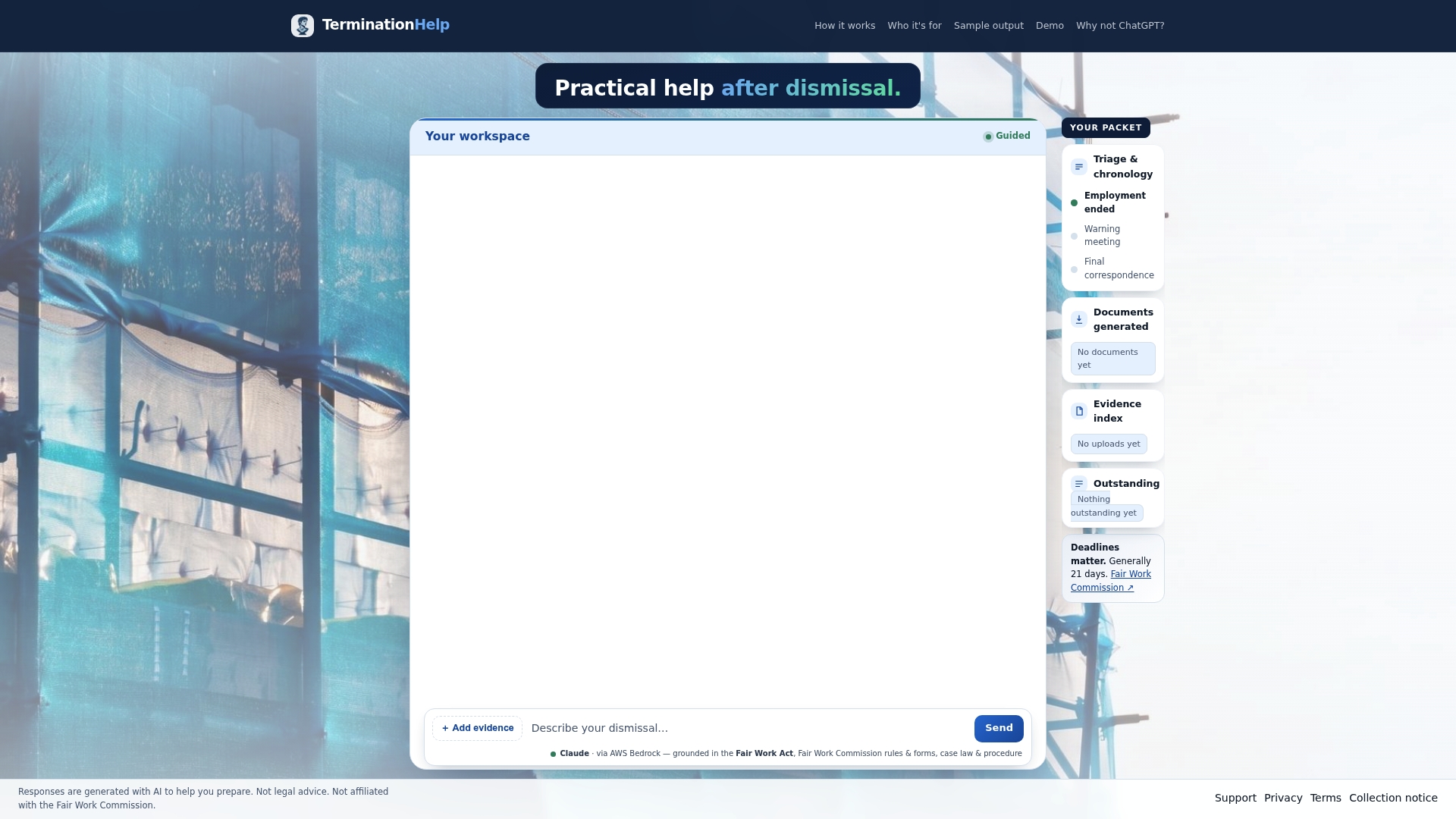
| What you need | What TerminationHelp provides |
|---|---|
| Eligibility check | Guided assessment against Fair Work thresholds |
| Evidence organisation | Structured, chronological packet from your documents |
| Form F2 preparation | Generated forms ready to lodge or hand to a lawyer |
TerminationHelp's preparation support turns scattered emails and notes into a Form F2 ready packet. Your 21-day window is running now, so start before it closes.
Sources
FAQ
Is constructive dismissal illegal in Australia?
Constructive dismissal itself is not a separate offence, but if your resignation is found to have been forced by your employer's conduct, it is legally treated as a dismissal under section 386 of the Fair Work Act. That means it can be challenged as unfair in the same way as an outright sacking.
What are the requirements for constructive dismissal?
You generally need to show your employer's conduct either intended to end your employment or made that the probable result, leaving you no real choice but to resign, according to Fair Work Commission guidance. You also need to show that conduct was the principal cause of your resignation, assessed objectively rather than by how you personally felt.
What are some examples of constructive dismissal?
Examples include being told to resign or face dismissal, unilateral demotions or pay cuts, and unaddressed serious safety or bullying complaints, as seen in Fair Work Commission decisions. Ordinary management decisions handled reasonably, like a fair performance conversation, generally do not qualify.
How do you tell if you are being pushed out of your job?
Warning signs include sudden unexplained changes to your role, pay or hours, being excluded from work you previously did, or repeated unaddressed complaints about your treatment. If you notice a pattern rather than a single incident, start documenting dates and details straight away in case you need to show it was deliberate or unreasonable conduct later.
How much does it cost to lodge an unfair dismissal claim?
The application fee for 2026 to 2027 is $92.70, and a fee waiver is available through Form F80 if paying would cause financial hardship. This fee applies regardless of whether your claim is based on constructive dismissal or an ordinary dismissal.
Article produced using AI. This is not legal advice.