

Yes, a casual employee can bring an unfair dismissal claim in Australia, but only where their casual service was regular and systematic and they had a reasonable expectation of continuing work. That service must also meet the minimum employment period of 6 months, or 12 months if the employer is a small business. If you believe you were dismissed unfairly, the urgent step is to check your dismissal date and lodge with the Fair Work Commission within 21 days.
TL;DR:
- Casual employees must demonstrate a regular and systematic pattern of work, with an ongoing expectation of employment, to qualify for unfair dismissal claims.
- Evidence like rosters, payslips, and shift offers should be collected and screenshot regularly, especially before any dispute or employer data removal occurs.
- Unfair dismissal applications must be lodged within 21 days of dismissal; late submissions require objective proof of exceptional circumstances for an extension.
- Genuine redundancy and serious misconduct are valid reasons for dismissal that typically do not support unfairness claims if proper procedures are followed.
- AI tools like TerminationHelp can assist casual employees in organizing evidence, verifying eligibility, and meeting tight deadlines for claims.
Table of Contents
- Eligibility: minimum employment period and small business rules
- What 'regular and systematic' and 'reasonable expectation' mean
- The 21-day deadline and when late applications are allowed
- When a dismissal is unfair, and when it is not
- Preparing and lodging your application
- Unfair dismissal vs general protections: choosing the right path
- How TerminationHelp supports casual employees preparing a claim
- Casual employees and the Fair Work Act
- Examples of unfair dismissal claims involving casual employees
- Refusing shifts or changes in hours and how that affects your claim
- Casual conversion rights and how they interact with unfair dismissal
- Are there exemptions from unfair dismissal protection for casual employees
- Practical perspective: common mistakes and top priorities
- Start a preparation workflow with TerminationHelp
- Sources
- FAQ
Eligibility: minimum employment period and small business rules
Before the Fair Work Commission will look at whether your dismissal was fair, it checks whether you have served long enough to qualify. For most employees that means 6 months of service, but if your employer is a small business, the qualifying period stretches to 12 months.
Small business status is worked out by headcount, not turnover. The count includes the dismissed employee, any other employees dismissed at the same time, and regular casual employees, and it can extend across associated entities under common ownership. A sole trader with 14 staff and a labour-hire casual working every week is still a small business for this purpose.
Casual service only counts towards that minimum period where the work was regular and systematic and came with a reasonable expectation of ongoing employment. Sporadic, one-off shifts generally will not count, no matter how long ago the first shift was.
Situations that typically count towards the minimum period include:
- Weekly or fortnightly rostering that continued for months without a real break in the pattern.
- Repeated shift offers that you accepted, creating a consistent work history with the same employer.
- A written or verbal understanding that more work would follow, even without guaranteed hours.
What 'regular and systematic' and 'reasonable expectation' mean
The Commission does not require identical hours every week. It looks at whether your employment was part of an established system rather than a series of unrelated engagements, and rostering patterns or a consistent pattern of accepted shifts can satisfy that test even if your hours varied.
The harder hurdle for most casuals is proving a reasonable expectation of continuing work. Evidence that the business relied on your availability, such as being routinely scheduled, filling in for a permanent role, or appearing on a published roster months in advance, carries more weight than simply having worked a lot of shifts.
Useful documents to gather include:
- Rosters or shift schedules covering as many months as possible.
- Payslips showing a consistent pattern of hours or income.
- Emails, texts or app messages offering future shifts.
- Any written casual employment contract or letter of engagement.
- Contact details for co-workers who can confirm your usual pattern of work.
Pro Tip: Screenshot rosters and shift offers as they happen. Employers sometimes remove historical rostering data once a dispute starts, and a contemporaneous screenshot is harder to dispute than a memory of your usual hours.
The 21-day deadline and when late applications are allowed
An unfair dismissal application must reach the Fair Work Commission within 21 calendar days of the dismissal taking effect. That date is usually your last day worked, the end of a notice period, or the last day of paid leave if you were dismissed while on leave.
A large majority of extension requests are refused for trivial reasons, according to the Fair Work Commission, because the Commission takes a narrow view of what counts as an exceptional circumstance. Being busy, stressed or simply unaware of the deadline is routinely rejected.
If you are close to or past the 21 days:
- Lodge immediately rather than waiting to perfect your evidence.
- If you are already late, prepare an extension request with dated, objective proof such as a medical certificate, hospital record or police report.
- Avoid relying on general statements about stress or workload alone, since these rarely satisfy the exceptional circumstances test.
When a dismissal is unfair, and when it is not
Section 385 of the Fair Work Act sets out what the Commission weighs when deciding whether a dismissal was harsh, unjust or unreasonable. It considers whether there was a valid reason connected to your capacity or conduct, whether you were told the reason and given a chance to respond, whether you had prior warnings for performance issues, and any other relevant circumstances such as your length of service or personal situation.
Two situations often escape a successful unfair dismissal claim even though they end employment abruptly.
- A genuine redundancy, where your role is no longer needed because of changes to the business's operational requirements, consultation obligations were met, and redeployment was properly considered.
- Serious misconduct, such as theft, fraud, assault or a wilful and deliberate breach of a lawful instruction, which can justify dismissal without notice.
If the redundancy was not genuine, for example if the same role was advertised again soon after, or the misconduct allegation does not hold up, the dismissal may still be found unfair despite the employer's label.
Preparing and lodging your application
Before you file, confirm you are covered by the national workplace relations system, that you are under any applicable high-income threshold or covered by an award or enterprise agreement, and that you meet the minimum employment period. Note your exact dismissal date, since that drives the 21-day clock.
A practical preparation sequence looks like this:
- Confirm eligibility: service length, small business status and coverage under an award or agreement.
- Collect evidence: rosters, payslips, correspondence, contracts and witness details.
- Complete Form F2 and lodge it with the Commission, paying or applying for a fee waiver.
- Attend conciliation, usually held by phone within a few weeks of lodging.
- If conciliation fails, prepare for a hearing where evidence is tested more formally.
Most matters resolve at conciliation rather than proceeding to a hearing. Where the Commission finds a dismissal unfair, its remedies follow a clear hierarchy.
| Remedy | When it applies | Key limit |
|---|---|---|
| Reinstatement | Preferred remedy where the employment relationship can be restored | None specified |
| Compensation | Ordered when reinstatement is inappropriate | Capped at 26 weeks' pay |
Unfair dismissal vs general protections: choosing the right path
Unfair dismissal asks whether your termination was harsh, unjust or unreasonable. General protections asks a different question: whether adverse action was taken against you because of a prohibited reason, such as taking sick leave, making a complaint, or exercising a workplace right.
- If your dismissal followed a complaint, a workers' compensation claim or sick leave, a general protections claim may fit better and has no compensation cap.
- You generally cannot run both claims over the same dismissal at once, so preserve evidence of the employer's motive early and get tailored advice before choosing.
How TerminationHelp supports casual employees preparing a claim
TerminationHelp is an AI-powered preparation tool built specifically around Fair Work Commission procedures. It runs eligibility checks, helps organise rosters and payslips into structured evidence, generates the required forms, and tracks the 21-day timeline. It is most useful when you are racing a deadline, need to pull scattered shift records into order, or want a clear conciliation preparation before you sit down with a lawyer or union.
Casual employees and the Fair Work Act
The Fair Work Act defines a casual employee by reference to whether there is no firm advance commitment to continuing work with an agreed pattern of hours, taking into account how the employment is actually offered and accepted. That definition matters because it decides whether you can later argue your work was, in substance, regular and systematic.
Casual employees hold most of the same protections as other employees once they clear the minimum service period. They can access unfair dismissal protection, general protections, and workplace health and safety rights on the same footing as permanent staff. What differs is the qualifying threshold: permanent employees start the clock from day one, while casuals must first show their engagement amounted to an established pattern of work rather than one-off shifts.
Casual employees do not accrue paid annual leave or personal leave in the way permanent employees do, and they typically receive a casual loading in place of some entitlements. None of that affects their unfair dismissal rights once the service and pattern-of-work tests are satisfied. A casual with 18 months of weekly rostered shifts is treated, for dismissal purposes, much like a part-time employee with the same tenure.

Examples of unfair dismissal claims involving casual employees
Cases before the Commission have turned on whether a casual's work looked like an ongoing arrangement or a string of disconnected shifts. In decisions involving rostered casuals with repeated weekly engagements, the Commission has sided with employees who could show a consistent roster pattern and a contract or practice suggesting the work would continue, even without a guarantee of set hours.
Other matters fail at the first hurdle because the casual worked infrequently, picked up shifts only occasionally across different periods, or had genuine gaps that broke the pattern of regular engagement. The distinction usually comes down to whether the employer's own rostering behaviour treated the casual as a standing part of the workforce, filling in for permanent staff or covering a recurring gap, rather than as an occasional extra pair of hands.
A recurring theme in these matters is that termination by simply removing someone from the roster, without any conversation or formal process, does not avoid unfair dismissal exposure. If the casual had built up a reasonable expectation of ongoing work, being quietly dropped from future rosters can itself amount to a dismissal that the Commission will scrutinise.

Refusing shifts or changes in hours and how that affects your claim
Refusing an occasional shift rarely ends your unfair dismissal prospects, but a pattern of refusals can complicate both your eligibility and your case on the merits. If you routinely turned down offered work, that can undercut an argument that the employer relied on your ongoing availability, which is part of what establishes a reasonable expectation of continuing employment.
It also matters for the substance of the dismissal. If an employer says it stopped rostering you because you repeatedly refused shifts or requested changes to your hours, that reason will be tested against the section 385 factors, including whether you were told the real reason and given a chance to respond. Refusing a lawful and reasonable request to work particular hours is different from refusing an unreasonable or unsafe change, and the Commission will look at the specific circumstances rather than treating every refusal the same way.
If your hours were cut back sharply after you asked for a change, such as reduced availability for caring responsibilities, keep records of that request and the employer's response. That timeline can be central evidence in either an unfair dismissal or a general protections claim.
Casual conversion rights and how they interact with unfair dismissal
Casual conversion gives eligible casuals a pathway to request permanent employment once they have worked a regular pattern of hours for a set period. Requesting conversion, or being eligible for it, does not by itself create unfair dismissal protection, but it often overlaps with the same evidence used to prove regular and systematic service.
If you were dismissed shortly after making a conversion request, that timing can be relevant. It may support an unfair dismissal claim if there was no genuine reason for the termination, and in some circumstances it may also raise a general protections concern if the dismissal looks connected to exercising a workplace right to request conversion. The two issues are assessed separately, but the underlying roster and correspondence evidence usually serves both.
Are there exemptions from unfair dismissal protection for casual employees
There is no blanket exemption that removes casuals from unfair dismissal protection. The exemptions that exist apply to the way the minimum period and coverage rules operate, not to casual status itself.
A casual who has not yet worked on a regular and systematic basis, or who has not reached the minimum service period, will not meet the eligibility threshold, which has the practical effect of excluding many short-term or genuinely irregular casuals. Employees earning above the high-income threshold and not covered by an award or enterprise agreement also fall outside protection, regardless of whether they are casual or permanent. Genuine redundancy and proven serious misconduct remain valid grounds for dismissal for casuals just as they are for other employees.
Practical perspective: common mistakes and top priorities
The biggest mistake casual workers make is waiting to gather perfect evidence before lodging. Check your dismissal date, save your roster history, and file within 21 days.
— Nicolas
Start a preparation workflow with TerminationHelp
Organising months of rosters, payslips and messages while a 21-day clock runs is the hardest part of a casual unfair dismissal claim, and AI-powered tools exist to help manage eligibility checks, form generation, and evidence organisation, keeping your deadlines in one place, whether you plan to file yourself or hand the packet to a union or lawyer.
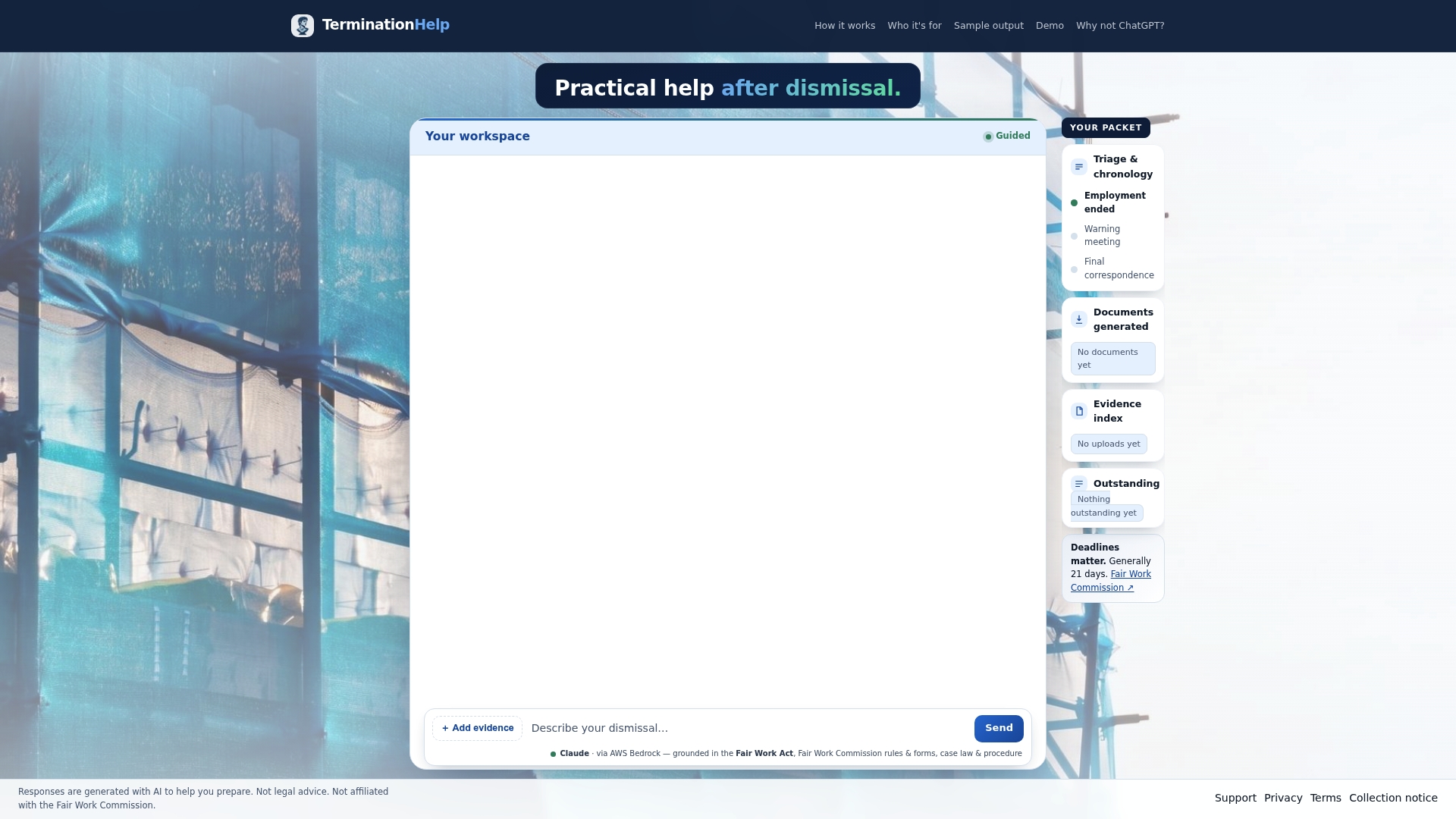
- Preparation support services typically cover eligibility checks, evidence organisation and form generation.
- Such services complement, rather than replace, advice from a union, community legal centre or employment lawyer.
Start your eligibility check with TerminationHelp before your 21-day window closes.
Sources
This article is general information, not a substitute for advice from a qualified lawyer. Consult a qualified legal professional about your own circumstances before acting on anything here.
FAQ
How much compensation will I get for unfair dismissal in Australia?
Compensation is not automatic and depends on your financial loss, with reinstatement the preferred remedy where possible. When compensation is ordered instead, it is capped at 26 weeks' pay and calculated from your remuneration.
What are the rights of a casual worker when getting fired?
A casual worker has the same right to a fair process as other employees once they meet the minimum service period and show their work was regular and systematic. That includes a valid reason for dismissal, notice of the reason, and a chance to respond before termination.
What are the chances of winning an unfair dismissal case?
There is no fixed figure for success rates, and outcomes depend heavily on your evidence of service pattern, the employer's stated reason and whether proper process was followed. Cases with clear rostering records and a documented reasonable expectation of ongoing work tend to fare better at conciliation.
What are some reasons why a casual employee can be terminated?
A casual employee can be lawfully terminated for a genuine redundancy, proven serious misconduct, or a valid performance or conduct reason where proper process was followed. A dismissal without a fair reason or process, or one linked to a prohibited reason such as taking sick leave, may still be challenged as unfair or as a general protections breach.
Recommended
Article produced using AI. This is not legal advice.