

Absence alone does not automatically equal abandonment under Australian law. Employers must accept that the employee has repudiated the contract before the employment relationship legally ends, and that acceptance has to follow a documented, reasonable process. Get it wrong and the Fair Work Commission can treat the outcome as a dismissal, opening the door to an unfair dismissal claim that employees must lodge within 21 days.
TL;DR:
- Employers must demonstrate genuine contact attempts, proper investigation, and provide a clear opportunity for explanation before treating an absence as abandonment.
- Automatic abandonment clauses were removed from modern awards after December 2018, requiring assessments based on facts and employer conduct.
- Failing to follow a documented, reasonable process risks being treated as a dismissal, which can lead to unfair dismissal claims within a strict 21-day deadline.
- Employers should keep detailed records of all contact efforts, check for pending leave or medical reasons, and seek legal advice before termination.
- Employees accused of abandonment should respond promptly in writing with evidence and confirm whether they are considered resigned or dismissed to protect their rights.
Table of Contents
- What abandonment means under Australian law
- Key Fair Work Commission guidance and leading cases
- Practical checklist: what employers must do before treating an absence as abandonment
- Risks and consequences for employers and employees
- What employees should do if accused of abandonment
- Common mistakes and practical controls for HR
- How we help you prepare an unfair dismissal or general protections application
- FAQ
- Sources
What abandonment means under Australian law
Abandonment of employment is not a standalone legal category. It describes a situation where an employee's conduct, usually an unexplained and prolonged absence with no communication, amounts to renunciation or repudiation of the employment contract. The employer then has a choice: accept that repudiation and treat the contract as at an end, or wait and seek more information. According to Fair Work Commission guidance, an employer must take positive action to accept the repudiation before the relationship actually ends, which means silence or assumption is not enough.
This matters because modern awards no longer give employers an automatic trigger. Clauses that once deemed an employee to have abandoned their job after a set number of unexplained absent days were removed from modern awards, with that change taking effect from the first full pay period on or after 20 December 2018, according to the Fair Work library. There is no automatic cut-off anymore.
A short example illustrates the distinction:
- An employee stops attending work, does not respond to calls or emails for two weeks, and has no leave approved: this may support a finding of abandonment if the employer made genuine contact attempts.
- An employee is hospitalised, a family member informs the employer late, and the employer terminates before checking: this is more likely to be treated as a dismissal, not abandonment, because the employer did not properly investigate.
Key Fair Work Commission guidance and leading cases
The Fair Work library's abandonment guidance sets out the practical test commissioners apply: was the absence without a reasonable excuse, without communication, and for an unreasonable length of time. Even when all three are present, the Commission still expects employers to have made reasonable contact attempts and to have considered whether the employee had a legitimate reason for being unreachable.
Recent decisions sharpen that expectation. In Mr Md Abdullah Haque v dnata Airport Services Pty Ltd [2026] FWC 1698, the Commission scrutinised the employer's conduct during an extended unexplained absence and considered whether the employer's own actions, rather than the employee's silence, effectively brought the employment to an end. The decision reinforces that even a long absence does not protect an employer that skipped proper process.
Older authorities, including cases commonly referred to as Sharpe and Searle, show how fact-specific these matters are: commissioners weigh contact attempts, the employee's history, and whether the employer's response was proportionate.
One documented fact carries real weight here: modern awards have excluded automatic abandonment clauses since the first full pay period on or after 20 December 2018, meaning every abandonment scenario since then is assessed on its individual facts rather than a fixed rule.
Patterns the Commission tends to find persuasive include:
- Written records of every phone call, email, text and emergency contact attempt made to the employee.
- Evidence the employer checked for pending leave requests or medical certificates before acting.
- A clear, dated notice giving the employee a reasonable opportunity to explain the absence before any termination decision.
Practical checklist: what employers must do before treating an absence as abandonment
A documentable process is the difference between a safe outcome and an unfair dismissal finding. Before concluding an employee has abandoned their job, work through these steps:
- Record every contact attempt by phone, email, and any emergency contact on file, noting the date, time, and outcome of each.
- Check existing records for approved or pending leave, rostered days off, or recent medical certificates that might explain the absence.
- Request a medical certificate or explanation in writing if there is any indication of illness, injury, or personal crisis.
- Set a clear, reasonable deadline for the employee to respond or return, and communicate it in writing.
- Follow internal policy on disciplinary process and escalation exactly as written, not as a shortcut.
- Get legal advice before finalising any termination letter, particularly where the absence is lengthy, but the explanation is unclear.
- Preserve all documentation, including timesheets, correspondence and internal notes, in case the matter proceeds to the Fair Work Commission.
Pro Tip: Send contact attempts through at least two channels (for example, phone and email) and keep timestamped copies: a single missed call rarely counts as a reasonable attempt.
Skipping any of these steps is common, particularly the written notice giving the employee a real opportunity to respond. The Fair Work Commission treats procedural fairness as close to essential in these matters, not optional good practice.

Risks and consequences for employers and employees
The core risk for employers is that refusing to roster or pay an employee, without formally accepting repudiation, can itself be read as the employer initiating termination, according to the Fair Work library. That distinction between an employer-initiated dismissal and a genuine employee resignation drives most outcomes at the Commission.
Where an employer fails to investigate properly, outcomes can include a finding of unfair dismissal and compensation orders. Cases such as Sharpe v MCG show that employers who acted without adequately inquiring into the circumstances have faced compensatory orders.
For employees, the critical figure is the clock. An unfair dismissal application must be lodged within 21 days of the dismissal taking effect, according to the Fair Work Commission, and that day of dismissal itself is excluded from the count. Extensions beyond 21 days require exceptional circumstances and are rarely granted.
- Keep copies of every text, email and letter exchanged with the employer during the absence.
- Note the exact date the employer communicated the dismissal, since this sets the 21-day deadline.
- Retain medical certificates or other evidence explaining the absence, even if submitted late.
What employees should do if accused of abandonment
If an employer suggests you have abandoned your job, respond in writing immediately and attach any supporting evidence, such as a medical certificate or proof you tried to make contact. Do not assume silence protects you: a documented response puts the burden back on the employer to justify treating your absence as abandonment.
Ask the employer to confirm in writing whether they consider you to have resigned or been dismissed, since the wording affects what claim you can bring and when the clock starts. If 21 days have nearly passed and your circumstances were genuinely exceptional (serious illness, for instance), the Fair Work Commission can consider a late application, though approval is not guaranteed.
- Write down the dismissal date the employer gave you, since this triggers the 21-day deadline.
- Gather every piece of correspondence that shows you attempted to explain your absence.
- Organise your evidence into a clear timeline before lodging anything with the Commission.
Common mistakes and practical controls for HR
The same employer errors show up repeatedly at the Commission: no contact attempts beyond a single call, refusing to roster or pay an employee without formally ending the contract, and treating a long absence as self-evident abandonment. Each of these tends to fail because the Commission looks at employer conduct, not just the employee's silence. The practical fix is unglamorous: a written leave policy, a simple escalation matrix for unexplained absences, and a habit of logging every contact attempt the moment it happens. For employers assembling evidence after the fact, and for employees organising theirs, keeping that evidence pack structured from day one saves considerable stress later.
— Nicolas
How we help you prepare an unfair dismissal or general protections application
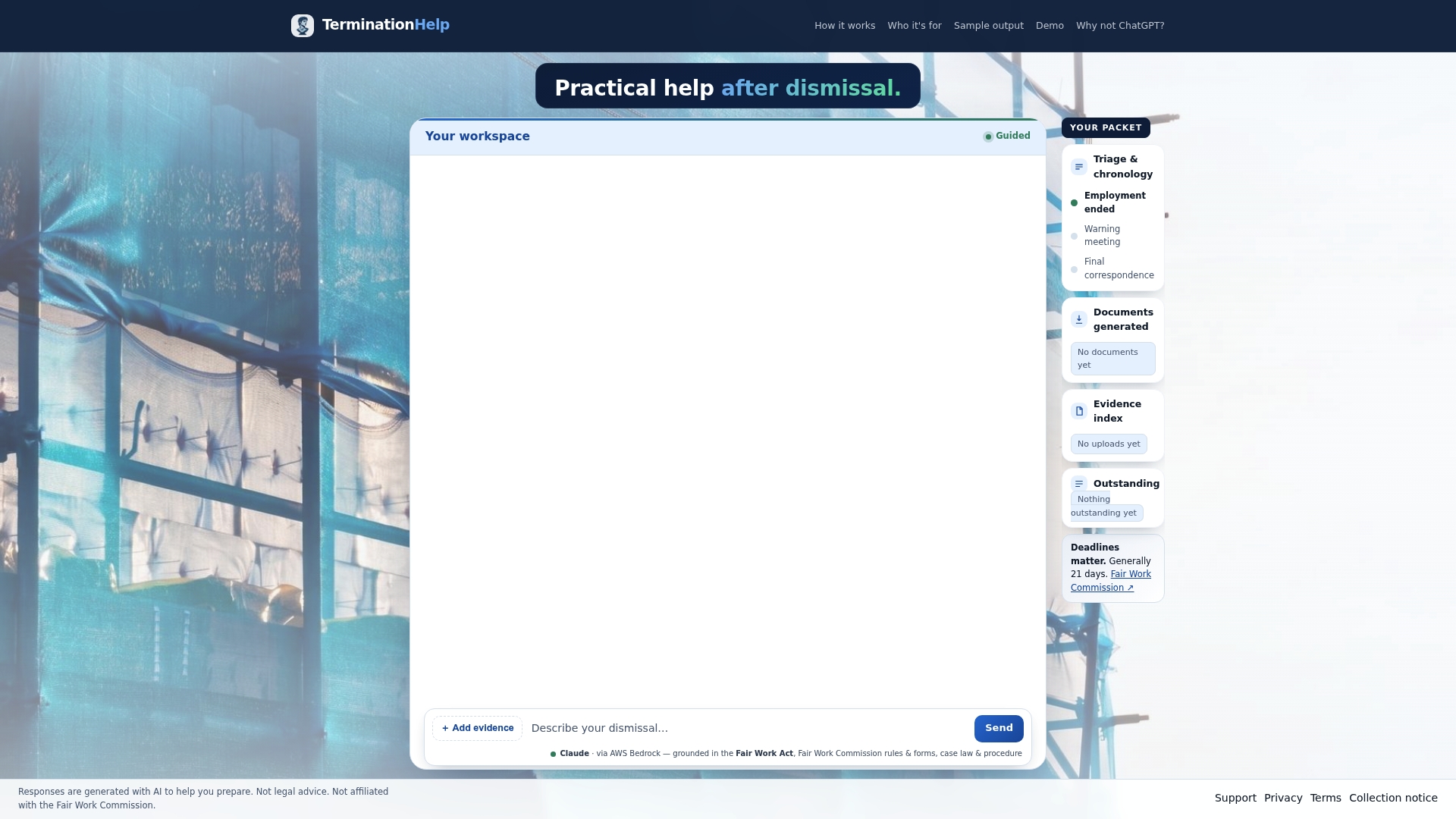
We built our preparation support specifically for Australian Fair Work matters, so every form, timeline and evidence checklist we generate reflects current Commission procedure rather than generic legal templates. Our platform walks you through organising contact logs, medical certificates and correspondence into a structured packet you can file yourself or hand to a lawyer, union or community legal centre.
| What we provide | Detail |
|---|---|
| Form generation | All required Fair Work forms for your matter stage |
| Evidence organisation | Structured packet from your uploaded documents |
| Focus | Australian Fair Work claims only |
| What it is not | Preparation support, not legal advice |
We are not a law firm and do not provide legal advice, but one in five dismissal disputes turns on whether the employer followed a documented process according to the patterns the Fair Work library describes, which is exactly the kind of record our tool helps you assemble. For HR teams wanting to reduce absenteeism before it becomes a dispute, Kloqk's guide to measuring and reducing absenteeism covers practical tracking controls, and for complex terminations, this guide to high-risk terminations is a useful supplementary read. If you are ready to organise your own matter, start with our preparation support workflow.
This article is general information, not a substitute for advice from a qualified lawyer. Consult a qualified legal professional about your own circumstances before acting on anything here.
FAQ
At what point is it considered job abandonment?
There is no fixed number of days: modern awards removed automatic abandonment clauses from the first full pay period on or after 20 December 2018. An absence is only treated as abandonment after the employer makes genuine contact attempts, finds no reasonable excuse, and the employee's conduct shows clear renunciation of the contract.
Can you be rehired after job abandonment?
Yes, there is no legal bar to rehiring someone whose previous employment ended through abandonment, since it is a factual characterisation rather than a formal record or finding against the person. Each employer makes its own hiring decision based on the circumstances.
What are examples of job abandonment?
A common example is an employee who stops attending work, does not respond to phone calls, emails or messages to an emergency contact, and has no approved leave or medical explanation on file. It becomes a harder question, and often an employer-initiated dismissal instead, when the employee has a legitimate reason the employer failed to check, as the Commission considered in Haque v dnata Airport Services Pty Ltd [2026] FWC 1698.
How long does it take for abandonment of employment?
There is no set timeframe in law; what matters is whether the absence was unexplained, uncommunicated and unreasonably long, weighed against the employer's own contact efforts. If the employer gets the process wrong, an employee has 21 days from the date the dismissal takes effect to lodge an unfair dismissal application with the Fair Work Commission.
Sources
- Abandonment of employment K600465 - Fair Work library
- Terminated at the employer's initiative | Fair Work Commission
Article produced using AI. This is not legal advice.